
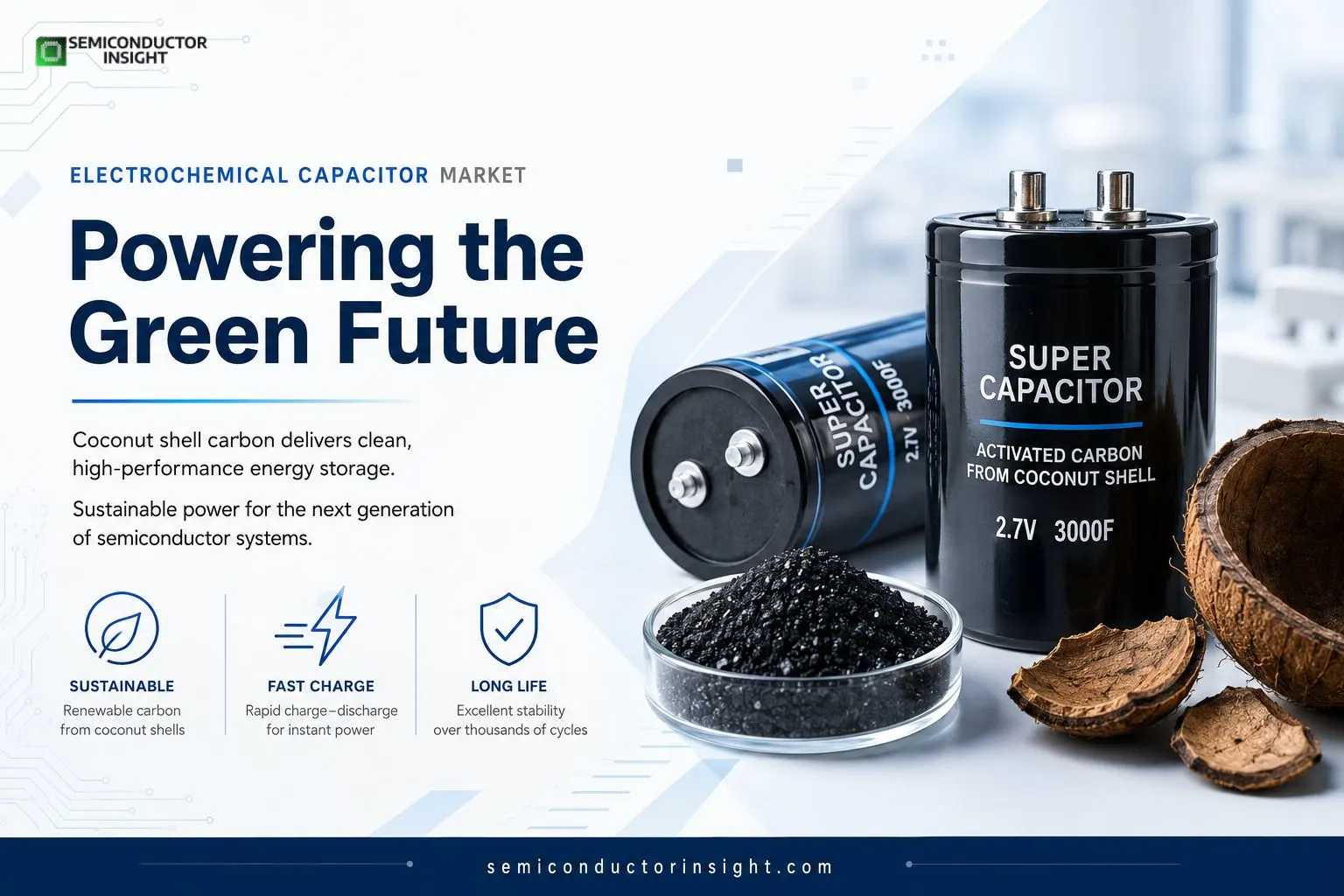
How Does the Electrochemical Capacitor with Activated Carbon from Coconut Shell Market Support High Performance Semiconductor Applications?
Activated carbon made from coconut shells is becoming one of the most promising examples of the ecologically friendly materials that the semiconductor industry is gradually adopting without sacrificing electrical performance.
Electrochemical capacitors manufactured using this renewable carbon source combine excellent conductivity, large surface area, rapid charge-discharge capability, and long operational life. As governments promote circular economies and electronics manufacturers pursue lower carbon footprints, coconut shell-based activated carbon is becoming an attractive material for energy storage devices integrated into semiconductor systems, industrial electronics, renewable energy infrastructure, and smart mobility.
Unlike conventional synthetic carbon materials, coconut shells transform agricultural waste into high-value electrode materials through carbonization and activation processes. This approach not only reduces biomass waste but also supports resource-efficient manufacturing, making the market increasingly relevant across both sustainability and semiconductor innovation.
Why Coconut Shell Carbon Is Becoming an Engineering Advantage?
- Activated carbon produced from coconut shells possesses a highly porous structure that can exceed 1,500 to 2,500 square meters of surface area per gram, enabling superior ion adsorption and fast electrochemical reactions. Such characteristics directly enhance capacitance while maintaining rapid charging cycles.
- Research published by universities and electrochemical journals has demonstrated that coconut shell-derived activated carbon can achieve excellent cycling stability, with laboratory supercapacitors retaining over 90% of their capacitance after tens of thousands of charge-discharge cycles under controlled testing conditions. This durability is attracting attention from designers developing compact power backup systems, wearable electronics, semiconductor sensors, and industrial automation devices.
- The growing interest also aligns with increasing investments in sustainable electronic materials rather than dependence on petroleum-derived carbon sources.
From Agricultural Waste to High Value Semiconductor Materials
One of the most remarkable developments in this market is the conversion of agricultural residues into advanced electronic materials.
The production process follows an increasingly optimized pathway:
Coconut Shell Collection
↓
Controlled Carbonization
↓
Steam or Chemical Activation
↓
Microporous Activated Carbon
↓
Electrode Fabrication
↓
Electrochemical Capacitor Integration
↓
Power Management Modules for Semiconductor Systems
Countries including Indonesia, the Philippines, India, Sri Lanka, and Vietnam remain major suppliers of coconut shells, creating reliable feedstock availability for activated carbon production. According to the Food and Agriculture Organization (FAO), global coconut production exceeds 60 million metric tons annually, ensuring abundant biomass resources for industrial carbon manufacturing.
Modern Electronics Demand Faster and Cleaner Energy Storage
Today’s semiconductor-powered products require instant energy delivery rather than prolonged battery discharge. Electrochemical capacitors complement batteries by supplying rapid bursts of power for applications such as:
- AI edge devices
- Industrial robots
- Smart electricity meters
- Semiconductor testing equipment
- Automotive electronic control systems
- Renewable energy converters
Electric vehicles increasingly employ supercapacitors alongside lithium-ion batteries to support regenerative braking and peak power assistance. Several automotive suppliers continue evaluating biomass-derived activated carbon electrodes to improve sustainability across next-generation energy storage platforms.
Research Laboratories Are Unlocking Higher Energy Density
Instead of focusing solely on capacitance improvements, researchers are now engineering hybrid electrode architectures that combine coconut shell activated carbon with graphene, carbon nanotubes, conductive polymers, and transition metal oxides.
Recent academic studies have demonstrated that hierarchical pore engineering enables better electrolyte penetration while reducing internal resistance. Scientists are also investigating nitrogen-doped and oxygen-functionalized coconut shell carbons that improve electrical conductivity and charge storage efficiency.
These developments are narrowing the performance gap between traditional supercapacitors and advanced battery technologies, creating new commercial opportunities for semiconductor manufacturers seeking compact, reliable power storage.
Circular Manufacturing Is Becoming a Market Differentiator
- Environmental sustainability is no longer limited to corporate reportingit is influencing material selection throughout electronics manufacturing.
- According to the International Energy Agency, global clean energy investment surpassed USD 2 trillion in 2024, with significant funding directed toward energy storage technologies, grid modernization, and advanced electronics.
- At the same time, the United Nations estimates that global electronic waste exceeds 60 million metric tons annually, encouraging manufacturers to adopt renewable raw materials wherever practical.
- Using coconut shell waste for activated carbon production supports both waste reduction and resource efficiency while lowering dependence on non-renewable carbon precursors.
Stay connected for additional in-depth information right here: https://semiconductorinsight.com/report/electrochemical-capacitor-with-activated-carbon-from-coconut-shell-market/
Innovation Is Expanding Beyond Traditional Supercapacitors
Manufacturers are increasingly exploring flexible electrochemical capacitors for wearable electronics, transparent energy storage devices, Internet of Things sensors, and printed semiconductor circuits.
Pilot-scale projects are also integrating artificial intelligence into activated carbon manufacturing to optimize pore distribution, activation temperature, and material consistency. Machine learning algorithms can rapidly analyze production parameters, helping manufacturers reduce defects while improving electrochemical performance.
With semiconductor devices becoming smaller, faster, and more energy efficient, naturally derived activated carbon materials are expected to play an increasingly important role in delivering sustainable energy storage without sacrificing reliability.

Comments (0)