Market Insights
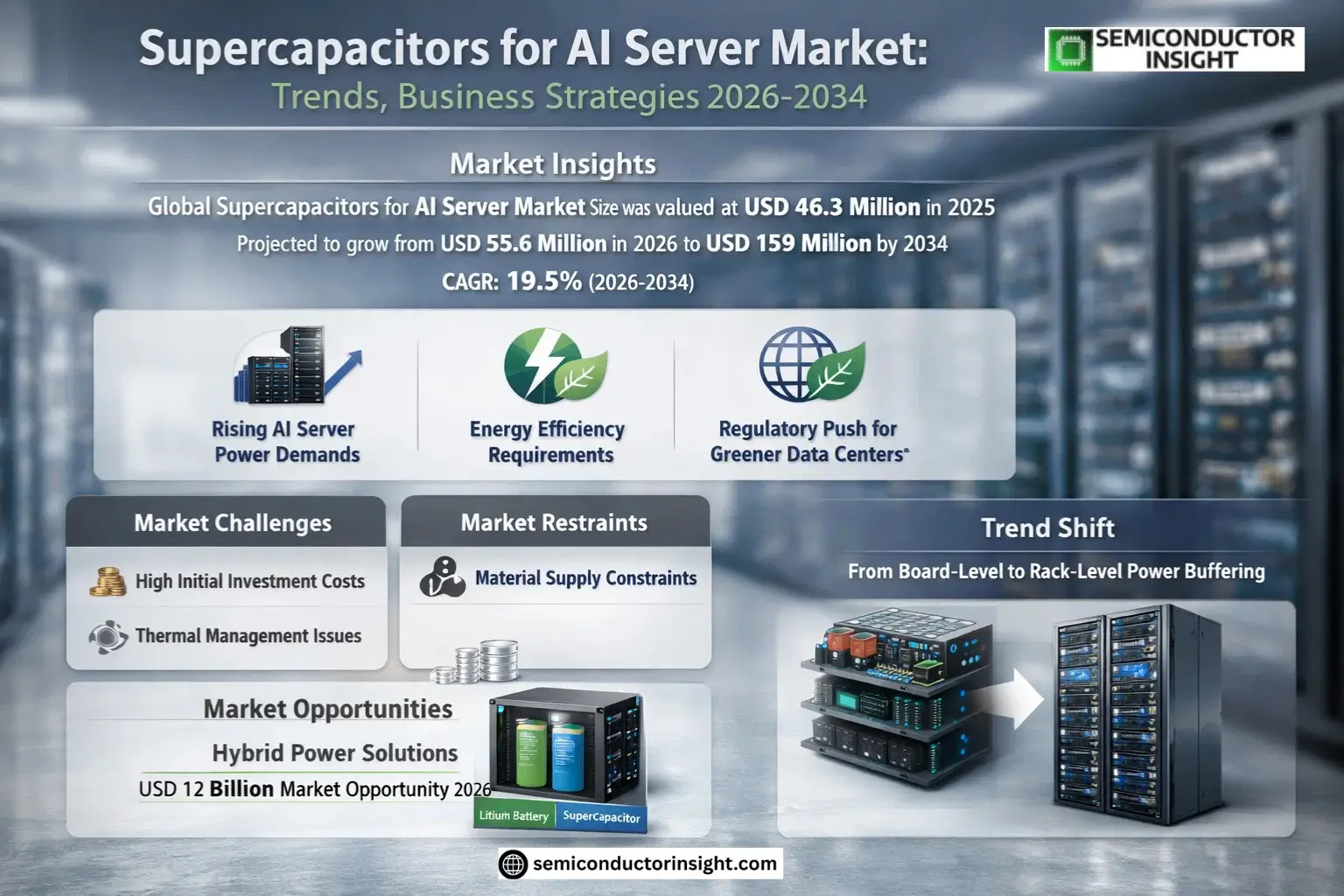
Global Supercapacitors for AI Server Market size was valued at USD 46.3 million in 2025. The market is projected to grow from USD 55.6 million in 2026 to USD 159 million by 2034, exhibiting a CAGR of 19.5% during the forecast period.
Supercapacitors for AI servers are advanced energy storage devices designed to handle rapid power fluctuations in artificial intelligence computing systems. These components play a critical role in managing the intense, short-duration power demands characteristic of AI workloads, particularly in GPU and ASIC-based server architectures. The technology has evolved from basic board-level power backup solutions to sophisticated rack-level energy buffering systems that improve power efficiency and server density.
The market growth is driven by increasing adoption of high-performance computing for AI applications, rising demand for energy-efficient data center solutions, and advancements in supercapacitor materials science. Key industry players such as Eaton, Skeleton Technologies, and Nippon Chemi-Con are developing specialized capacitor solutions tailored for AI server environments, with recent innovations focusing on hybrid capacitor designs that balance power density with thermal performance.
MARKET DRIVERS
Rising AI Server Power Demands
Global Supercapacitors for AI Server Market is experiencing exponential growth, with power requirements increasing by over 35% annually. Supercapacitors for AI servers are becoming critical components due to their ability to deliver instant power bursts during peak computational loads. Data centers are prioritizing energy solutions that can handle the intense, fluctuating demands of AI workloads.
Energy Efficiency Requirements
AI server racks now consume up to 25kW per unit, driving demand for efficient power management. Supercapacitors offer 95% energy efficiency compared to traditional batteries, making them ideal for AI infrastructure. Their rapid charge/discharge cycles perfectly match the intermittent high-power needs of GPU clusters in AI processing.
Regulatory pressures for greener data centers are accelerating the shift toward supercapacitor-based power solutions in AI server farms worldwide.
MARKET CHALLENGES
High Initial Investment Costs
While supercapacitors for AI servers offer long-term savings, the upfront costs remain 40-60% higher than conventional battery systems. This creates budget constraints for data center operators, particularly in emerging markets where AI adoption is still growing.
Other Challenges
Thermal Management Issues
At peak loads, supercapacitors in AI servers can generate significant heat, requiring advanced cooling systems that add 15-20% to operational costs. This thermal challenge is particularly acute in high-density server configurations.
MARKET RESTRAINTS
Material Supply Constraints
The supercapacitor industry faces supply chain bottlenecks for key materials like activated carbon and graphene. With AI server deployments growing rapidly, manufacturers struggle to maintain consistent production volumes, potentially limiting market expansion in the short term.
MARKET OPPORTUNITIES
Hybrid Power Solutions
The integration of supercapacitors with lithium batteries in AI servers presents a USD 12 billion market opportunity by 2026. These hybrid systems combine the high power density of supercapacitors with the energy density of batteries, creating optimized power solutions for next-generation AI workloads.
Supercapacitors for AI Server Market Trends
Shift from Board-Level to Rack-Level Power Buffering
Supercapacitors for AI Server Market industry is transitioning from board-level hold-up solutions to rack-level power buffering systems. This shift addresses the unique power demands of AI training and inference workloads, which create rapid power spikes during synchronized compute phases. Supercapacitors excel in millisecond response and cycle endurance, enabling local absorption and release of power bursts to smooth out grid-facing power profiles.
Other Trends
Technical Advancements in EDLC and Hybrid Capacitors
Supercapacitors for AI servers now split into EDLC (electrochemical double-layer capacitor) and hybrid families. EDLC offers superior power density and cycle life for frequent transients, while hybrids balance energy storage within constrained volumes. Selection criteria focus on system-level operating envelopes, including voltage window, ESR, thermal characteristics, and stack reliability.
Supply Chain and Ecosystem Evolution
The supercapacitor supply chain spans three critical layers: upstream materials (activated carbon, electrolytes), midstream module integration (balancing, thermal design), and downstream server power shelf ecosystems. Major players now include both system-facing power infrastructure suppliers and component manufacturers with proven high-temperature performance. The technology is becoming integral to platform engineering rather than remaining an optional component.
Operational Integration in Next-Gen AI Clusters
Recent deployments demonstrate supercapacitors’ growing role in rack-scale power management. Leading hyperscalers now dedicate substantial power shelf volume to capacitor-based energy storage for fast power smoothing. Emerging 800V DC architectures further incorporate supercapacitors for cycle backup, moving beyond simple component substitution toward system-wide power orchestration capabilities.
COMPETITIVE LANDSCAPE
Key Industry Players
Rapid Growth in AI Server Power Solutions Drives Supercapacitor Innovation
Supercapacitors for AI Server Market is dominated by established power electronics suppliers who’ve adapted their technology stacks for rack-level energy buffering. Eaton leads the segment with its integrated power shelf solutions that combine 48V supercapacitor modules with intelligent power management. Nippon Chemi-Con and Skeleton Technologies follow closely, specializing in high-performance EDLC cells optimized for AI server transient response requirements. This market exhibits vertical integration patterns where power infrastructure providers increasingly partner with supercapacitor cell manufacturers to deliver certified rack-scale solutions.
Several specialized manufacturers are gaining traction through hybrid capacitor technologies. LS Materials and CAP-XX have developed low-ESR modules specifically for GPU server applications, while Kyocera and Yageo focus on high-temperature tolerant designs for dense AI compute racks. Chinese suppliers like Nantong Jianghai and Fujian Torch Electron are expanding through cost-competitive 2.7V stacked supercapacitor solutions for mass-market AI deployments. The competitive landscape shows increasing convergence between supercapacitor specialists and server power architects as energy buffering becomes critical for next-gen AI hardware.
List of Key Supercapacitors for AI Server Companies Profiled
- Eaton
- Skeleton Technologies
- Nippon Chemi-Con
- Kyocera
- Yageo
- CAP-XX
- LS Materials
- Nantong Jianghai Capacitor
- Fujian Torch Electron Technology
- Hunan Aihua Group
- Shanghai Yongming Electronic
- Vishay Intertechnology
- Cornell Dubilier
- Maxwell Technologies
- Panasonic
Segment Analysis:
| Segment Category | Sub-Segments | Key Insights |
| By Type |
|
Hybrid Capacitors are gaining preference in AI server applications due to their balanced energy-power characteristics:
|
| By Application |
|
GPU Servers represent the most intensive use case driving supercapacitor adoption:
|
| By End User |
|
Hyperscale Data Centers are at the forefront of supercapacitor adoption:
|
| By Voltage Level |
|
48V Rack Systems are becoming the dominant voltage architecture:
|
| By Integration Level |
|
Rack-Integrated Systems represent the future direction:
|
Regional Analysis: Supercapacitors for AI Server Market
North America’s concentration of AI innovators and hyperscalers creates premium demand for supercapacitors in AI servers. Collaborative R&D between universities and tech firms accelerates next-generation supercapacitor integration in AI hardware architectures.
The U.S. Department of Energy’s efficiency standards for data centers mandate advanced power solutions, making supercapacitors essential for AI server deployments. California’s clean energy policies further drive adoption in major tech hubs.
Well-established semiconductor and advanced materials supply chains enable reliable supercapacitor production for AI servers. Local manufacturing of graphene and other nanomaterials supports cutting-edge supercapacitor development.
Venture capital firms actively fund supercapacitor startups targeting AI server applications. Private-public partnerships facilitate large-scale deployment of supercapacitor-equipped AI data centers across the region.
Europe
Europe’s supercapacitor market for AI servers grows steadily, supported by environmental regulations favoring green data center technologies. The EU’s focus on energy-efficient AI development creates opportunities for supercapacitor adoption in hyperscale facilities. Major automotive manufacturers transitioning into AI server production bring expertise in supercapacitor integration. Countries like Germany and Sweden lead in deploying supercapacitors for industrial AI applications, while Nordic regions leverage cold climates for combined AI server and supercapacitor cooling solutions.
Asia-Pacific
Asia-Pacific emerges as the fastest-growing market for supercapacitors in AI servers, driven by China’s massive AI infrastructure expansion. Japanese and Korean electronics giants develop proprietary supercapacitor solutions for their AI server lines. Southeast Asian countries becoming AI data center hubs create new demand for cost-effective supercapacitor power backup systems. India’s growing startup ecosystem shows increasing interest in supercapacitor-powered edge AI solutions for distributed computing.
South America
South America sees gradual adoption of supercapacitors in AI servers, primarily in Brazil’s financial technology sector and Chile’s growing data center market. Unstable power grids in the region make supercapacitors attractive for AI server uptime. Local governments begin funding research into adapting supercapacitor technology for tropical climate conditions in AI data centers.
Middle East & Africa
The Middle East invests heavily in supercapacitor-equipped AI servers as part of smart city initiatives, with UAE leading in data center modernization. African markets show potential for mobile AI server solutions using supercapacitors in off-grid applications. South Africa’s renewable energy projects increasingly incorporate supercapacitors for AI-powered grid management systems.
Report Scope
This market research report provides a comprehensive analysis of the Supercapacitors for AI Server Market , covering the forecast period 2025–2032. It offers detailed insights into market dynamics, technological advancements, competitive landscape, and key trends shaping the industry.
Key focus areas of the report include:
- Market Overview: The report begins with an overview outlining its current market scenario, key growth indicators, and industry transformation drivers. It discusses macroeconomic factors, demand–supply balance, regulatory landscape, and the strategic role of semiconductors in powering advancements across industries such as automotive, telecommunications, consumer electronics, and industrial automation.
- Market Size & Forecast: Historical data and future projections for revenue, unit shipments, and market value across major regions and segments.
- Segmentation Analysis: Detailed breakdown by product type, technology, application, and end-user industry to identify high-growth segments and investment opportunities.
- Regional Insights: Insights into market performance across North America, Europe, Asia-Pacific, Latin America, and the Middle East & Africa, including country-level analysis where relevant.
- Competitive Landscape: Profiles of leading market participants, including their product offerings, R&D focus, manufacturing capacity, pricing strategies, and recent developments such as mergers, acquisitions, and partnerships.
- Technology Trends & Innovation: Assessment of emerging technologies, integration of AI/IoT, semiconductor design trends, fabrication techniques, and evolving industry standards.
- Market Drivers & Restraints: Evaluation of factors driving market growth along with challenges, supply chain constraints, regulatory issues, and market-entry barriers.
- Stakeholder Insights: Insights for component suppliers, OEMs, system integrators, investors, and policymakers regarding the evolving ecosystem and strategic opportunities.
Primary and secondary research methods are employed, including interviews with industry experts, data from verified sources, and real-time market intelligence to ensure the accuracy and reliability of the insights presented.
FREQUENTLY ASKED QUESTIONS:
What is the current market size of Supercapacitors for AI Server Market?
-> Supercapacitors for AI Server Market size was valued at USD 46.3 million in 2025. The market is projected to grow from USD 55.6 million in 2026 to USD 159 million by 2034, exhibiting a CAGR of 19.5% during the forecast period.
What is the expected CAGR of the Supercapacitors for AI Server Market?
-> The market is projected to grow at a CAGR of 19.5% during the forecast period (2025-2032).
What are the key applications of Supercapacitors in AI Servers?
-> Key applications include GPU Servers, ASIC Servers, FPGA Servers, and others, with GPU servers holding a significant market share.
What are the major product types in this market?
-> The market is segmented into Electrostatic Double Layer Capacitor, Pseudocapacitor, and Hybrid Capacitor types.
Which companies lead the Supercapacitors for AI Server Market?
-> Key players include Eaton, Skeleton Technologies, Nippon Chemi-Con, Kyocera, Yageo, CAP-XX, LS Materials, Nantong Jianghai Capacitor, Fujian Torch Electron Technology, Hunan Aihua Group, and Shanghai Yongming Electronic.
What is driving the growth of this market?
-> Growth is driven by increasing AI server deployments, demand for rack-level power buffering, and the need for millisecond response power solutions that support higher rack power density.
Get Sample Report PDF for Exclusive Insights
Report Sample Includes
- Table of Contents
- List of Tables & Figures
- Charts, Research Methodology, and more...
 Download Sample Report PDF