

How Big Is the Wall Mounted Kiosk Market in 2026? Technology, Usage and Deployment Signals
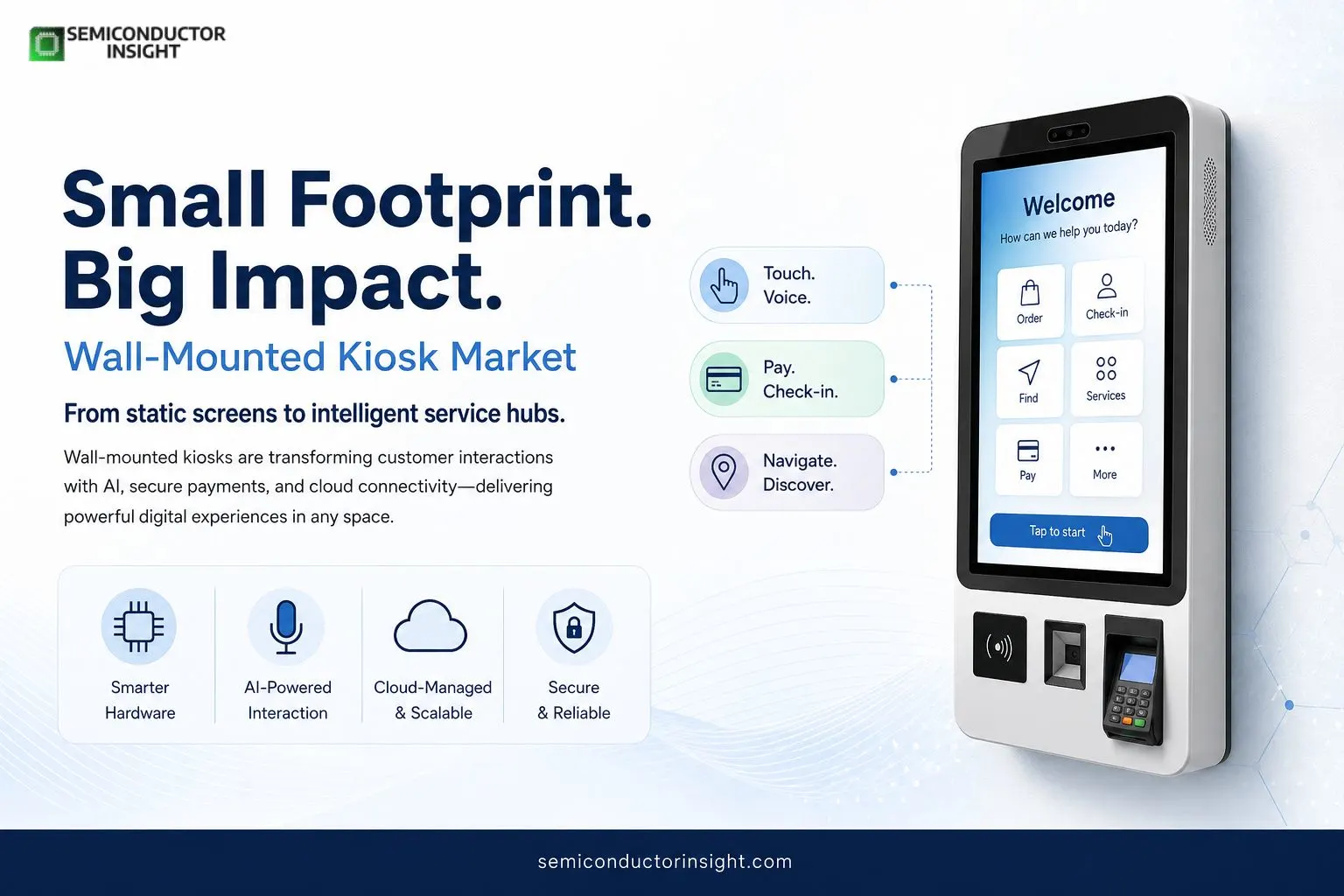
Wall-mounted kiosks are evolving from static information terminals into compact computing platforms capable of handling ordering, check-in, wayfinding, payments, queue management, digital forms and interactive content. Their appeal comes from a simple physical advantage: they deliver a digital service without requiring a large footprint.
Modern systems can combine a touchscreen, processor, camera, speakers, payment hardware, QR reader, connectivity module and cloud-managed software inside one enclosure. This makes them particularly relevant to restaurants, hospitals, airports, retail stores, banks, universities, hotels and government facilities.
Amazon, for example, now positions its Signage Stick around kiosk-mode operation, 4K visuals and Wi-Fi 6E connectivity, showing how relatively computing hardware compact is increasingly being designed for continuously running commercial displays.
The hardware stack is becoming more semiconductor intensive
A wall-mounted kiosk may look like a display product from the outside, but internally it resembles a small edge-computing system.
Touch panel → display controller → CPU/GPU → memory → connectivity → camera/sensors → payment or scanning hardware → cloud software
The semiconductor content therefore extends beyond the processor. Modern designs can require display-driver ICs, memory chips, Wi-Fi/Bluetooth modules, USB controllers, power-management ICs, audio chips, security elements and image-processing components.
That architecture creates an important connection between the kiosk industry and semiconductor innovation. More capable processors allow kiosks to perform functions locally instead of sending every interaction to a remote server.
AI is moving from the cloud toward the customer interface
- The next generation of wall-mounted kiosks is increasingly designed to understand more than a touchscreen command. Voice interaction, computer vision, multilingual interfaces and AI-assisted recommendations can transform a conventional terminal into an intelligent service point.
- AWS Marketplace currently features voice-AI solutions designed specifically for retail and quick-service restaurant kiosks. These systems combine automatic speech recognition, natural-language understanding and real-time interfaces to support ordering and customer interaction.
- This matters because the kiosk becomes capable of serving customers who may struggle with small touch targets, complex menus or unfamiliar languages.
Where wall-mounted systems are finding practical use
The strongest applications are emerging wherever organizations have repetitive customer-facing processes.
In healthcare, wall-mounted terminals can support patient registration, appointment check-in and navigation. In retail, they can provide product discovery, inventory lookup and self-service ordering. In hospitality, they can manage check-in, room information and guest services. Airports and transportation facilities can use them for directions, ticketing and passenger information.
The format is particularly useful where floor space is expensive. Mounting the interface vertically keeps aisles and counters relatively clear while maintaining an always-available digital access point.
Does Tesla use silicon carbide?
- Tesla has used silicon-carbide power semiconductors, particularly in its electric-vehicle powertrain inverters. This is separate from wall-mounted kiosk electronics, but it is a useful semiconductor example because it demonstrates why material selection matters in compact, power-sensitive systems.
- A teardown of the Tesla Model 3 inverter identified 24 1-in-1 power modules, with each module containing two SiC MOSFETs. STMicroelectronics reported that the modules were assembled on a pin-fin heatsink and designed to reduce conduction and switching losses.
- The U.S. Department of Energy’s Oak Ridge National Laboratory material similarly identifies the Model 3 as an early automotive application of SiC MOSFETs and notes 24 MOSFETs per module in its documentation.
- Tesla’s own technical documentation also shows that the Model 3 platform has undergone multiple production revisions, including different production periods for Fremont and Shanghai vehicles.
- The broader lesson for kiosk designers is relevant: power-efficient semiconductor architecture enables smaller thermal solutions, higher computing performance and more compact equipment. SiC it is generally relevant to higher-power conversion rather than ordinary kiosk processing, but the engineering principle carries across both industries.
A quieter transformation is happening in the software layer
Hardware is only half of the kiosk equation. Cloud-connected content management is becoming increasingly important because businesses may operate hundreds or thousands of terminals.
A centrally managed system can update menus, prices, promotional material, operating instructions and software without physically visiting every screen. AWS’s current digital-signage ecosystem, for example, emphasizes centralized content-management compatibility and automated kiosk-mode operation.
This turns a wall-mounted kiosk from a one-time hardware installation into a continuously managed digital endpoint.
You can freely browse our most recent updated report to learn more about it before scrolling further: https://semiconductorinsight.com/report/wall-mounted-kiosk-market-size-share-trends-market/
The next specification will be written around experience
The most interesting shift in 2026 is that kiosk buyers are increasingly evaluating interaction quality rather than screen size alone. Fast response, accessibility, remote diagnostics, secure connectivity, low power consumption, camera capability and AI-enabled interfaces can determine whether a terminal actually improves service delivery.
Wall-mounted kiosks are consequently becoming part of the broader edge-computing ecosystem. Their physical footprint may remain small, but the technology inside is becoming substantially more sophisticated, connecting displays, processors, sensors, connectivity and cloud platforms into a single customer-facing system.

Comments (0)