Wall Mounted Kiosk Market Insights
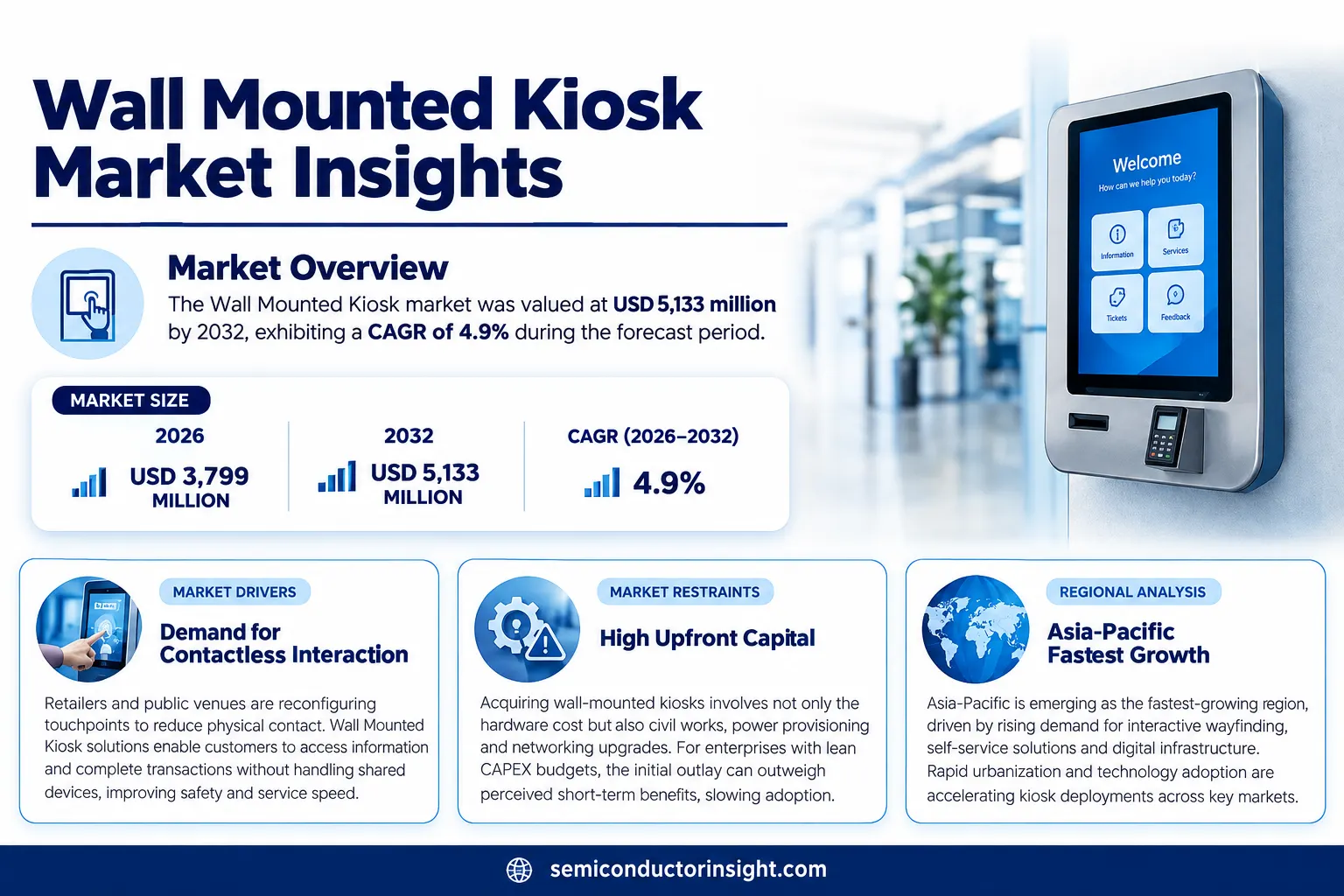
Wall Mounted Kiosk market was valued at USD 5,133 million by 2032, exhibiting a CAGR of 4.9% during the forecast period.
A wall mounted kiosk is a space‑saving interactive or informational terminal fixed to a vertical surface, typically integrating a PCAP touch display, lockable enclosure and optional peripherals such as scanners, cameras or payment devices. It is deployed in reception areas, corridors, retail walls, hospitals and transport venues where floor space is limited and durability is required.The market benefits from two converging upgrade cycles: continued rollout of self‑service touchpoints across retail, healthcare and transport, and the evolution of digital signage into managed interactive endpoints. Because wall mounting conserves floor space and enhances security, demand accelerates for wayfinding, check‑in and ticketing applications; however, price sensitivity in lower‑margin segments poses challenges for manufacturers seeking higher gross margins.
MARKET DRIVERS
Demand for Contactless Interaction
Retailers and public venues are reconfiguring touchpoints to reduce physical contact. Wall Mounted Kiosk Market solutions enable customers to locate information, place orders, or complete transactions without handling shared devices, thereby addressing heightened health concerns while preserving service speed.
Integration with Smart Infrastructure
Municipalities are embedding IoT sensors and real‑time data feeds into urban fixtures. Wall‑mounted kiosks serve as the visual conduit for this data, turning street furniture into interactive information nodes that support navigation, transit updates, and civic alerts.
➤ “In the next two years, 40 % of city‑level information displays will be wall‑mounted interactive kiosks, according to field surveys.”
These forces create a feedback loop: as more agencies adopt digital signage, the ecosystem of content management platforms expands, prompting vendors to introduce higher‑resolution screens and robust connectivity options, which in turn accelerates deployment rates.
MARKET CHALLENGES
Installation Complexity
Mounting a kiosk on existing walls often requires structural assessment, reinforcement, and coordination with building management. The need for professional installers raises project timelines and can deter smaller operators from scaling deployments.
Other Challenges
Maintenance Overheads
Routine cleaning, software updates, and hardware diagnostics demand dedicated staff or outsourced service contracts. Unplanned downtime directly impacts user satisfaction, especially in high‑traffic locations such as transit hubs.
MARKET RESTRAINTS
High Upfront Capital
Acquiring a wall‑mounted unit involves not only the hardware price but also civil works, power provisioning, and networking upgrades. For enterprises operating on lean CAPEX budgets, the initial outlay can outweigh perceived short‑term benefits, slowing adoption curves.Financial models that spread costs over multi‑year service agreements are emerging, yet they require robust demand forecasting to justify the long‑term commitment, which many organizations find difficult to produce with confidence.
MARKET OPPORTUNITIES
Emerging Retail Use Cases
Luxury boutiques and fast‑fashion chains are exploring wall‑mounted kiosks for personalized styling assistance, leveraging AI‑driven recommendations that draw on purchase history and real‑time inventory. This approach transforms static displays into revenue‑generating touchpoints.Additionally, pop‑up concepts in malls and airports are adopting modular wall‑mounted units that can be repositioned quickly, offering brands a flexible platform to capture impulse traffic without committing to permanent fixtures.
Wall Mounted Kiosk Market Trends
Shift Toward Space‑Optimized Self‑Service
Wall Mounted Kiosk Market in 2025 recorded revenue of $3.8 billion, supported by a steady stream of installations in environments where floor space is at a premium. Retail chains, hospital networks, and transportation hubs have converged on wall‑mounted formats to replace conventional floor‑standing units, taking advantage of the lower footprint and the ability to embed tamper‑resistant enclosures. Production volumes reached roughly 1.98 million units, with an average selling price of $2,100, indicating a mature pricing equilibrium that balances hardware cost against a gross margin ranging from 20 % to 40 %. The most common configurationsbasic touch displays paired with QR scannersare being ordered in larger batches than higher‑spec models that include payment modules, reflecting a segmentation between high‑volume, low‑complexity deployments and niche, transaction‑focused uses.
Other Trends
Sector‑Specific Adoption Patterns
Healthcare facilities have become the fastest‑growing segment for wall‑mounted solutions. Waiting‑room check‑in stations and visitor‑management terminals reduce staffing pressure while preserving patient privacy. In the retail sector, wayfinding displays and quick‑order kiosks are installed along corridor walls to streamline shopper flow and to present promotions without obstructing aisles. Transportation operatorsairports and railway stationsfavor wall units for ticketing and real‑time information because the devices can be placed at gate sides, minimizing queue length. Meanwhile, financial institutions deploy wall‑mounted payment kiosks in branch lobbies, leveraging the locked enclosure to meet security standards while freeing floor space for customer service representatives.
Integration of Interactive Signage Functions
The convergence of digital signage and self‑service functionality is reshaping Wall Mounted Kiosk Market. Manufacturers now ship devices that combine high‑brightness LCD panels with multi‑touch firmware, enabling brands to switch between passive advertising and interactive engagement with a single hardware platform. This dual‑use capability reduces capital expenditure for operators who previously maintained separate signage networks and kiosk fleets. Software‑as‑a‑service layers allow remote content updates, analytics collection, and integration with loyalty programs, turning every wall‑mounted unit into a data‑rich touchpoint. As enterprises seek to maximize ROI on their physical‑digital ecosystems, the demand for modular accessoriessuch as integrated printers, NFC readers, and AI‑driven camerashas risen, prompting original equipment manufacturers to expand their accessory catalogs. The result is a market that rewards flexibility and scalability more than sheer hardware specifications.
COMPETITIVE LANDSCAPE
Key Industry Players
Wall Mounted Kiosk Market: Competitive Overview 2025‑2032
The segment is led by a handful of global integrators whose breadth of hardware engineering and software services creates a de‑facto tiered structure. NCR Voyix Corporation commands the largest share, leveraging a portfolio that combines veteran POS expertise with recent investments in secure enclosure design, allowing it to dominate high‑volume installations in banking and transportation hubs. Diebold Nixdorf follows closely, differentiating through modular payment options that accommodate rapid firmware upgrades, a capability prized by retail chains seeking to future‑proof their self‑service points. Both firms capitalize on economies of scale that keep unit costs below the $2,100 average while preserving margins in the 20‑40 % band, a factor that reinforces their bargaining power with distributors and large‑scale project owners.Beyond the duopoly, a vibrant cohort of midsize specialists injects diversity into the market. TCN Vending and iMin Technology focus on niche retail environments where compact dimensions and low‑maintenance designs are decisive. Seelinkin and Crow Works excel in the healthcare arena, offering antimicrobial surfaces and integrated patient‑check‑in workflows. Smaller innovators such as Advanced Kiosks, Olea Kiosks, and REDYREF Interactive target regional public‑service contracts, tailoring firmware to municipal way‑finding standards. Companies like SlabbKiosks and DynaTouch pursue outdoor‑rated chassis, expanding the addressable space into transit stations where exposure to the elements demands ruggedization. This tiered ecosystem ensures that procurement officers can match product sophistication to budget constraints without sacrificing the reliability that wall‑mounted solutions promise.
List of Key Wall Mounted Kiosk Companies Profiled
- NCR Voyix Corporation
- Diebold Nixdorf
- TCN Vending
- iMin Technology
- Seelinkin
- Fuji Electric
- Crow Works
- TouchWo
- Advanced Kiosks
- Comark
- Olea Kiosks
- Meridian Kiosks
- REDYREF Interactive
- SlabbKiosks
- DynaTouch
- eKiosk GmbH
- LamasaTech
- Armodilo
- Cammax Limited
Segment Analysis:
| Segment Category | Sub-Segments | Key Insights |
| By Type |
|
Indoor Wall Mounted Kiosk is favored for its seamless integration into interior environments, offering:
|
| By Application |
|
Retail deployments capitalize on:
|
| By End User |
|
Consumers benefit from:
|
| By Interaction Model |
|
Interactive Touch Kiosk is preferred because:
|
| By Size |
|
24 Inch units strike a balance that:
|
Regional Analysis: Wall Mounted Kiosk Market
North America
Leading retailers view wall‑mounted kiosks as a conduit for omnichannel engagement, deploying them to showcase product videos, enable quick inventory checks, and process in‑store pickups. The tactile yet unobtrusive design encourages shoppers to explore digital promotions without disrupting aisle flow, reinforcing brand loyalty while gathering real‑time foot‑traffic data.
Hospitals and outpatient clinics leverage wall‑mounted kiosks to streamline patient check‑ins, dispense pre‑visit instructions, and present health‑education content. The vertical orientation aligns with tight corridor spaces, reducing clutter while enhancing patient throughput and satisfaction scores.
Airports and train stations adopt wall‑mounted kiosks for wayfinding, ticketing, and real‑time service alerts. Their prominence on high‑traffic walls improves visibility, enabling travelers to access critical information swiftly, which in turn raises ancillary revenue through targeted advertising.
Enterprises integrate wall‑mounted kiosks in reception areas to manage visitor registration, display corporate news, and provide secure network access. The design supports a polished brand image while automating routine front‑desk duties, freeing staff for higher‑value interactions.
Europe
European markets exhibit a measured uptake of wall‑mounted kiosks, driven by stringent privacy regulations that compel vendors to embed advanced encryption and on‑device processing. Retail chains across Germany and France prioritize kiosks that can comply with GDPR while offering localized language packs, catering to diverse consumer bases. Additionally, public sector projects in Scandinavia experiment with interactive wayfinding solutions in transport terminals, signaling a gradual shift toward digital public infrastructure.
Asia‑Pacific
In Asia‑Pacific, rapid urbanization and a youthful consumer demographic accelerate interest in interactive wall displays. While adoption rates lag behind North America, major metropolitan areas such as Singapore and Sydney deploy kiosks for smart‑city initiatives, blending real‑time transit data with tourism content. Manufacturers tailor hardware to humid climates and multilingual interfaces, positioning the region as a fertile ground for next‑generation kiosk solutions.
South America
South American enterprises view wall‑mounted kiosks as a cost‑effective entry point for digitizing storefronts, especially in Brazil and Chile where small‑to‑medium retailers dominate. The emphasis lies on rugged designs capable of withstanding high foot traffic and variable power conditions. Moreover, governmental health campaigns employ kiosks to disseminate vaccination information, leveraging their visibility on public walls to reach underserved populations.
Middle East & Africa
The Middle East & Africa region balances luxury-driven deployments in premium malls with pragmatic installations in emerging markets. In the United Arab Emirates, high‑end retailers integrate wall‑mounted kiosks with AR capabilities to enhance shopper immersion, while African nations explore basic versions for banking outreach and citizen services. Connectivity challenges drive vendors to prioritize offline content caching, ensuring consistent user experiences despite network instability.
Report Scope
This market research report provides a comprehensive analysis of the Wall Mounted Kiosk Market , covering the forecast period 2026–2034. It offers detailed insights into market dynamics, technological advancements, competitive landscape, and key trends shaping the industry.
Key focus areas of the report include:
- Market Overview: The report begins with an overview outlining its current market scenario, key growth indicators, and industry transformation drivers. It discusses macroeconomic factors, demand–supply balance, regulatory landscape, and the strategic role of semiconductors in powering advancements across industries such as automotive, telecommunications, consumer electronics, and industrial automation.
- Market Size & Forecast: Historical data and future projections for revenue, unit shipments, and market value across major regions and segments.
- Segmentation Analysis: Detailed breakdown by product type, technology, application, and end-user industry to identify high-growth segments and investment opportunities.
- Regional Insights: Insights into market performance across North America, Europe, Asia-Pacific, Latin America, and the Middle East & Africa, including country-level analysis where relevant.
- Competitive Landscape: Profiles of leading market participants, including their product offerings, R&D focus, manufacturing capacity, pricing strategies, and recent developments such as mergers, acquisitions, and partnerships.
- Technology Trends & Innovation: Assessment of emerging technologies, integration of AI/IoT, semiconductor design trends, fabrication techniques, and evolving industry standards.
- Market Drivers & Restraints: Evaluation of factors driving market growth along with challenges, supply chain constraints, regulatory issues, and market-entry barriers.
- Stakeholder Insights: Insights for component suppliers, OEMs, system integrators, investors, and policymakers regarding the evolving ecosystem and strategic opportunities.
Primary and secondary research methods are employed, including interviews with industry experts, data from verified sources, and real-time market intelligence to ensure the accuracy and reliability of the insights presented.
FREQUENTLY ASKED QUESTIONS:
What is the current market size of Wall Mounted Kiosk Market?
-> Wall Mounted Kiosk Market was valued at USD 5,133 million by 2032, growing at a CAGR of 4.9% during the forecast period.
Which key companies operate in Wall Mounted Kiosk Market?
-> Key players include NCR Voyix Corporation, Diebold Nixdorf, TCN Vending, iMin Technology, Seelinkin, Fuji Electric, Crow Works, TouchWo, Advanced Kiosks, Comark, Olea Kiosks, Meridian Kiosks, REDYREF Interactive, SlabbKiosks, DynaTouch, Evoke Creative, eKiosk GmbH, LamasaTech, Armodilo, Cammax Limited.
What are the key growth drivers?
-> Key growth drivers include the continued rollout of self‑service touchpoints in retail, healthcare, transport and public services, the modernization of digital signage into interactive endpoints, and the need for space‑saving, secure installations in corridors, reception areas and queue lines.
Which region dominates the market?
-> The market shows strong adoption across North America, Europe and Asia, with Asia displaying the fastest growth due to high demand for interactive way‑finding and ticketing solutions.
What are the emerging trends?
-> Emerging trends include integration of QR/barcode scanners, cameras and AI‑driven analytics, expanded use of interactive touch kiosks for way‑finding and self‑check‑in, and the blending of digital signage with transactional capabilities.
Get Sample Report PDF for Exclusive Insights
Report Sample Includes
- Table of Contents
- List of Tables & Figures
- Charts, Research Methodology, and more...
 Download Sample Report PDF