QR Code Scanner Module Market Insights
Global QR Code Scanner Module market size was valued at USD 751 million in 2025. The market is projected to reach USD 1,040 million by 2032, exhibiting a CAGR of 4.9% during the forecast period.
The QR code scanning module is an integrated device that captures the two-dimensional code image through the image sensor, and analyzes the data in the image through the built-in processing chip and decoding algorithm to achieve rapid reading and recognition of the two-dimensional code.
The market is experiencing rapid growth due to several factors, including heightened demand across retail, industrial, consumer electronics, agriculture, and other sectors, alongside advancements in compact imaging and decoding technologies. These drivers are enhancing efficiency in applications from contactless payments to inventory management. Initiatives by key players continue to propel innovation and market expansion. DFRobot, Shenzhen Camabio Biometrics Technology, Shenzhen Yuanjingda Internet of Things Technology, Hangzhou Grow Technology, Shenzhen Masung Technology, Guangzhou Yoko Electronics, Shenzhen RTscan Technology, and Tianjin Wavecreating Micro Intelligent Technology are some of the key players operating in the market with diverse product portfolios.
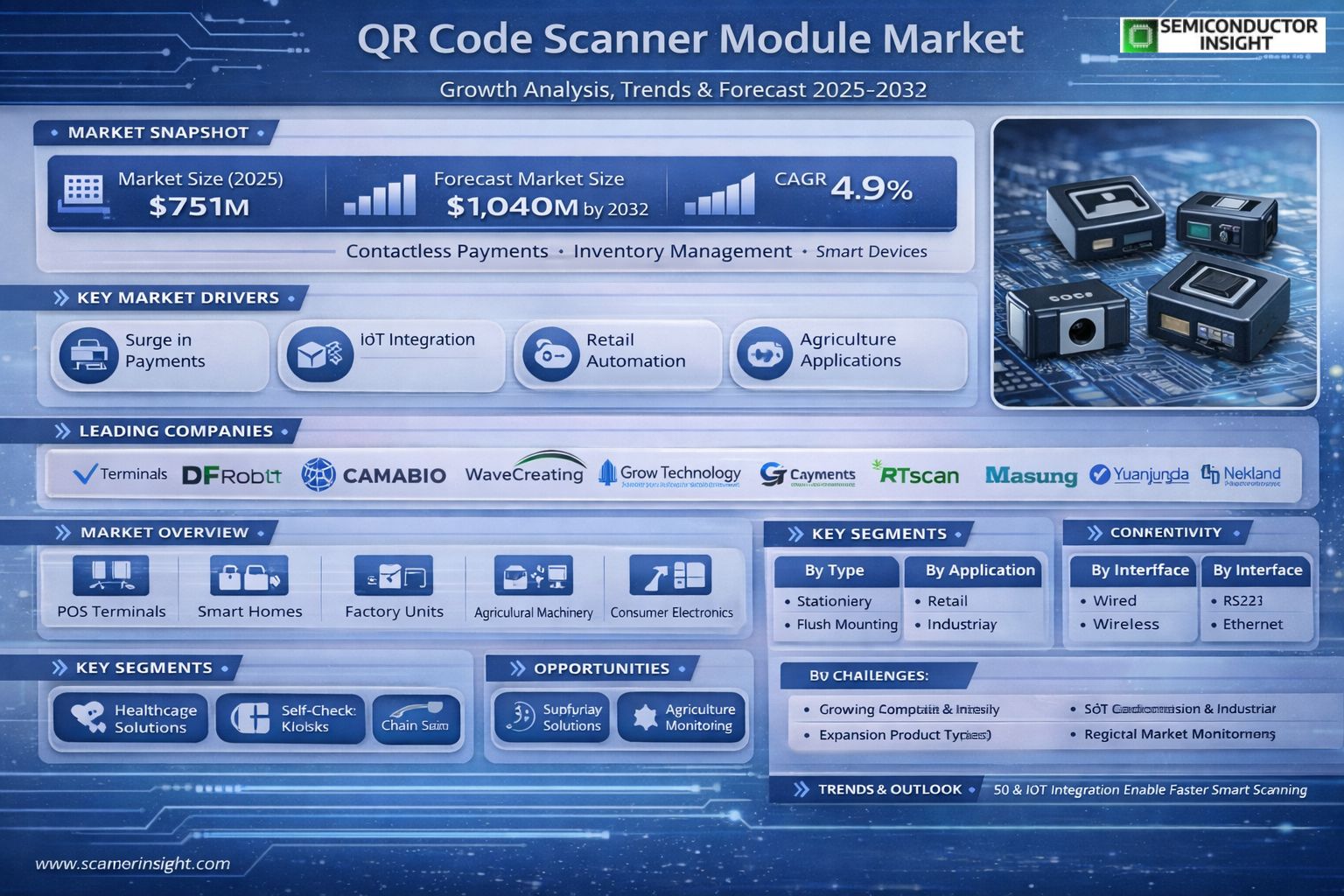
MARKET DRIVERS
Surge in Contactless Payments
QR Code Scanner Module Market is experiencing robust growth due to the widespread adoption of contactless payment systems globally. With consumers increasingly favoring quick and hygienic transaction methods, especially post-pandemic, embedded QR scanning modules in POS terminals and mobile devices have become essential. Market projections indicate a compound annual growth rate (CAGR) exceeding 11% through 2028, driven by this shift.
IoT and Supply Chain Integration
Integration of QR code scanner modules into IoT ecosystems for real-time inventory tracking and logistics optimization further accelerates market expansion. Industries such as retail and manufacturing leverage these modules for seamless asset management, reducing operational inefficiencies by up to 25%. This trend underscores the demand for compact, high-performance scanning hardware.
➤ Global smartphone penetration surpassing 85% enhances accessibility of QR code scanning modules in consumer electronics.
Advancements in miniaturization and affordability are enabling broader deployment across diverse applications, solidifying the foundational drivers of QR Code Scanner Module Market.
MARKET CHALLENGES
Technical Compatibility Issues
One primary challenge in QR Code Scanner Module Market is ensuring compatibility with varying QR code formats and lighting conditions, which can lead to scan failures in real-world deployments. Manufacturers face difficulties in optimizing modules for diverse environments, impacting reliability in sectors like logistics.
Other Challenges
Competition from Software Solutions
The rise of camera-based software scanners in smartphones poses a threat, as they offer cost-effective alternatives to dedicated hardware modules. This shift challenges module providers to differentiate through superior speed and accuracy, particularly in industrial settings.
Additionally, cybersecurity vulnerabilities in connected scanning modules require ongoing mitigation efforts, adding complexity to product development cycles.
MARKET RESTRAINTS
Supply Chain Disruptions
Persistent global supply chain issues, including semiconductor shortages, significantly restrain growth in QR Code Scanner Module Market. Production delays have increased lead times by 30-40% for key components like image sensors, hindering scalability for OEMs.
High initial development costs for advanced modules with features like AI-enhanced decoding further limit market entry for smaller players, consolidating power among established firms.
Regulatory compliance with data privacy standards, such as GDPR, imposes additional burdens, slowing innovation and adoption in privacy-sensitive regions.
MARKET OPPORTUNITIES
Expansion in Healthcare and Retail
QR Code Scanner Module Market presents substantial opportunities in healthcare for patient tracking and medication verification, where modules can reduce errors by 20%. Retail automation through self-checkout kiosks also fuels demand.
Emerging markets in Asia-Pacific offer untapped potential, with rising digitalization projected to drive module shipments up by 15% annually.
Integration with 5G and edge computing enables faster, low-latency scanning applications, opening doors for smart city initiatives and beyond.
QR Code Scanner Module Market Trends
Growing Adoption in Retail and Industrial Sectors
QR Code Scanner Module Market is experiencing notable momentum driven by expanding applications in retail and industrial environments. These integrated devices, equipped with image sensors and decoding algorithms, enable rapid recognition of two-dimensional codes, enhancing operational efficiency. Retailers leverage them for seamless inventory management and customer interactions, while industrial settings utilize them for asset tracking and quality control processes. This dual-sector demand underscores a primary trend toward versatile deployment, fostering innovation in compact, high-speed scanning solutions tailored to diverse workflows.
Other Trends
Expansion Across Product Types
Developments in product types such as stationary and flush mounting configurations are shaping QR Code Scanner Module Market landscape. Stationary modules offer robust performance in fixed installations, ideal for high-volume scanning stations, whereas flush mounting variants provide sleek integration into surfaces, suiting space-constrained applications. Manufacturers are refining these types to improve durability and decoding accuracy, responding to user needs for reliable performance in varied conditions.
Regional Market Dynamics and Competitive Landscape
In QR Code Scanner Module Market, regional variations highlight Asia’s prominence, particularly China, alongside steady growth in North America and Europe. Key players including DFRobot, Shenzhen Camabio Biometrics Technology, Shenzhen Yuanjingda Internet of Things Technology, Hangzhou Grow Technology, and Shenzhen Masung Technology dominate, holding significant revenue shares through strategic advancements and supply chain optimizations. The competitive environment features ongoing developments in consumer electronics, agriculture, and other applications, with surveys indicating drivers like technological enhancements and challenges such as integration complexities. Industry experts note potential in emerging markets, emphasizing the need for adaptive strategies amid evolving demands in sectors like consumer electronics and agriculture. Overall, these trends signal sustained evolution, with stakeholders focusing on segmentation opportunities by type and application to capture growth in a fragmented yet promising QR Code Scanner Module Market.
COMPETITIVE LANDSCAPE
Key Industry Players
QR Code Scanner Module Market: Leading Manufacturers and Share Analysis
QR Code Scanner Module Market features a fragmented competitive landscape dominated by specialized manufacturers, primarily based in China, offering integrated devices with image sensors and decoding algorithms for rapid QR code recognition. Key leaders such as DFRobot and Shenzhen Camabio Biometrics Technology spearhead innovation, capturing significant revenue shares among the global top five players, which together hold a substantial portion of the market in 2025. The market structure is characterized by OEM-focused suppliers addressing diverse segments like stationary and flush-mounted modules, driven by demand in retail, industrial automation, and consumer electronics. Intense competition revolves around processing speed, integration capabilities, and cost-efficiency, with established players leveraging R&D to maintain positions amid a projected CAGR of 4.9% through 2032.
Beyond the top tier, niche players like Shenzhen Yuanjingda Internet of Things Technology, Hangzhou Grow Technology, Shenzhen Masung Technology, and Guangzhou Yoko Electronics provide targeted solutions for applications in agriculture and others, contributing to market diversification. Companies such as Shenzhen RTscan Technology and Tianjin Wavecreating Micro Intelligent Technology focus on high-performance modules for regional demands, particularly in Asia. Emerging competitors enhance the ecosystem through specialized developments, mergers, and expansions, fostering technological advancements while navigating challenges like price pressures and supply chain dynamics. This competitive environment supports steady growth, with surveyed manufacturers emphasizing trends in IoT integration and multi-code decoding capabilities.
List of Key QR Code Scanner Module Companies Profiled
- DFRobot
- Shenzhen Camabio Biometrics Technology
- Shenzhen Yuanjingda Internet of Things Technology
- Hangzhou Grow Technology
- Shenzhen Masung Technology
- Guangzhou Yoko Electronics
- Shenzhen RTscan Technology
- Tianjin Wavecreating Micro Intelligent Technology
- Newland Hi-Tech Group
- Honeywell International
- Zebra Technologies
- Cognex Corporation
- Keyence Corporation
- Datalogic S.p.A.
- Omron Microscan
Segment Analysis:
| Segment Category | Sub-Segments | Key Insights |
| By Type |
|
Leading Segment: Stationary
|
| By Application |
|
Leading Segment: Retail
|
| By End User |
|
Leading Segment: Retailers
|
| By Connectivity |
|
Leading Segment: Wired
|
| By Interface |
|
Leading Segment: USB
|
Regional Analysis: QR Code Scanner Module Market
Asia-Pacific
Booming e-commerce and retail automation propel demand for QR code scanner modules in Asia-Pacific. Compact designs enable easy integration into handheld devices and fixed scanners, streamlining checkout processes and reducing operational costs for businesses focused on efficiency.
Local R&D emphasizes rugged, high-speed modules with omnidirectional scanning capabilities. Integration with 5G and edge computing enhances real-time data processing, vital for logistics and manufacturing where precision drives competitive edges in QR Code Scanner Module Market.
Intense rivalry among regional giants fosters innovation and cost efficiencies. Strategic partnerships with global tech firms accelerate module customization, strengthening Asia-Pacific’s role in shaping QR code scanner module standards and supply chains worldwide.
Expansion into emerging applications like augmented reality and autonomous systems promises sustained leadership. Business strategies emphasize sustainability, with eco-friendly materials gaining traction to align with regional green initiatives through 2034.
North America
North America exhibits strong growth in QR Code Scanner Module Market, driven by advanced retail and healthcare sectors. The United States leads with widespread adoption in contactless payments and patient tracking systems, where high-reliability modules ensure data security and quick processing. Innovation centers focus on software-hardware synergies, embedding AI for error-free decoding in diverse lighting conditions. Logistics firms utilize modules for warehouse automation, optimizing routes and inventory visibility. Regulatory emphasis on privacy bolsters trust in QR-based solutions, encouraging enterprise-wide deployment. While production lags behind Asia-Pacific, strategic imports and local assembly support tailored solutions for fintech and smart retail. Future business strategies highlight integration with blockchain for tamper-proof transactions, positioning North America as a premium market influencer through 2034.
Europe
Europe’s QR Code Scanner Module Market thrives on stringent quality standards and digital single market initiatives. Germany and the UK pioneer industrial applications, integrating modules into robotics for precision manufacturing and quality control. Retail chains embrace them for omnichannel experiences, linking physical stores to online inventories seamlessly. Sustainability drives demand for energy-efficient, recyclable modules amid green regulations. Healthcare leverages QR codes for vaccine tracking and medical records, prioritizing compliance with GDPR. Collaborative ecosystems among OEMs foster modular designs adaptable to vending machines and access control. Challenges like fragmented supply chains are mitigated through regional alliances, ensuring resilience. Looking ahead, strategies focus on 6G compatibility and edge AI, cementing Europe’s role in high-value QR code scanner module innovations by 2034.
South America
In South America, QR Code Scanner Module Market gains momentum from expanding e-commerce and informal retail networks. Brazil and Argentina lead adoption in mobile payments and agricultural supply chains, where affordable modules enable small businesses to digitize operations. Urbanization spurs integration into public transport ticketing and event management systems. Local manufacturers adapt designs for rugged environments, supporting logistics in remote areas. Government digital inclusion programs accelerate penetration in underserved markets. While infrastructure gaps pose hurdles, rising smartphone penetration offsets them, driving grassroots innovation. Business strategies emphasize cost-effective scalability, with partnerships enhancing module accessibility and fostering market maturity toward 2034.
Middle East & Africa
The Middle East & Africa QR Code Scanner Module Market emerges as a growth hotspot, fueled by oil & gas digitization and fintech revolutions. UAE and South Africa integrate modules into smart oilfield monitoring and cashless ecosystems, enhancing traceability and efficiency. Retail modernization in malls adopts them for loyalty programs and inventory. Harsh climates demand durable, heat-resistant designs, spurring specialized R&D. Mobile money services in Africa leverage QR codes for financial inclusion, bridging urban-rural divides. Investments in smart cities amplify public sector use. Strategies prioritize affordable, solar-powered variants to address power constraints, positioning the region for accelerated expansion in QR Code Scanner Module Market by 2034.
Report Scope
This market research report provides a comprehensive analysis of the QR Code Scanner Module Market , covering the forecast period 2025–2032. It offers detailed insights into market dynamics, technological advancements, competitive landscape, and key trends shaping the industry.
Key focus areas of the report include:
- Market Overview: The report begins with an overview outlining its current market scenario, key growth indicators, and industry transformation drivers. It discusses macroeconomic factors, demand–supply balance, regulatory landscape, and the strategic role of QR Code Scanner Modules in powering advancements across industries such as retail, industrial, consumer electronics, agriculture, and others.
- Market Size & Forecast: Historical data and future projections for revenue, unit shipments, and market value across major regions and segments.
- Segmentation Analysis: Detailed breakdown by product type, technology, application, and end-user industry to identify high-growth segments and investment opportunities.
- Regional Insights: Insights into market performance across North America, Europe, Asia-Pacific, Latin America, and the Middle East & Africa, including country-level analysis where relevant.
- Competitive Landscape: Profiles of leading market participants, including their product offerings, R&D focus, manufacturing capacity, pricing strategies, and recent developments such as mergers, acquisitions, and partnerships.
- Technology Trends & Innovation: Assessment of emerging technologies, integration of AI/IoT, semiconductor design trends, fabrication techniques, and evolving industry standards.
- Market Drivers & Restraints: Evaluation of factors driving market growth along with challenges, supply chain constraints, regulatory issues, and market-entry barriers.
- Stakeholder Insights: Insights for component suppliers, OEMs, system integrators, investors, and policymakers regarding the evolving ecosystem and strategic opportunities.
Primary and secondary research methods are employed, including interviews with industry experts, data from verified sources, and real-time market intelligence to ensure the accuracy and reliability of the insights presented.
FREQUENTLY ASKED QUESTIONS:
What is the current market size of QR Code Scanner Module Market?
-> QR Code Scanner Module Market was valued at USD 751 million in 2025 and is expected to reach USD 1,040 million by 2032, at a CAGR of 4.9% during the forecast period.
Which key companies operate in QR Code Scanner Module Market?
-> Key players include DFRobot, Shenzhen Camabio Biometrics Technology, Shenzhen Yuanjingda Internet of Things Technology, Hangzhou Grow Technology, Shenzhen Masung Technology, Guangzhou Yoko Electronics, Shenzhen RTscan Technology, and Tianjin Wavecreating Micro Intelligent Technology, among others.
What are the key growth drivers?
-> Key growth drivers include rising demand in retail, industrial, and consumer electronics applications, advancements in image sensors and decoding algorithms, and integration in IoT devices.
Which region dominates the market?
-> Asia is the fastest-growing region, driven by key markets like China, Japan, and India, while North America holds significant share.
What are the emerging trends?
-> Emerging trends include stationary and flush mounting product types, expansion into agriculture applications, and enhancements in processing chips for faster recognition.

Get Sample Report PDF for Exclusive Insights
Report Sample Includes
- Table of Contents
- List of Tables & Figures
- Charts, Research Methodology, and more...
 Download Sample Report PDF