
How Big Is the MEMS Resonators Market in 2026? Technology Trends and Industry Insights
Every digital device depends on one invisible function before it can process information, transmit data or synchronise signals precise timing. For decades, quartz crystals fulfilled that role across consumer electronics, telecommunications and industrial systems.
Today, however, silicon-based MEMS resonators are emerging as an advanced alternative that aligns more closely with the demands of AI hardware, edge computing, automotive electronics and high-density semiconductor packaging.
- MEMS resonators can more effectively integrate with contemporary chip production since they are made using semiconductor manufacturing techniques, in contrast to quartz components that depend on naturally produced crystals.
- They are becoming a more appealing choice for designers looking for dependable timing in electronic systems with limited space due to their small size, enhanced mechanical resilience, and compatibility with automated wafer-level manufacture.
- Recent product developments also reflect this transition. Manufacturers are introducing MEMS resonators in ultra-small chip-scale packages while supporting operating temperatures from -40°C to +125°C, making them suitable for industrial automation, connected vehicles and harsh operating environments. These specifications enable stable timing performance across applications where environmental conditions frequently fluctuate.
Semiconductor Timing Evolution
Quartz Crystal
↓
Surface-Mount Crystal
↓
MEMS Resonator
↓
MEMS Oscillator
↓
Integrated Timing Platform
The progression illustrates how timing technology has evolved from discrete crystal components toward semiconductor-compatible platforms capable of supporting increasingly complex electronic architectures.
Why Silicon Timing Is Becoming a Design Priority?
- The semiconductor industry is placing greater emphasis on components that improve both electrical performance and manufacturing efficiency. MEMS resonators address this need by combining precision timing with silicon fabrication techniques that fit naturally into advanced packaging ecosystems.
- Instead of depending on fragile crystalline structures, MEMS devices use micro-machined silicon resonating elements that demonstrate high resistance to vibration and mechanical shock.
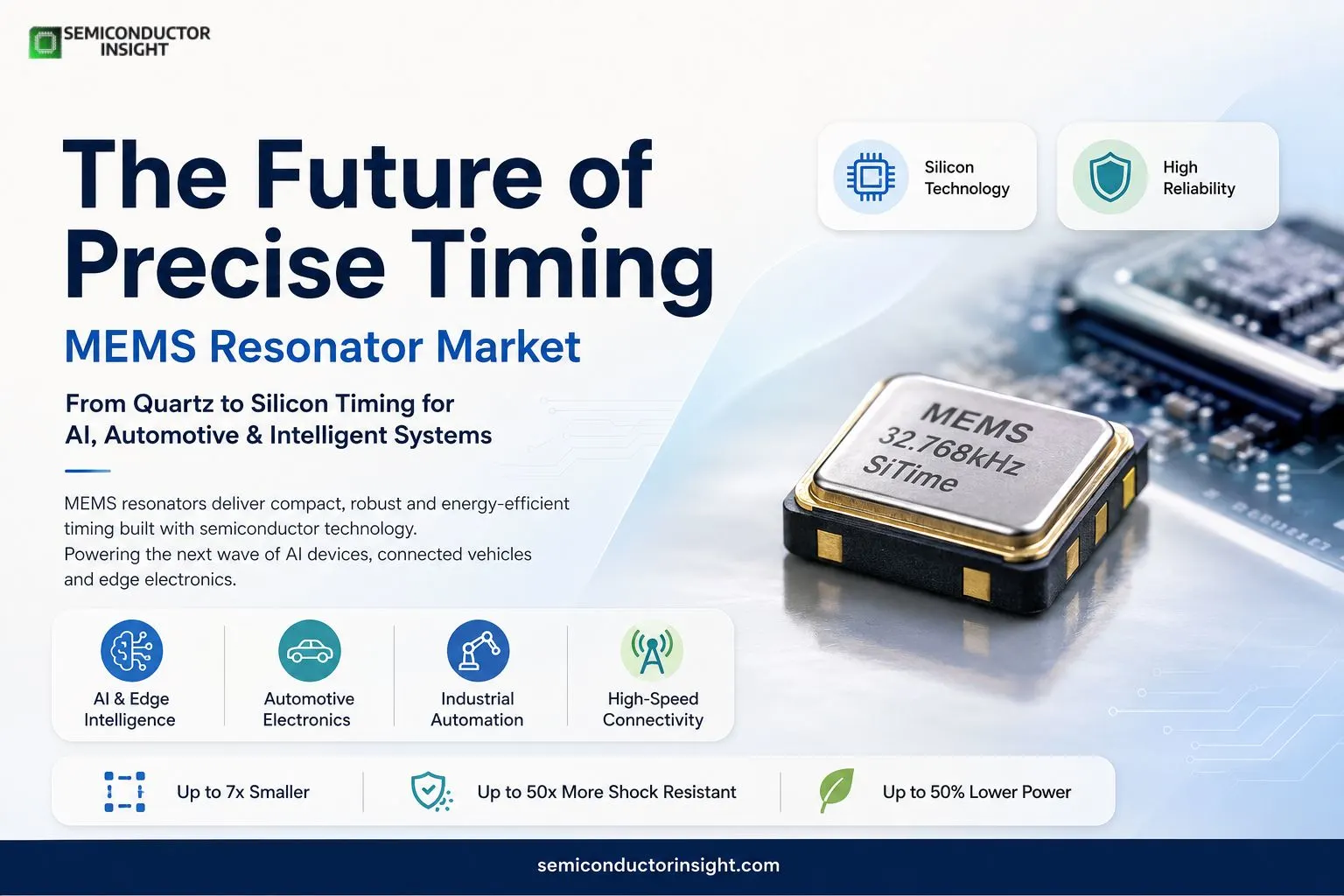
- According to recent technical information from SiTime, modern MEMS resonator platforms can deliver up to 50 times greater shock resistance, three times faster start-up, and occupy footprints up to seven times smaller than comparable quartz-based timing components.
- These characteristics are particularly valuable for wearable electronics, industrial sensors, autonomous systems and edge AI hardware, where compact design and reliability directly influence overall device performance.
- Another important advantage lies in power efficiency. Timing devices may consume only a small portion of total system energy, but in battery-operated products every microwatt matters. Recent MEMS timing platforms have demonstrated up to 50% lower oscillator power consumption, helping extend operational life in portable electronics, wireless sensor nodes and Internet of Things devices.
Discover more report insights; just browse our latest free update here: https://semiconductorinsight.com/report/global-mems-active-resonator-market/
The New Language of Precision Electronics
MEMS resonators are increasingly influencing how semiconductor engineers approach system architecture rather than functioning merely as replacement timing components.
Silicon fabrication → Frequency generation → Signal synchronisation → Data processing → Wireless communication → intelligent system response
This design pathway highlights why timing accuracy has become inseparable from the performance of AI accelerators, automotive controllers, industrial robots and next-generation communication devices. As computing workloads become more distributed and interconnected, maintaining synchronised clock signals across multiple processing elements is becoming just as important as increasing processor speed itself.
Where MEMS Resonators Are Creating the Biggest Engineering Impact
The application landscape for MEMS resonators has broadened considerably over the past few years. While smartphones and consumer electronics continue to represent significant deployment areas, the strongest momentum is now coming from systems that demand continuous operation under changing environmental conditions. Electric vehicles, industrial automation, software-defined networking equipment and edge AI devices all rely on stable timing references to coordinate processing, communication and sensing functions.
Automotive electronics provide one of the clearest examples. Advanced driver-assistance systems (ADAS), radar modules, LiDAR controllers and vehicle domain controllers require timing components that remain accurate despite vibration, rapid temperature fluctuations and continuous operation. Silicon-based MEMS resonators are increasingly selected because they are designed to withstand mechanical stress while maintaining frequency stability throughout the vehicle’s operating life.
Industrial Internet of Things deployments are creating another layer of opportunity. Modern smart factories may incorporate tens of thousands of connected sensors within a single production network, each depending on reliable clock synchronisation for predictive maintenance, machine coordination and real-time analytics. As these networks continue to expand, compact timing devices are becoming fundamental building blocks rather than supporting components.
Technology Adoption Path
Research Laboratory
↓
Wafer-Level Fabrication
↓
MEMS Resonator Integration
↓
Electronic Module Assembly
↓
AI Edge Device
↓
Industrial and Automotive Deployment
This progression illustrates how MEMS resonator technology moves from semiconductor fabrication into high-value electronic systems that require long-term reliability.
Innovation Chain
Artificial Intelligence
→ High-Speed Connectivity
→ MEMS Timing Platforms
→ Reliable System Synchronisation
→ Intelligent Electronics
Rather than serving as an isolated component, the resonator becomes part of a tightly integrated semiconductor ecosystem.
A Shift from Supporting Component to Strategic Semiconductor Technology
- Timing has traditionally been viewed as an enabling function operating quietly in the background.
- That perception is changing as electronic systems become faster, smaller and increasingly interconnected.
- Whether supporting AI-enabled industrial robots, wearable medical electronics, autonomous vehicles or next-generation communication infrastructure, MEMS resonators are becoming essential to maintaining synchronised and dependable system performance.
Their combination of semiconductor-compatible manufacturing, compact dimensions, mechanical robustness and energy-efficient operation aligns closely with the priorities of modern chip design.
As innovation continues across advanced packaging, edge intelligence and connected electronics, MEMS resonators are steadily moving from a specialised timing solution to a strategic semiconductor technology that underpins the performance of tomorrow’s intelligent devices.

Comments (0)