
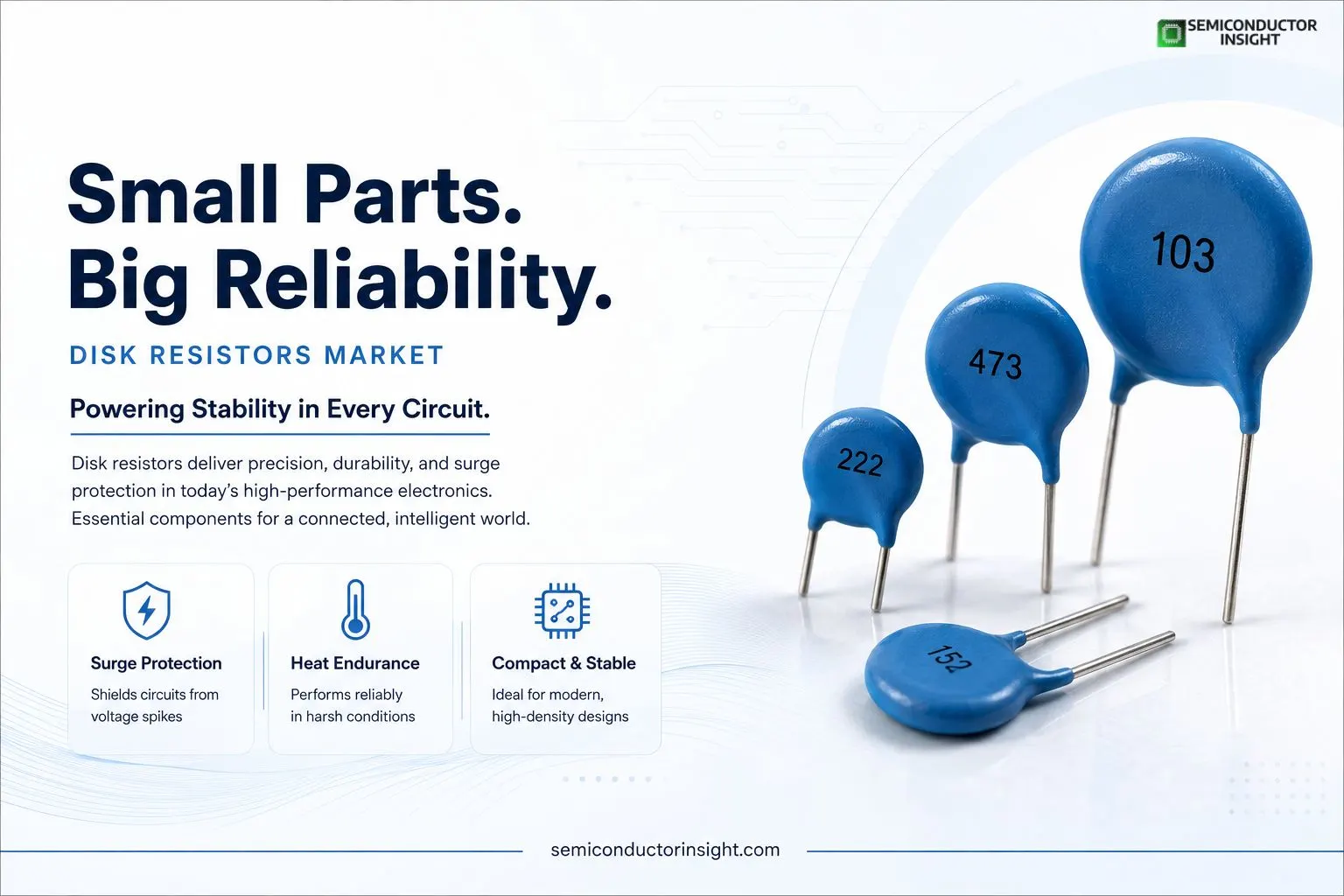
How Big Is Disk Resistors Market in 2026? Industry Insights and Manufacturing Statistics
Disk Resistors Market is experiencing renewed attention as electronic systems become smaller, faster, and capable of operating under increasingly demanding electrical conditions. While processors and semiconductor chips often dominate discussions about modern electronics, passive components such as disk resistors remain fundamental to circuit stability, voltage regulation, surge absorption, and current control. Their compact ceramic construction, thermal endurance, and consistent electrical characteristics make them indispensable across consumer electronics, industrial automation, automotive systems, telecommunications equipment, renewable energy installations, and medical electronics.
Semiconductor Trade Statistics (WSTS) reports that billions of printed circuit boards are built and well over one trillion semiconductor devices are shipped annually by the worldwide semiconductor industry. Disc resistors are among the fundamental building blocks of contemporary electronic design since every intricate electronic assembly uses dozens or even hundreds of passive components.
From Ceramic Materials to Precision Performance
- The performance of a disk resistor begins with advanced ceramic engineering.
- Manufacturers carefully combine ceramic substrates with conductive compounds before shaping, firing, coating, and electrically testing every component.
- Modern production facilities employ laser trimming and automated inspection systems to ensure resistance values remain within strict tolerances required for industrial and automotive applications.
- Many production lines now inspect tens of thousands of components every hour using machine vision systems capable of detecting microscopic surface defects before packaging.
- These automated quality systems help manufacturers maintain reliability in applications where component failure can interrupt critical electronic operations.
Manufacturing Journey
Ceramic Powder Selection
│
Material Blending
│
Disk Forming
│
High Temperature Sintering
│
Electrode Printing
│
Laser Calibration
│
Electrical Testing
│
Automated Packaging
│
Electronics Manufacturing
AI Servers and Electric Vehicles Are Expanding Component Requirements
The rapid expansion of artificial intelligence computing infrastructure has significantly increased demand for stable passive components capable of operating continuously inside high-density servers. Modern AI accelerator boards contain thousands of electronic components working together to manage power delivery, thermal regulation, and signal integrity.
At the same time, electric vehicles have become another important application area. According to the International Energy Agency (IEA), global electric car sales exceeded 17 million units in previous years, while battery manufacturing capacity continues expanding across Asia, Europe, and North America. Every electric vehicle integrates numerous electronic control units, battery management systems, onboard chargers, and power conversion modules that rely on high-quality resistive components for dependable operation.
Reliability Testing Is Becoming More Demanding Than Ever
Manufacturers no longer evaluate disk resistors solely by resistance values. Product qualification increasingly includes thermal shock testing, humidity resistance, vibration endurance, mechanical stress analysis, and long-duration electrical loading.
Industry laboratories routinely expose components to temperatures ranging from -55°C to above 155°C, depending on application standards. Automotive-grade components may undergo more than 1,000 hours of continuous reliability testing before approval for production vehicles. Such rigorous validation reflects the growing expectation for uninterrupted performance in mission-critical electronics.
To find out more, feel free to browse our latest updated report: https://semiconductorinsight.com/report/disk-resistors-market/
Performance Priorities
- Stable resistance during temperature fluctuations
- High insulation strength for long operational life
- Excellent pulse handling capability
- Compact geometry for dense PCB layouts
- Consistent electrical behavior under continuous load
Digital Manufacturing Is Reshaping Passive Component Production
Factories producing disk resistors are rapidly adopting Industry 4.0 technologies. Automated dispensing systems, robotic material handling, AI-powered optical inspection, and predictive maintenance software now operate alongside conventional manufacturing equipment.
Several leading electronics manufacturers have introduced digital production monitoring capable of tracking hundreds of process variables simultaneously, enabling faster defect detection and improved production consistency. Real-time process analytics also reduce material waste while supporting higher manufacturing throughput during periods of strong electronics demand.
Increasing adoption of industrial robots has further strengthened production efficiency. According to the International Federation of Robotics (IFR), more than 4 million industrial robots are now operating in factories worldwide, with electronics manufacturing representing one of the largest deployment sectors.
Where Disk Resistors Quietly Enable Everyday Technologies
- Although rarely visible to end users, disk resistors perform essential functions inside countless electronic products used every day.
- They help stabilize power supplies in networking equipment, regulate charging circuits in portable devices, protect industrial controllers from electrical disturbances, and improve signal conditioning in communication hardware.
Their application range now extends well beyond traditional electronics into smart meters, photovoltaic inverters, wind turbine controllers, railway signaling systems, healthcare diagnostic equipment, aerospace electronics, robotics, and advanced factory automation platforms. As electronic systems become increasingly connected through artificial intelligence, edge computing, and industrial digitalization, dependable passive components remain vital to ensuring consistent electrical performance throughout the global electronics ecosystem.

Comments (0)