
How Are Submersible Level Sensors Market Technologies Supporting Water and Chemical Control in Modern Fabs?
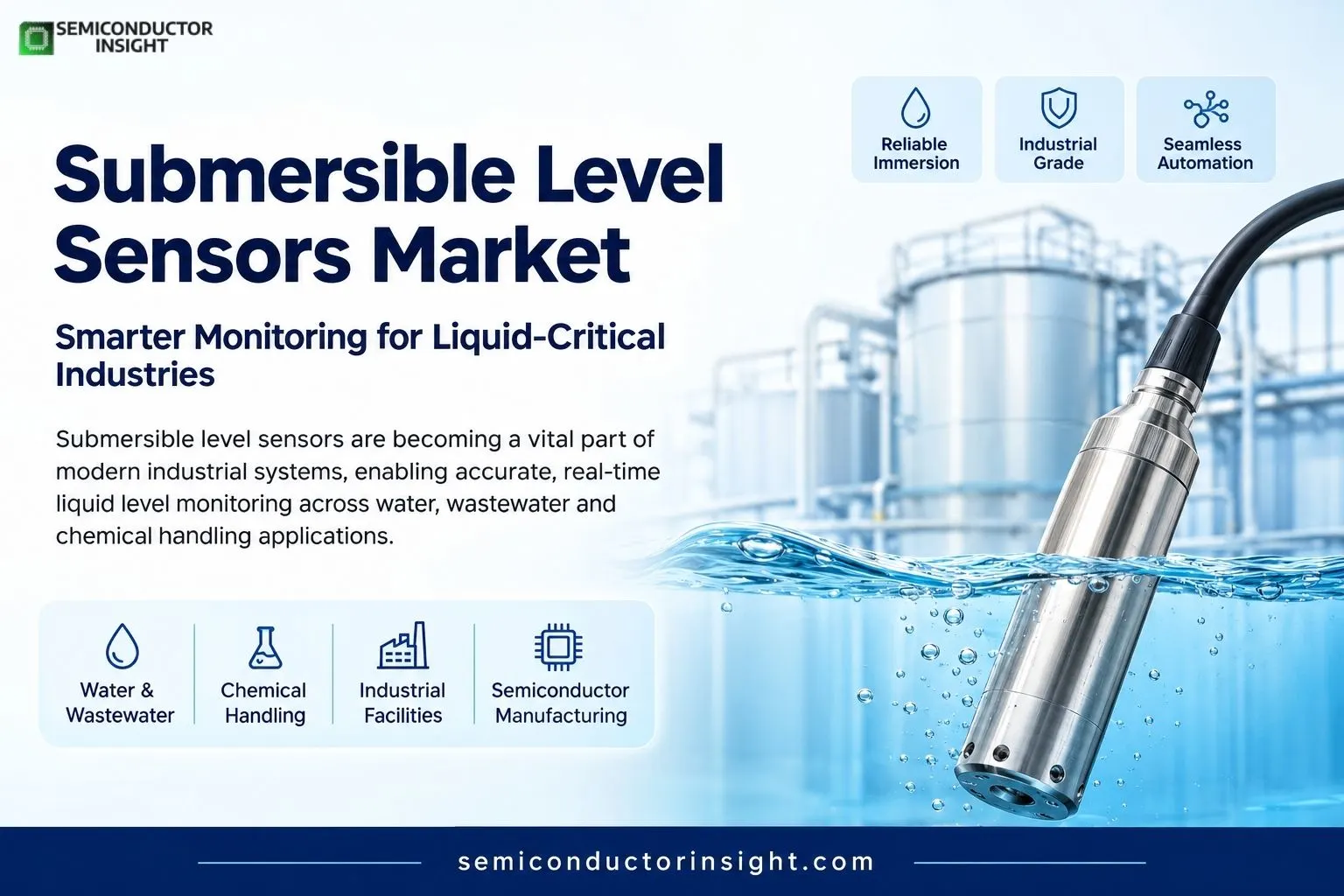
Submersible Level Sensors Market is gaining a more specialized role as factories become increasingly dependent on continuous liquid monitoring. A submersible sensor sits directly inside a tank, well, reservoir or other liquid environment and converts hydrostatic pressure into a level reading. In semiconductor manufacturing, that basic principle becomes considerably more important because water, wastewater and chemical-handling infrastructure must operate continuously and with tight process control.
Modern submersible instruments commonly combine a sealed pressure element, protective housing, vented cable and an industrial signal such as 4-20 mA. TE Connectivity, for example, offers submersible level platforms with 316L wetted materials, IP68 protection, 10-28 V supply and pressure accuracy down to ±0.25% FSO depending on configuration.
The sensor is small but the liquid system is enormous
- The scale of semiconductor water infrastructure explains why level measurement deserves attention.
- Intel’s Ocotillo campus environmental planning provides an example of the volumes involved: three advanced fabs at full build-out were modeled to draw approximately 14 million gallons of water per day, including around 4 million gallons of potable water and 10 million gallons of reclaimed water.
- That means a level sensor installed in one comparatively small tank can become part of a much larger chain involving water treatment, storage, process distribution, reclamation and discharge.
Water source → treatment → storage tank → process supply → collection → treatment/reclamation → reuse or discharge
- The sensor’s job is straightforward, but the information it supplies can influence pumps, alarms, refill cycles and automated control systems throughout this chain.
Why immersion changes the measurement equation?
A submersible level sensor is made to function when physically submerged, in contrast to instruments that are installed externally. The sensor can determine level from the pressure applied above its sensing diaphragm since hydrostatic pressure rises with liquid depth.
- OMEGA’s PXM78 series illustrates the engineering approach with a hermetically sealed stainless-steel housing, vented cable and 4-20 mA output.
- Its specifications include 10-40 VDC excitation, approximately 0.25% combined linearity, hysteresis and repeatability, and operating temperatures from -29°C to 93°C.
For semiconductor facilities, however, selecting a sensor is not simply about depth range. Wetted materials, chemical compatibility, sealing, electrical isolation and contamination considerations become equally important.
A 4-20 mA signal still matters in a digital fab
It is easy to assume that newer factories have moved entirely toward wireless or highly digital sensing. In practice, the familiar 4-20 mA interface remains important because it integrates readily with industrial control architectures.
TE Connectivity’s current submersible portfolio includes both 1-5 V and 4-20 mA configurations, while it’s intrinsically safe AST4500/4510 series supports pressure ranges extending from 1 psi to 208 psi, depending on model. The products are also available with ATEX and IECEx certification for applicable installations.
Pressure diaphragm → electrical conversion → 4-20 mA signal → PLC/SCADA → pump or valve control → alarm and process response
The simplicity of this chain is one reason pressure-based level measurement remains relevant alongside newer sensing technologies.
You Can Freely Surf Our Latest Updated Report Here: https://semiconductorinsight.com/report/submersible-level-sensors-market/
Semiconductor water systems are becoming more circular
- The latest fab infrastructure is not simply about consuming water and sending it away.
- Semiconductor facilities increasingly separate water streams, treat wastewater and recover water for lower-criticality applications.
- Industry reporting on fab water systems describes interconnected loops involving ultrapure-water production, segregated wastewater, polishing and reuse before eventual cooling, scrubbing or discharge.
- That creates several measurement points where dependable level information can matter, including reclaimed-water tanks, collection vessels, treatment stages and wastewater infrastructure.
- The opportunity is therefore broader than the cleanroom itself. Much of the potential application sits in the support infrastructure surrounding wafer processing.
Current product specifications show where the market is moving
The technical direction can be seen in commercially available sensor configurations. TE’s flush submersible AST4520, for instance, offers IP68 protection, 316L construction, 4-20 mA output and operating temperatures from -40°C to 80°C, with configurable pressure ranges reaching 208 psi.
These specifications point toward a market where reliability, immersion protection and compatibility with industrial automation are becoming as important as the measurement principle itself.
The next opportunity sits between sensors and infrastructure
Submersible Level Sensors Market is consequently becoming less about a standalone instrument and more about the information layer supporting liquid-intensive industrial facilities. Semiconductor manufacturing provides an especially interesting application because enormous water flows, reclamation systems and chemical-handling operations all require dependable monitoring.
As new fabs increase water-treatment capacity and push more systems toward automated operation, submersible sensors can serve as one of the quiet measurement technologies keeping those infrastructure loops stable. The technology may look simple a pressure sensor placed below the liquid surface but its role becomes much larger when that reading is connected to pumps, treatment systems, alarms and the continuous operation of a semiconductor facility.

Comments (0)