

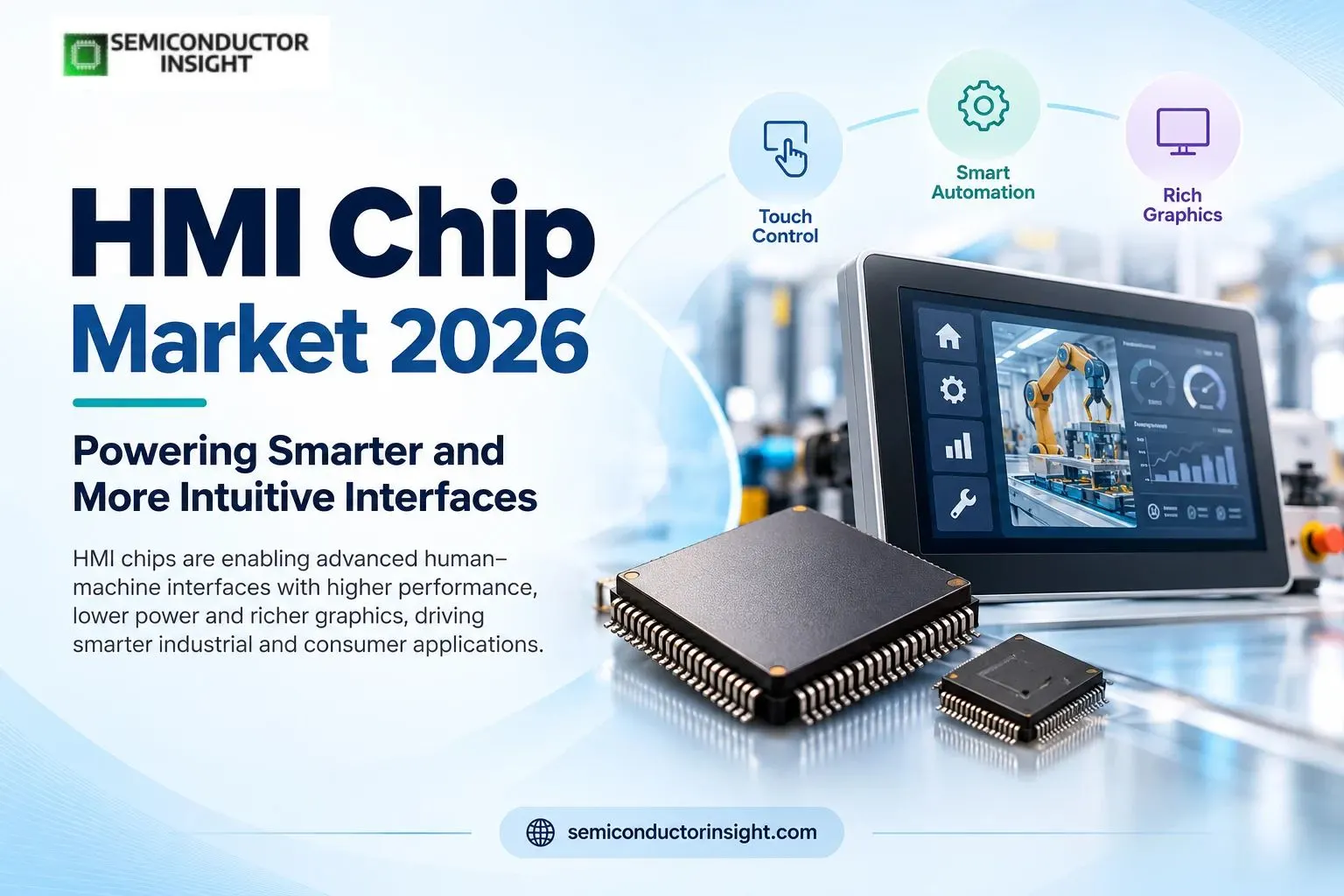
HMI Chip Market 2026: Up to 6 CPU Cores, Multi-Display Graphics, and AI Processing Move into the Vehicle Cabin
The automotive interface is no longer just a dashboard with buttons and a touchscreen. Voice commands, digital instrument clusters, passenger displays, cameras, gesture recognition, driver monitoring and personalized digital assistants are becoming part of the same cabin experience. Behind these functions sits a new generation of semiconductor architecture.
HMI Chip Market is consequently moving from relatively simple display and input processing toward application processors and system-on-chips capable of handling graphics, AI, connectivity, sensing and safety functions simultaneously.
The Cockpit Is Becoming a Computing Zone
Modern HMI architecture increasingly resembles a compact edge-computing system.
Sensors → HMI processor → AI inference → Graphics engine → Display / audio / vehicle response
This change is particularly visible in software-defined vehicles, where functionality can increasingly be modified through software rather than being permanently tied to individual hardware controls.
Renesas describes its R-Car family as supporting in-vehicle infotainment, peer-to-peer displays, AI assistants, automated-driving functions and cross-domain solutions combining ADAS and infotainment. The platform is also designed around automotive functional-safety requirements up to ASIL-D.
Six Cores Can Now Sit Behind the Interface
- The processor architecture itself illustrates how far HMI silicon has evolved.
- NXP’s i.MX 95 family can incorporate up to six Arm Cortex-A55 application cores alongside separate real-time safety processing. It also combines graphics, vision processing, connectivity and an integrated neural-processing unit.
- That means one semiconductor platform can potentially coordinate several workloads that previously required more fragmented hardware.
- The important shift is not simply higher computing performance. It is the ability to combine multiple functions while meeting automotive reliability, security and real-time requirements.
AI Is Moving Into the Passenger Cabin
AI is becoming one of the most important new ingredients in HMI design.
In October 2025, NXP introduced the i.MX 952 processor specifically for AI-powered vision, HMI and in-cabin sensing. Its integrated NPU is designed to support applications including driver monitoring and child-presence detection while combining sensor inputs at the edge.
This changes the meaning of an HMI chip. Instead of simply interpreting a touchscreen command, the processor can increasingly understand information from cameras, microphones and other sensors before presenting an appropriate response.
Qualcomm Is Pushing the Cockpit toward Multimodal Interaction
Qualcomm’s Snapdragon Cockpit Elite provides another indication of where premium HMI architectures are heading.
- The platform combines Qualcomm Oryon CPU technology with an Adreno GPU and an NPU architecture intended for AI-enabled automotive experiences.
- Qualcomm states that the platform is designed to support more than 40 multimodal sensors and up to 16 high-resolution displays.
- That is a significant architectural departure from the traditional single-screen infotainment concept.
A vehicle can instead become a distributed visual environment where the driver, front passenger and rear passengers interact with different digital surfaces.
You can freely browse our most recent updated report to learn more about it before scrolling further: https://semiconductorinsight.com/report/hmi-chip-market/
Displays Are Only One Part of the HMI Equation
The HMI chip is increasingly connected to components that were previously treated separately.
Renesas’ automotive cockpit reference architecture combines an R-Car SoC with power-management, clock-generation, display and haptic technologies. The system is designed to support high image quality and multiple video outputs.
This illustrates an important development: HMI performance depends on the complete semiconductor ecosystem rather than the processor alone.
Memory bandwidth, display interfaces, PMICs, graphics acceleration, camera inputs and haptic controllers can all influence the responsiveness of the final user experience.
Safety Is Becoming Part of the User Interface
Automotive HMI cannot be treated like smartphone electronics.
A vehicle interface may display warnings, provide camera views, deliver driver alerts or interact with systems connected to safety functions. That places functional safety and cybersecurity much closer to everyday user interaction.
NXP’s i.MX 95 supports ISO 26262 ASIL-B and IEC 61508 SIL 2 capabilities, while its security architecture includes an EdgeLock Secure Enclave.
The result is a new design priority: the best HMI chip must combine responsiveness and graphics performance with predictable, secure operation.
From Buttons to Context-Aware Interaction
- The next major change is contextual interaction.
- Instead of requiring a driver to navigate several menus, AI-enabled HMI systems can combine voice, visual information, vehicle status and sensor data to determine what information should be presented.
- NXP’s current HMI work specifically connects evolving in-cabin interfaces with driver monitoring, safety and more context-aware interaction.
- This is where semiconductor capability becomes visible to the consumer. Faster inference, better graphics and sensor processing ultimately appear as simpler interactions inside the cabin.
The HMI Chip Is Becoming the Cabin’s Digital Coordinator
The transformation can be summarized simply:
Display controller → Graphics processor → Automotive SoC → AI-enabled cockpit computer
That progression explains why HMI chips are attracting attention across the semiconductor ecosystem. Vehicle interfaces are becoming richer, but the underlying requirement is becoming more demanding as well: multiple displays, cameras, sensors, connectivity, graphics, AI and safety functions must operate together.
In 2026, the HMI chip is therefore no longer just the silicon behind a touchscreen. It is increasingly becoming one of the computing foundations of the software-defined vehicle, connecting the human experience inside the cabin with the intelligence of the vehicle itself.

Comments (0)