
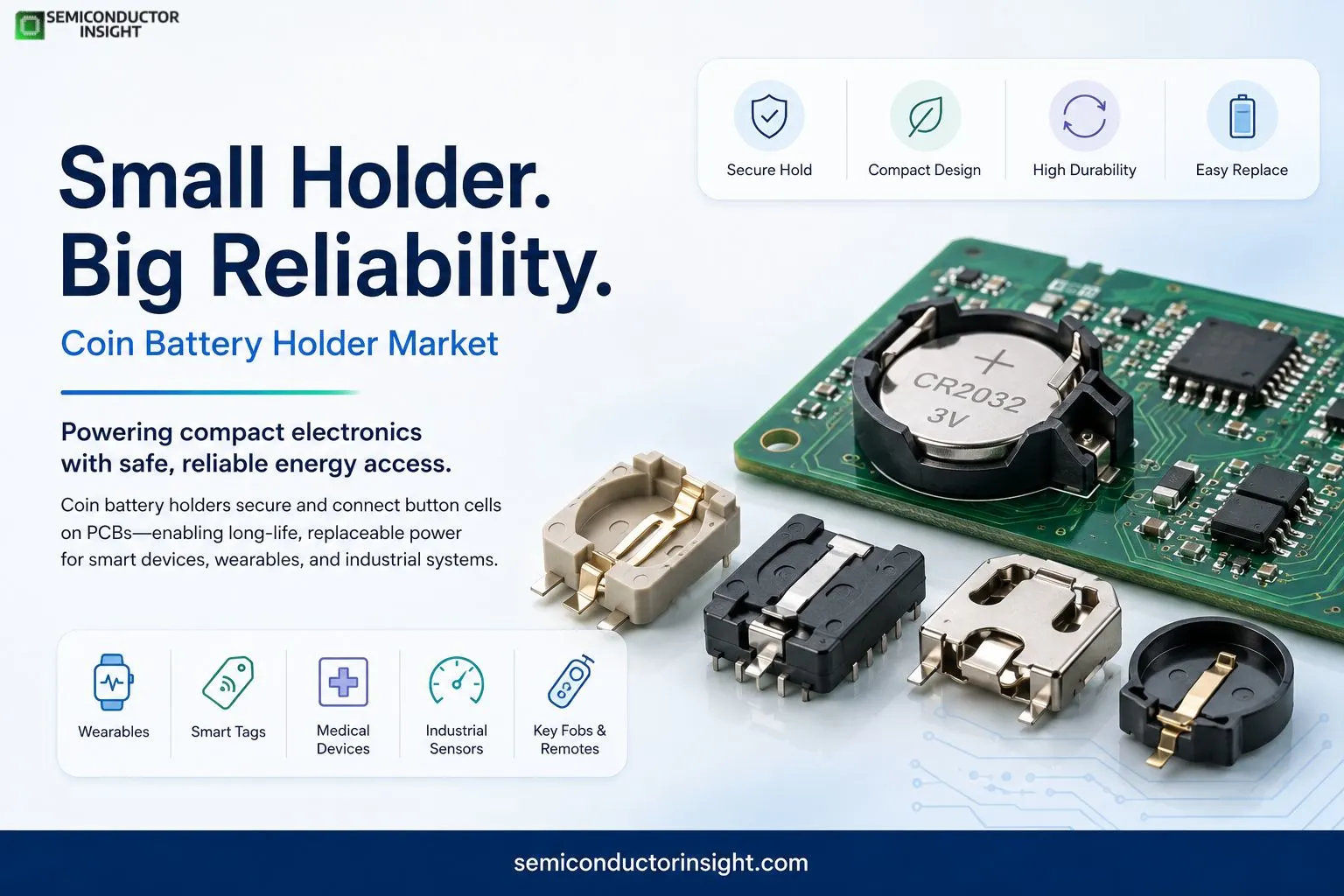
High-Reliability Coin Battery Holder Market 2026 USD 1.3B Backing Medical and Industrial Semiconductor Boards
Coin battery holders are mechanical electrical components that secure coin or button cells on printed circuit boards while maintaining reliable contact and serviceability over thousands of insertion cycles. They bridge electrochemical energy sources and semiconductor circuitry in devices that must remain ultra compact yet still allow field replacement of batteries.
Standard holders support popular diameters such as 12 mm, 16 mm, 20 mm, 23 mm, 24 mm, and 30 mm, covering mainstream chemistries like CR2032 widely used in consumer and industrial electronics. Their footprint planning directly affects PCB routing density, EMI behavior, and enclosure thickness in semiconductor-based designs such as remote controls, smart tags, and metering modules.
For More Detailed Insights, You Can Surf Our Latest Report Here: https://semiconductorinsight.com/report/coin-battery-holder-market/
Where coin battery holders matter most today
Coin battery holders are present across applications where long shelf life and low quiescent current dominate over high energy throughput. Typical uses include wearables, medical patches, smart cards, sensors, PC motherboard RTC sections, and key fobs, all of which rely on low-power semiconductor logic and mixed-signal ICs.
In many mass-market products, a single coin cell combined with optimized microcontroller sleep modes can support three to five years of operation, making mechanical reliability of the holder as important as the semiconductor architecture. A simple example is a smart thermostat sensor node using one coin cell, a radio SoC, and a PCB-mount holder rated for more than 100 removal cycles during its deployed life.
Market scale and technical diversity
- Battery holders as a broader category were valued at roughly USD 1.24 billion in past years, and coin cell formats account for a significant share because they are the default choice in thin, space constrained designs.
- As compact consumer and industrial electronics ship in tens of millions of units per year globally, coin battery holders map almost linearly to device volumes in wearables, smart tags, and embedded sensor boards.
- Vendors supply both thru-hole and surface-mount variants, allowing integration into double-sided and high-density boards with automated assembly.
- For example, families of holders cover at least six major diameter classes and are offered in multiple contact materials and plating options to match distinct reliability and cost targets within the semiconductor supply chain.
Design shifts in 2026 layouts
In 2026, more designs migrate from thru-hole coin battery holders to low-profile surface-mount versions to minimize assembly steps and support automated reflow lines. This shift aligns with broader semiconductor manufacturing trends that favor single-pass SMT assembly for RF modules, sensor boards, and wearable PCBs.
Compact holders that allow vertical or horizontal cell orientation are increasingly used to balance antenna placement, mechanical stiffness, and user access within small housings. As device thickness targets fall below 8 10 mm in many consumer products, millimeter-level changes in holder height and retention design become critical to industrial design and enclosure engineering.
Safety regulations and child protection focus
Recent regulatory attention on coin cell ingestion incidents has forced brands to reassess how holders contribute to overall product safety, particularly in toys and household electronics. Designs now emphasize positive locking mechanisms, screw-secured battery compartments, and tamper resistant geometries to prevent easy removal by children while still supporting maintenance by adults.
Compliance with regional safety standards translates into tighter tolerances on insertion force, contact spring design, and markings on PCBs that host coin battery holders. In practice, that means engineering teams must consider holder geometry as part of the regulatory certification strategy alongside semiconductor ESD performance and enclosure materials.
Manufacturing and customization pathways
- Coin battery holders are produced using stamped metal parts, high temperature plastics, and precision forming processes that must stay compatible with reflow profiles used for semiconductor components. Manufacturers offer customization options such as different retention clips, polarity markings, and offset leads to accommodate unique board layouts and branding requirements.
- Open source hardware projects and tutorials demonstrate that even small teams can design bespoke coin cell holder PCBs, integrate them with LED or sensor circuits, and send them for low-volume fabrication. This democratization at the prototyping level often precedes larger commercial runs, where the same mechanical concepts scale into thousands of units on standard SMT lines.
Integration outlook across connected devices
As more everyday objects embed sensors, radios, and microcontrollers, coin battery holders remain a practical choice for nodes that require replaceable power but do not justify larger pack formats. They enable cost-effective energy access in segments like smart home accessories, asset tracking tags, and retail beacons, where devices need multi-year operation from single cells.
The ongoing push toward miniaturization and low-power silicon suggests steady incremental growth for coin battery holders, particularly in designs shipping in tens of thousands to millions of units annually. At the same time, regulatory pressure and evolving user expectations will keep driving innovations in retention mechanisms, materials, and assembly practices around these seemingly simple but critical components in the semiconductor hardware stack.

Comments (0)