

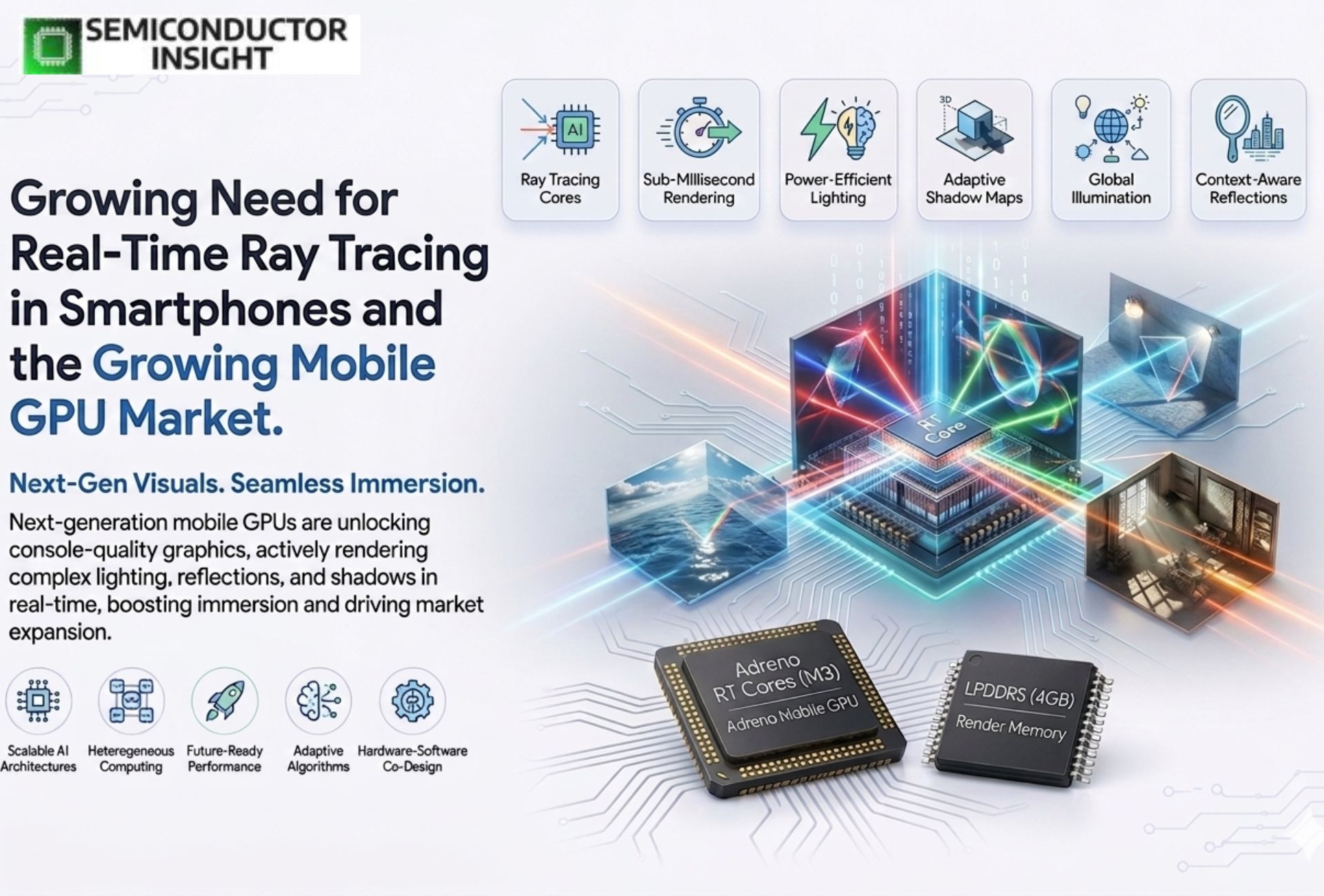
The Growing Need for Real-Time Ray Tracing in Smartphones and the Growing Mobile GPU Market
Mobile GPU market has evolved far beyond mobile gaming performance. Graphics processors inside smartphones are now supporting artificial intelligence tasks, computational photography, augmented reality, video rendering, and advanced display management. Technologies such as Qualcomm Adreno, Arm Mali, and Apple GPU architectures are becoming central to how modern mobile devices process visual data and deliver real-time computing experiences.
In 2025 and 2026, smartphone manufacturers are increasingly promoting GPU capabilities alongside CPU performance during flagship launches. Mobile graphics processors are now responsible for enabling high refresh rate displays, AI-enhanced imaging, low-latency gaming, and energy-efficient multitasking across premium smartphones and tablets.
Apple’s latest A-series chipsets, Qualcomm Snapdragon platforms, and MediaTek Dimensity processors are all placing stronger emphasis on integrated graphics capabilities. This shift reflects growing demand for devices capable of handling console-quality rendering and AI-assisted workloads without relying heavily on cloud processing.
Want to learn more about the report? Check out our latest updated version for free: https://semiconductorinsight.com/report/mobile-gpu-adreno-mali-apple-gpu-market/
AI Smartphones Are Expanding the Role of Mobile GPUs
One of the strongest trends shaping the mobile GPU market is the rise of AI-focused smartphones. Generative AI features such as on-device image creation, live translation, voice assistants, and intelligent photo editing require significant parallel computing performance. Mobile GPUs are increasingly supporting these AI operations alongside dedicated neural processing units.
According to Qualcomm technical presentations and developer documentation, newer Snapdragon chipsets are designed to distribute AI tasks across CPU, GPU, and NPU components to improve efficiency and reduce latency. Apple has also expanded GPU-assisted machine learning optimization within iPhones, particularly for imaging and video processing workflows.
Samsung’s Galaxy AI rollout and Google’s AI-driven Pixel ecosystem have further accelerated interest in mobile graphics acceleration. As smartphone companies compete on-device intelligence capabilities, GPU architectures are becoming more important for balancing visual performance and battery efficiency.
Mobile Gaming Hardware Is Entering a New Performance Cycle
- The mobile gaming ecosystem continues to influence semiconductor innovation across the mobile GPU market.
- Titles such as PUBG Mobile, Genshin Impact, Call of Duty Mobile, and Honkai Star Rail require increasingly advanced rendering capabilities to support high frame rates and complex graphics environments.
- According to data published by Newzoo and Sensor Tower gaming reports, global mobile gaming revenues exceeded USD 90 billion in recent years, with billions of mobile game downloads recorded annually across iOS and Android ecosystems.
- This scale is forcing chipset developers to optimize thermal management, frame stability, and power efficiency for prolonged gaming sessions.
- Qualcomm’s Adreno GPUs have become closely associated with gaming-centric Android devices, while Apple GPUs continue to demonstrate strong graphics benchmark performance within premium iPhones and iPads.
- Arm Mali architectures also remain widely deployed across smartphones powered by MediaTek and Samsung Exynos chipsets.
Ray Tracing Is Moving From Consoles to Smartphones
Real-time ray tracing, once limited primarily to gaming PCs and consoles, is now entering the smartphone semiconductor landscape. Mobile GPU developers are introducing hardware-level ray tracing support to improve reflections, lighting accuracy, and immersive rendering quality.
Samsung and Qualcomm demonstrated ray tracing-enabled mobile experiences during recent chipset launches, while Apple integrated advanced graphics rendering capabilities into its latest mobile silicon platforms. These developments indicate that smartphone graphics are increasingly moving closer to console-grade visual environments.
Although mobile thermal limitations still restrict extended high-end rendering, semiconductor engineers continue improving efficiency through smaller process nodes and adaptive graphics scaling technologies.
Smaller Chip Architectures Are Delivering Bigger Graphics Gains
The transition toward advanced semiconductor fabrication processes is helping mobile GPU performance improve significantly without proportional increases in power consumption. TSMC and Samsung Foundry continue manufacturing mobile chipsets using increasingly smaller nanometre technologies that allow higher transistor density and better thermal efficiency.
Apple’s advanced silicon integration strategy has demonstrated how tightly optimized hardware and software ecosystems can enhance GPU performance while maintaining battery longevity. Qualcomm and MediaTek are similarly investing in graphics optimization to support demanding workloads across Android ecosystems.
Modern flagship smartphone chipsets now contain tens of billions of transistors. Apple reported over 19 billion transistors in earlier A-series chips, while newer semiconductor designs continue pushing integration density even further.
Mobile GPUs Are Quietly Transforming Smartphone Cameras
- One of the less discussed developments in the mobile GPU market is the growing role of graphics processors in smartphone photography and video processing. GPUs increasingly support image segmentation, HDR rendering, portrait effects, cinematic video stabilization, and computational enhancement workflows.
- Modern smartphones process billions of image operations during photography sessions. AI-assisted image rendering pipelines now depend heavily on GPU acceleration to deliver real-time adjustments before users even capture a photo.
- This evolution has become especially visible in flagship smartphone launches where camera quality is directly linked to semiconductor processing capability rather than only lens hardware.
Why the Semiconductor Industry Is Watching Mobile GPU Development Closely?
Mobile GPUs are no longer secondary smartphone components. They are becoming central computing engines for AI processing, gaming, immersive media, and visual intelligence. Semiconductor companies are investing heavily in graphics architecture because smartphones are evolving into compact high-performance computing platforms.
As foldable devices, mixed reality applications, and AI-assisted mobile experiences continue expanding globally, the mobile GPU market is expected to remain one of the most strategically important segments within the semiconductor industry.

Comments (0)