
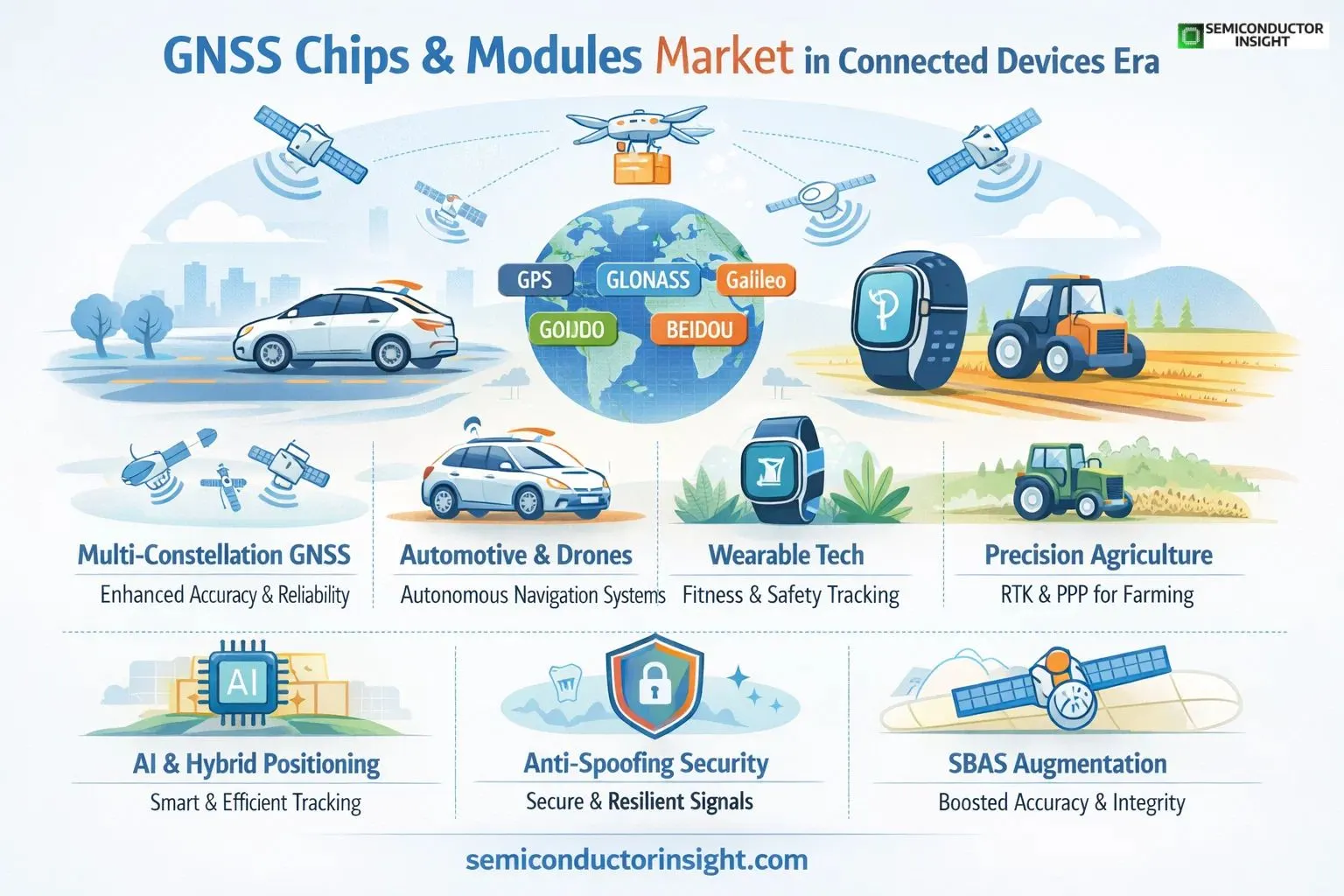
GNSS Chips and Modules Market in Connected Devices Era
GNSS chips and modules market is no longer limited to navigation in cars or mobile phones. With the acceleration of connected ecosystems from autonomous vehicles to drones and wearable these location processors are central to precision, reliability, and real-time decisioning in complex environments.
As semiconductor innovation pushes boundaries, GNSS (Global Navigation Satellite System) capabilities have expanded beyond GPS to include multi-constellation support, integrated signal processing, and hybrid positioning.
Why GNSS Chips Are No Longer Just GPS?
Consumer awareness of location services has evolved to expect pinpoint accuracy, faster time-to-first-fix (TTFF), and robust performance in urban canyons or indoors. Traditional GPS has given way to multi-constellation GNSS processing simultaneously leveraging signals from GPS (USA), GLONASS (Russia), Galileo (EU), and BeiDou (China).
This shift matters most in dense urban environments. For example, in IEEE Communications Magazine, engineers highlighted that multi-constellation GNSS chips reduce positioning errors by up to 50% in metropolitan canyons compared to single-system solutions. This is achieved through enhanced redundancy, improved satellite geometry, and advanced signal filtering techniques.
Semiconductor Design Innovation: Advanced Architecture
Chipmakers are innovating at the silicon level to integrate GNSS receivers with system-on-chip (SoC) designs that handle signal acquisition, interference mitigation, and assisted positioning. Companies like Qualcomm and MediaTek have embedded these capabilities into flagship mobile SoCs, offering hybrid positioning that fuses satellite data with cellular and Wi-Fi signals.
A 2025 EE Times article explored how the integration of GNSS with AI accelerators on SoCs enhances low-power location tracking for wearable devices. This combination enables continuous tracking without significantly draining battery an important breakthrough for fitness wearables and safety devices.
Automotive and Self Driving Systems Commercial Integration
- Perhaps the most transformative segment for GNSS chips is automotive and autonomous mobility. Here, GNSS modules are paired with inertial measurement units (IMUs), LIDAR, and computer vision to create robust vehicle positioning systems.
- Tesla’s Autopilot and Full Self-Driving (FSD) frameworks, for instance, rely on a fusion of GNSS and sensor suites as reported by Automotive Tech Review to support lane-level accuracy, even in weak signal areas. While the company continues to refine its architectures, the example illustrates a broader industry transition from standalone GPS to sensor-fused localization.
- Likewise, Continental and Bosch have detailed prototypes of GNSS + IMU modules designed to maintain location accuracy in tunnels or under dense foliage scenarios that would previously cause navigation drift.
Drones, Robots, and Precision Agriculture
Unmanned systems represent another growth vector. In agriculture, GNSS modules with real-time kinematic (RTK) and precise point positioning (PPP) technologies are enabling centimeter-level accuracy for planting, spraying, and harvesting. A feature in Precision Ag Today showed that RTK-enabled tractors reduced overlap in field coverage by 20%, optimizing resource usage and crop yield.
Similarly, drone delivery initiatives in logistics and urban air mobility are leveraging advanced GNSS modules for geofencing and corridor navigation. Tech journals, including Drone Industry Insights, have covered case studies where hybrid GNSS + visual-inertial navigation systems sustain accuracy during GPS outages.
Please Take a Look at Our Updated Report before Continuing: https://semiconductorinsight.com/report/global-gnss-chips-and-modules-market/
Wearable and Consumer Electronics Adoption
The wearable market from fitness bands to smart glasses pushes designers to optimize GNSS chips for power efficiency and size without sacrificing performance. A Mobile World Live review compared recent smart watches and found that those using multi-band GNSS chips consistently delivered route tracking accuracy within 3 meters a stark improvement over earlier generations.
This differentiation not only enhances fitness tracking but also supports safety features like fall detection alerts with accurate location tagging an emerging expectation among consumers.
Satellite Augmentation and Resilience
GNSS performance does not solely depend on satellite reception; it also benefits from augmentation systems like SBAS (Satellite-Based Augmentation Systems) and ground networks that improve accuracy, integrity, and availability.
Articles in GPS World underscore how systems like WAAS (US), EGNOS (EU), and QZSS (Japan) enhance civilian positioning especially for safety-critical applications like aviation, marine navigation, and autonomous logistics. Integrating SBAS correction data directly into GNSS modules is a competitive differentiator for chip designers looking to support regulated domains.
Security, Interference, and Anti-Spoofing Measures
As GNSS usage expands into mission-critical systems, security has emerged as a core concern. Spoofing and interference can compromise positioning, with potential safety consequences in transport and infrastructure.
A recent Signal Processing Magazine study highlighted chip-level anti-spoofing algorithms that detect and reject anomalous signal patterns a leap forward from traditional firmware-only defences. Companies developing hardened GNSS modules now emphasize layered security from antenna design to software-defined receivers.
GNSS chips and modules market is a vibrant segment of the semiconductor ecosystem with innovation driven by multi-constellation support, integration with sensor fusion, AI-enabled processors, and resilient design against interference.

Comments (0)