
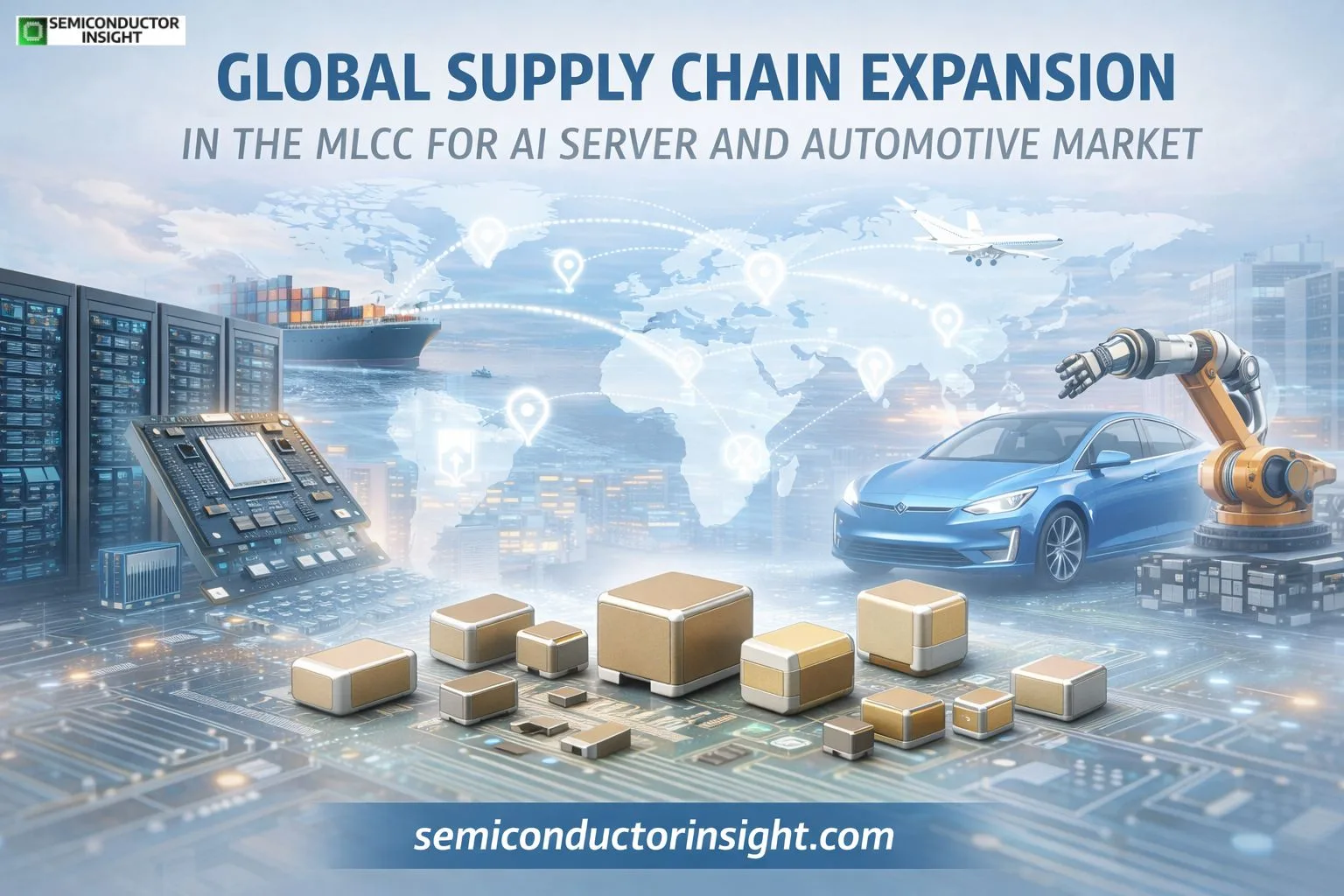
Global Supply Chain Expansion in the MLCC for AI Server and Automotive Market
In the evolving semiconductor ecosystem, multilayer ceramic capacitors (MLCCs) have quietly become one of the most critical electronic components enabling advanced computing and intelligent mobility. These compact passive components regulate voltage, filter electrical noise, and stabilize power delivery across highly sophisticated electronic systems.
With the global surge in artificial intelligence computing infrastructure and the rapid electrification of vehicles, demand for MLCCs is expanding significantly. AI servers deployed in hyperscale data centers require thousands of MLCC units to maintain stable energy flow across processors, GPUs, and high-speed memory systems. Similarly, modern electric and autonomous vehicles integrate thousands of capacitors across electronic control units, infotainment systems, sensors, and battery management technologies.
As digital infrastructure and smart mobility converge, the MLCC for AI Server and Automotive Market is becoming a crucial segment within the broader semiconductor supply chain.
AI Data Centers Increasing Component Density in Server Architectures
- The rapid expansion of artificial intelligence applications is transforming the design of modern data centers. AI servers equipped with advanced GPUs and accelerators require extremely stable power distribution networks to manage high computational loads.
- To ensure reliable system performance, manufacturers integrate large volumes of MLCCs into server motherboards and processor modules. These components stabilize power fluctuations, prevent signal interference, and maintain system reliability during intensive workloads.
- Major technology companies such as NVIDIA, Intel, and AMD are driving the deployment of AI-focused servers that require significantly higher electronic component density compared to traditional computing infrastructure. As a result, semiconductor component suppliers are expanding MLCC production capabilities to support the explosive growth of AI computing platforms.
- The growing reliance on AI infrastructure and high-performance computing is therefore creating a strong foundation for long-term MLCC demand.
To Stay Tuned with More meaningful and In-Depth Insights, Do Visit here: https://semiconductorinsight.com/report/mlcc-for-ai-server-and-automotive-market/
Automotive Electronics Evolution Expanding MLCC Requirements
The automotive industry is rapidly transitioning toward electrified and software-defined vehicles. Advanced driver assistance systems, electric powertrains, vehicle connectivity platforms, and autonomous driving technologies are significantly increasing the number of electronic components within vehicles.
A conventional internal combustion vehicle may contain a few thousand MLCC units, while modern electric vehicles can incorporate more than 10,000 capacitors across different electronic systems. These capacitors are essential for stabilizing voltage levels in battery management systems, power converters, and advanced sensing technologies.
Automotive leaders including Tesla, Toyota, Hyundai, and Volkswagen are integrating advanced electronic architectures to support electric mobility and automated driving capabilities. This shift toward electronics-intensive vehicle platforms is strengthening the demand for high-reliability MLCC components designed specifically for automotive environments.
Global Semiconductor Supply Chains and Component Trade Dynamics
- The MLCC industry is deeply integrated into the global semiconductor supply chain. Major manufacturing hubs are concentrated in East Asia, particularly in Japan, South Korea, Taiwan, and China, where leading electronic component manufacturers operate large-scale production facilities.
- Japan continues to play a dominant role in the high-end MLCC segment due to the presence of advanced manufacturing technologies and established component suppliers. Companies such as Murata Manufacturing, TDK Corporation, and Taiyo Yuden are globally recognized for producing high-performance MLCCs used in automotive electronics and advanced computing hardware.
- Meanwhile, countries including China and South Korea are expanding production capacities to strengthen domestic semiconductor supply chains and reduce dependence on imported electronic components.
- The global import-export network for MLCC components reflects the interconnected nature of the electronics industry. Semiconductor manufacturers ship MLCC units across multiple continents where they are integrated into server hardware, automotive electronics, consumer devices, and industrial systems.
- Such government-driven policies are expected to reinforce the growth of the semiconductor ecosystem and expand the production capacity of electronic components including MLCCs.
Technology Advancements Shaping Next Generation MLCC Designs
Continuous innovation in materials engineering and semiconductor packaging technologies is enabling the development of smaller yet more powerful MLCC components. Manufacturers are focusing on increasing capacitance density while reducing component size to support compact electronics designs.
Advanced MLCC designs are now capable of handling higher voltages and operating efficiently within high-temperature environments such as electric vehicle powertrains and AI server processors.
Emerging technologies including silicon carbide power electronics, autonomous vehicle sensors, and AI accelerators will require increasingly sophisticated passive components to maintain stable electrical performance.

Comments (0)