
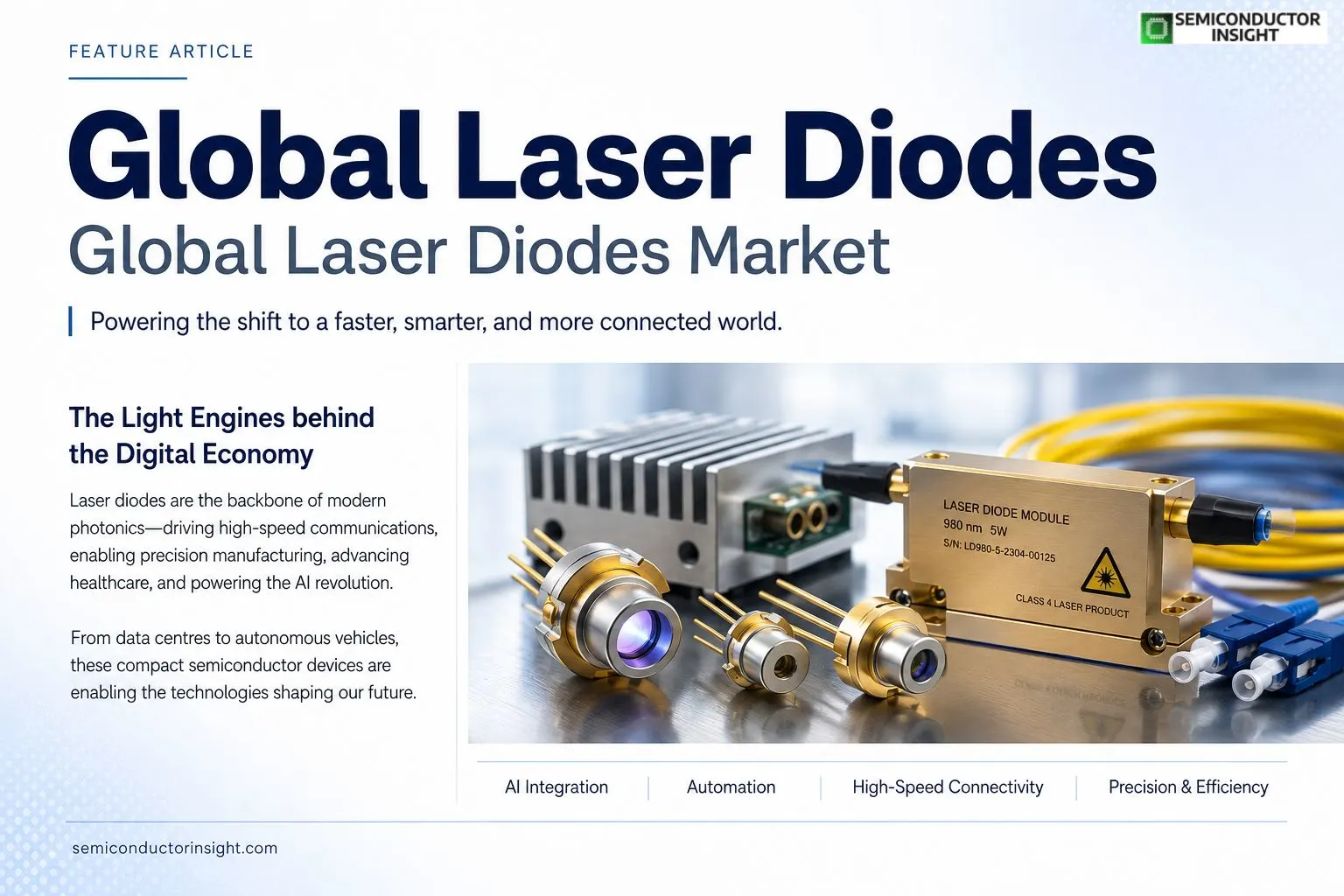
Global Laser Diodes Market 2026: USD 4.45 billion to USD 9.12 billion at 7.1% CAGR
For decades, semiconductor innovation has largely been measured by processing power and transistor density. Today, however, another technology is rapidly gaining strategic importance across industries: laser diodes. These compact semiconductor devices have become indispensable components in communications, manufacturing, healthcare, mobility, and artificial intelligence infrastructure.
As global economies become increasingly dependent on high-speed data transmission, precision sensing, and automated systems, laser diodes are moving from specialised applications into mainstream technology ecosystems. Their ability to generate highly focused light with exceptional efficiency makes them one of the most influential building blocks of modern photonics.
The Light Engines behind the Digital Economy
ü Every second, billions of digital interactions rely on optical communication networks powered by semiconductor lasers. Laser diodes form the backbone of fibre-optic communication systems that carry internet traffic between cities, countries, and hyperscale data centres.
ü According to international telecommunications statistics, global internet users now exceed 5.5 billion people, while worldwide data traffic continues to reach record levels annually. To support this growth, cloud operators and network providers are investing heavily in optical interconnect technologies where laser diodes play a central role.
ü Recent expansions of AI-focused data centres have further increased demand for high-speed optical transceivers that depend on advanced laser diode technologies to move massive datasets efficiently.
AI Infrastructure Creates an Unexpected Growth Frontier
Artificial intelligence has emerged as one of the strongest demand catalysts for optical semiconductor technologies. Training large AI models requires enormous computational resources connected through ultra-fast communication networks.
Leading technology companies are constructing facilities containing tens of thousands of advanced GPUs, generating unprecedented requirements for optical networking equipment. Laser diodes enable the transmission of data between servers with lower latency and higher bandwidth than conventional electrical connections.
As AI clusters continue scaling, photonics is becoming increasingly important in maintaining system efficiency, positioning laser diodes as a crucial enabler of next-generation computing architectures.
Manufacturing Floors Turn to Precision Light
Industrial laser systems have evolved from niche equipment into essential production tools. Laser diodes are now widely integrated into cutting, welding, engraving, additive manufacturing, and quality inspection systems.
The International Federation of Robotics reports that global operational industrial robot installations exceed 4 million units. Many of these automated platforms utilise laser-based sensing and processing technologies to improve manufacturing accuracy.
Electric vehicle production offers a clear example. Modern battery assembly lines increasingly employ laser-based welding systems capable of producing highly consistent connections while minimising material waste and production defects.
Healthcare Devices Enter a New Optical Era
Medical technology is becoming increasingly dependent on laser diode innovation. From surgical systems to diagnostic equipment, semiconductor lasers are enabling greater precision and improved patient outcomes.
Laser diodes are commonly used in ophthalmology procedures, dermatology treatments, dental equipment, and advanced imaging systems. Their compact size and energy efficiency make them particularly suitable for portable and minimally invasive medical devices.
Recent developments in wearable health monitoring and optical sensing technologies are also creating opportunities for specialised low-power laser diode platforms designed for continuous measurement applications.
LiDAR Moves from Experiment to Commercial Reality
Ø The automotive sector is creating one of the most visible opportunities for laser diode deployment through LiDAR technology. These systems emit laser pulses to generate highly detailed three-dimensional maps of surrounding environments.
Ø Several autonomous driving programs and advanced driver assistance systems now rely on laser-based sensing to enhance vehicle awareness. As automotive manufacturers pursue safer and more intelligent mobility platforms, semiconductor laser technologies continue gaining attention.
Ø Industry analysts note that modern LiDAR systems can generate millions of measurement points per second, demonstrating the remarkable capabilities of laser diode-enabled sensing architectures.
New Materials Open New Possibilities
Innovation in semiconductor materials is expanding the performance boundaries of laser diodes. Gallium arsenide, indium phosphide, and gallium nitride technologies are enabling devices optimised for specific wavelengths and applications.
Research institutions worldwide are exploring new photonic structures capable of delivering greater power efficiency, enhanced thermal performance, and improved reliability. These developments are particularly important for applications requiring continuous operation under demanding conditions.
The increasing convergence of semiconductor engineering and photonics research is creating opportunities for highly integrated optical platforms that combine multiple functions within compact packages.
From Components to Strategic Technologies
· Laser diodes are no longer viewed simply as electronic components. They are increasingly recognised as strategic technologies supporting the infrastructure of modern digital economies.
· Whether transmitting data between AI servers, guiding robotic manufacturing systems, enabling advanced medical procedures, or supporting autonomous sensing platforms, laser diodes have become deeply embedded in critical technology ecosystems.
As industries continue prioritising speed, precision, and efficiency, semiconductor laser technologies are expected to remain at the centre of the global transition toward more connected, intelligent, and photonics-driven systems.

Comments (0)