Market Insights
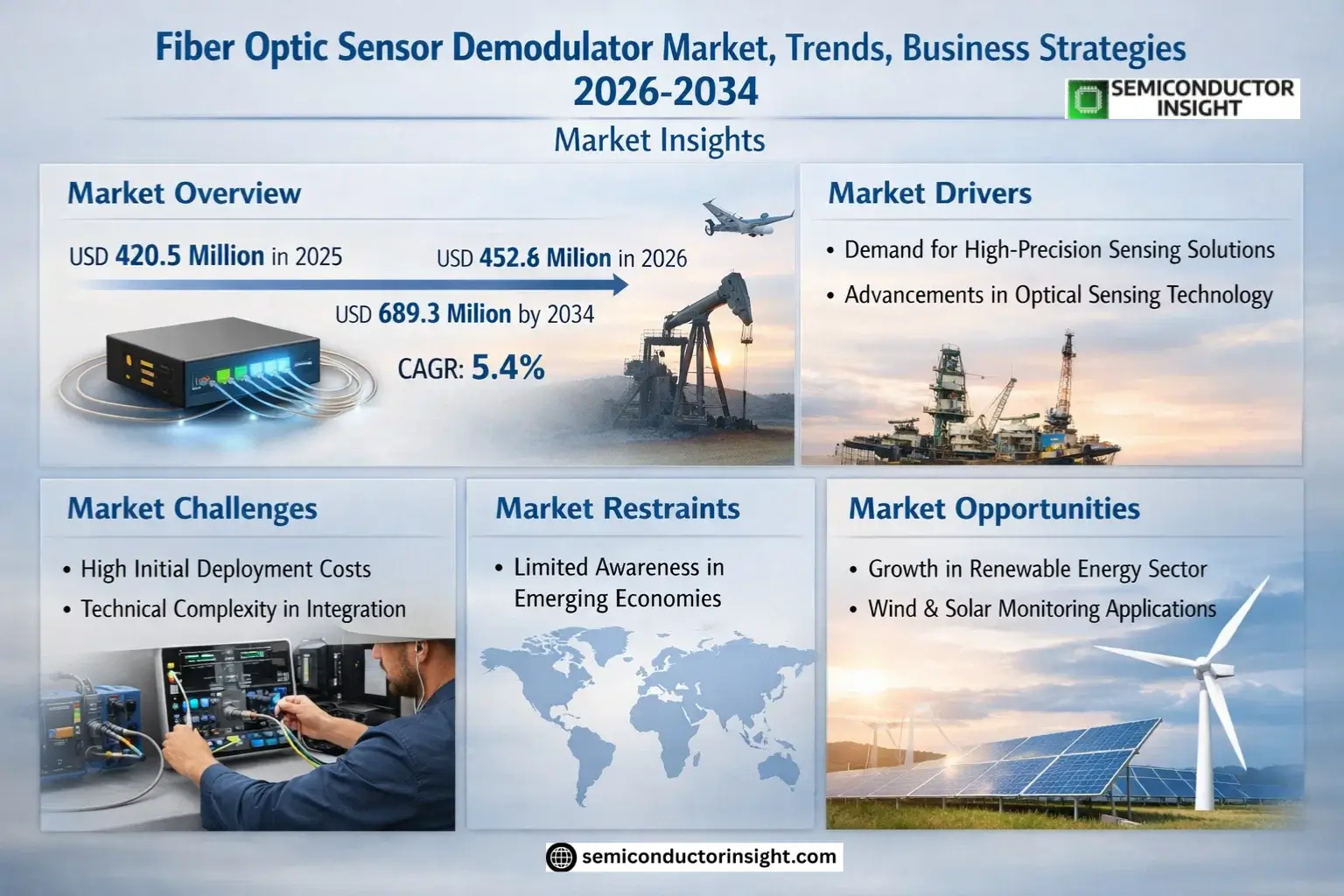
Global Fiber Optic Sensor Demodulator Market size was valued at USD 420.5 million in 2025. The market is projected to grow from USD 452.8 million in 2026 to USD 689.3 million by 2034, exhibiting a CAGR of 5.4% during the forecast period.
Fiber Optic Sensor Demodulators are critical devices used to interpret signals from fiber Bragg grating (FBG) sensors, enabling precise measurement of strain, temperature, and vibration in static and dynamic environments. These demodulators offer high accuracy, multi-channel capabilities, and immunity to electromagnetic interference, making them indispensable in industries such as aerospace, automotive, industrial manufacturing, and healthcare.
The market growth is driven by increasing demand for real-time monitoring solutions in harsh environments where traditional sensors fail. Advancements in optical sensing technologies and rising investments in smart infrastructure further propel adoption. Key players like GEOKON, HBM, and Beijing Tongwei Technology dominate the competitive landscape with continuous innovations in demodulation techniques.
MARKET DRIVERS
Increasing Demand for High-Precision Sensing Solutions
Global Fiber Optic Sensor Demodulator Market is witnessing substantial growth due to the rising need for high-precision sensing in critical industries. Sectors such as oil & gas, aerospace, and healthcare are adopting fiber optic demodulators for their superior accuracy and reliability in harsh environments. These devices play a crucial role in monitoring structural health, temperature, and pressure with minimal signal loss.
Advancements in Optical Sensing Technology
Technological innovations in fiber optic demodulators, including improved wavelength sensitivity and compact designs, are driving market expansion. The development of multi-parameter demodulators capable of simultaneous measurement further enhances their adoption. Market projections indicate an annual growth rate of 8.3% as industries transition from traditional electronic sensors to optical alternatives.
Government investments in smart infrastructure projects, particularly in developed economies, are creating additional demand for advanced fiber optic demodulation systems.
MARKET CHALLENGES
High Initial Deployment Costs
The sophisticated technology behind fiber optic sensor demodulators results in significant installation and maintenance expenses, posing adoption barriers for small and medium enterprises. System calibration requires specialized expertise, adding to operational costs.
Other Challenges
Technical Complexity in Integration
Retrofitting existing monitoring systems with fiber optic demodulators presents compatibility issues across diverse industrial platforms. The market faces a shortage of skilled technicians capable of handling advanced optical sensing networks.
MARKET RESTRAINTS
Limited Awareness in Emerging Economies
Despite proven advantages, fiber optic sensor demodulator adoption remains limited in developing regions due to inadequate technical knowledge and preference for lower-cost alternatives. Market penetration currently concentrates in North America and Europe, comprising 68% of global revenue.
MARKET OPPORTUNITIES
Expansion in Renewable Energy Sector
The growing renewable energy market presents significant opportunities for fiber optic sensor demodulators, particularly in wind turbine monitoring and photovoltaic systems. These applications demand precise strain and temperature measurements under dynamic environmental conditions, where optical sensors outperform conventional alternatives.
Fiber Optic Sensor Demodulator Market Trends
Increasing Demand for High-Precision Sensing Solutions
Fiber Optic Sensor Demodulator Market is witnessing steady growth driven by rising demand for high-precision measurement solutions across industries. These devices offer superior accuracy in static and dynamic monitoring applications, with capabilities to withstand electromagnetic interference – a critical requirement in industrial settings. The aerospace sector particularly benefits from their lightweight design and long-distance measurement capabilities.
Other Trends
Advancements in Multi-Channel Demodulation
Recent technological developments have focused on enhancing multi-channel capabilities in Fiber Optic Sensor Demodulators. Manufacturers are introducing systems capable of simultaneously processing data from multiple FBG sensors, improving efficiency in large-scale monitoring applications such as structural health monitoring of bridges and pipelines.
Regional Market Dynamics
North America currently leads in Fiber Optic Sensor Demodulator adoption, particularly in aerospace and defense applications. However, Asia-Pacific is emerging as the fastest-growing region, driven by China’s expanding industrial manufacturing sector and infrastructure development projects requiring advanced monitoring solutions.
Other Trends
Portable Demodulator Segment Growth
The market is seeing increased demand for portable Fiber Optic Sensor Demodulators, particularly for field applications in energy infrastructure and civil engineering. These compact devices offer the same precision as desktop models while providing greater operational flexibility.
Competitive Landscape Evolution
Fiber Optic Sensor Demodulator Market remains moderately consolidated, with established players like GEOKON and HBM maintaining strong positions through continuous innovation. Chinese manufacturers are gaining market share by offering cost-effective solutions, particularly for industrial applications in emerging economies.
COMPETITIVE LANDSCAPE
Key Industry Players
Market Dominated by Precision Instrument Specialists Amid Growing Fiber Optic Demand
Global Fiber Optic Sensor Demodulator Market exhibits a consolidated structure with GEOKON and HBM leading as technology pioneers, collectively holding significant market share. These established players dominate through their advanced multi-channel demodulation systems and strong aerospace/industrial clientele. The market sees intense R&D competition in wavelength resolution and dynamic range capabilities, particularly for structural health monitoring applications.
Niche specialists like Smart Fibres and YOSC are gaining traction with compact portable solutions for medical and automotive sectors. Chinese manufacturers including Beijing Tongwei Technology and Beijing Fibote Photoelectric Technology demonstrate aggressive pricing strategies, capturing mid-market segments across Asia-Pacific regions. Emerging innovations in distributed sensing systems are creating new opportunities for technology-focused entrants.
List of Key Fiber Optic Sensor Demodulator Companies Profiled
- GEOKON
- HBM
- MegaSense
- Smart Fibres
- Beijing Tongwei Technology
- Beijing Fibote Photoelectric Technology
- YOSC
- Skyray Opto-Electronic Technologies
- NanZee Sensing
- YG Optics
- Jinan Dahui Photoelectric Technology
- XC Optic
- Beijing HONGLIN Opto-Electronic Technology
- Wave Optics
- Ougan Monitoring
Segment Analysis:
| Segment Category | Sub-Segments | Key Insights |
| By Type |
|
Desktop dominates due to its:
|
| By Application |
|
Industrial Manufacturing leads because:
|
| By End User |
|
Original Equipment Manufacturers show strongest adoption due to:
|
| By Measurement Capability |
|
Dynamic Monitoring is gaining traction because:
|
| By Technology |
|
FBG Based technology prevails as it offers:
|
Regional Analysis: Fiber Optic Sensor Demodulator Market
North America
The U.S. accounts for over 60% of North American market share, with Silicon Valley and Boston emerging as key innovation centers for advanced demodulator architectures. Collaborative research between universities and corporations drives breakthroughs in signal processing algorithms.
Canada’s energy sector demonstrates growing demand for ruggedized demodulators in pipeline monitoring, while Mexico shows increasing adoption in manufacturing automation. The shale gas boom continues to fuel optical sensor deployments across extraction sites.
Strict OSHA and CSA safety standards mandate precise structural health monitoring, creating sustained demand. Recent FAA mandates for aircraft structural monitoring are opening new opportunities in aerospace applications of fiber optic demodulators.
Emerging smart city initiatives across major metropolitan areas are expected to drive the next wave of growth, particularly for distributed sensing systems requiring high-performance demodulation capabilities in traffic and infrastructure monitoring.
Europe
Europe represents the second-largest market for fiber optic sensor demodulators, characterized by strong adoption in renewable energy and industrial automation. Germany leads regional demand due to its advanced manufacturing sector, particularly in automotive and machinery applications. The North Sea offshore wind farms utilize specialized demodulators for structural monitoring. Strict EU regulations on industrial safety and environmental monitoring continue to stimulate market growth. Research institutions across Switzerland and the UK are developing next-generation demodulators for biomedical applications.
Asia-Pacific
APAC exhibits the fastest growth rate, powered by rapid industrialization and infrastructure development. China dominates regional demand, with massive deployments in power grid monitoring and high-speed rail systems. Japan maintains technological leadership in precision demodulators for semiconductor manufacturing. India shows promising growth in smart city projects and oil refinery applications. Government investments in defense modernization programs across Southeast Asian nations are creating new opportunities for fiber optic sensing systems.
Middle East & Africa
The Middle East demonstrates strong demand from oil & gas operations, particularly in GCC countries deploying advanced pipeline monitoring systems. Israel emerges as a technology hub for military-grade demodulators. Africa shows nascent but growing adoption in mining safety applications and power infrastructure monitoring, with South Africa leading regional developments.
South America
Brazil accounts for the majority of regional demand, primarily in offshore oil exploration and hydroelectric power generation. Chile’s mining sector shows increasing adoption of fiber optic demodulators for structural health monitoring. Infrastructure modernization projects across the region are expected to drive steady growth, though economic volatility remains a challenge.
Report Scope
This market research report provides a comprehensive analysis of the Fiber Optic Sensor Demodulator Market, covering the forecast period 2025–2034. It offers detailed insights into market dynamics, technological advancements, competitive landscape, and key trends shaping the industry.
Key focus areas of the report include:
- Market Overview: The report begins with an overview outlining its current market scenario, key growth indicators, and industry transformation drivers. It discusses macroeconomic factors, demand-supply balance, regulatory landscape, and the strategic role of fiber optic sensor demodulators in powering advancements across industries such as industrial manufacturing, aerospace, automotive, and medical.
- Market Size & Forecast: Historical data and future projections for revenue, unit shipments, and market value across major regions and segments.
- Segmentation Analysis: Detailed breakdown by product type, application, and end-user industry to identify high-growth segments and investment opportunities.
- Regional Insights: Insights into market performance across North America, Europe, Asia, South America, and the Middle East & Africa, including country-level analysis where relevant.
- Competitive Landscape: Profiles of leading market participants, including their product offerings, R&D focus, manufacturing capacity, pricing strategies, and recent developments such as mergers, acquisitions, and partnerships.
- Technology Trends & Innovation: Assessment of emerging technologies, integration of AI/IoT, and evolving industry standards.
- Market Drivers & Restraints: Evaluation of factors driving market growth along with challenges, supply chain constraints, regulatory issues, and market-entry barriers.
- Stakeholder Insights: Insights for component suppliers, OEMs, system integrators, investors, and policymakers regarding the evolving ecosystem and strategic opportunities.
Primary and secondary research methods are employed, including interviews with industry experts, data from verified sources, and real-time market intelligence to ensure the accuracy and reliability of the insights presented.
FREQUENTLY ASKED QUESTIONS:
What is the current market size of Fiber Optic Sensor Demodulator Market?
-> Fiber Optic Sensor Demodulator Market size was valued at USD 420.5 million in 2025. The market is projected to grow from USD 452.8 million in 2026 to USD 689.3 million by 2034, exhibiting a CAGR of 5.4% during the forecast period.
Which key companies operate in Fiber Optic Sensor Demodulator Market?
-> Key players include GEOKON, HBM, MegaSense, Smart Fibres, Beijing Tongwei Technology, Beijing Fibote Photoelectric Technology, YOSC, Skyray Opto-Electronic Technologies, NanZee Sensing, and YG Optics, among others. In 2025, the global top five players had a share approximately % in terms of revenue.
What are the key growth drivers?
-> Key growth drivers include high precision, multi-channel capabilities, long-distance applications, and anti-electromagnetic interference properties of fiber optic sensor demodulators.
Which region dominates the market?
-> The U.S. market size is estimated at USD million in 2025 while China is to reach USD million during the forecast period.
What are the emerging trends?
-> Emerging trends include increasing adoption in industrial manufacturing and aerospace applications, technological advancements in portable demodulators, and growing demand for medical applications.
Get Sample Report PDF for Exclusive Insights
Report Sample Includes
- Table of Contents
- List of Tables & Figures
- Charts, Research Methodology, and more...
 Download Sample Report PDF