
Global Electrification Boom 2026 Pushes Isolated DC-DC Converter Market into High Growth Power Infrastructure Applications
Global Electrification Boom 2026 Pushes Isolated DC-DC Converter Market into High Growth Power Infrastructure Applications
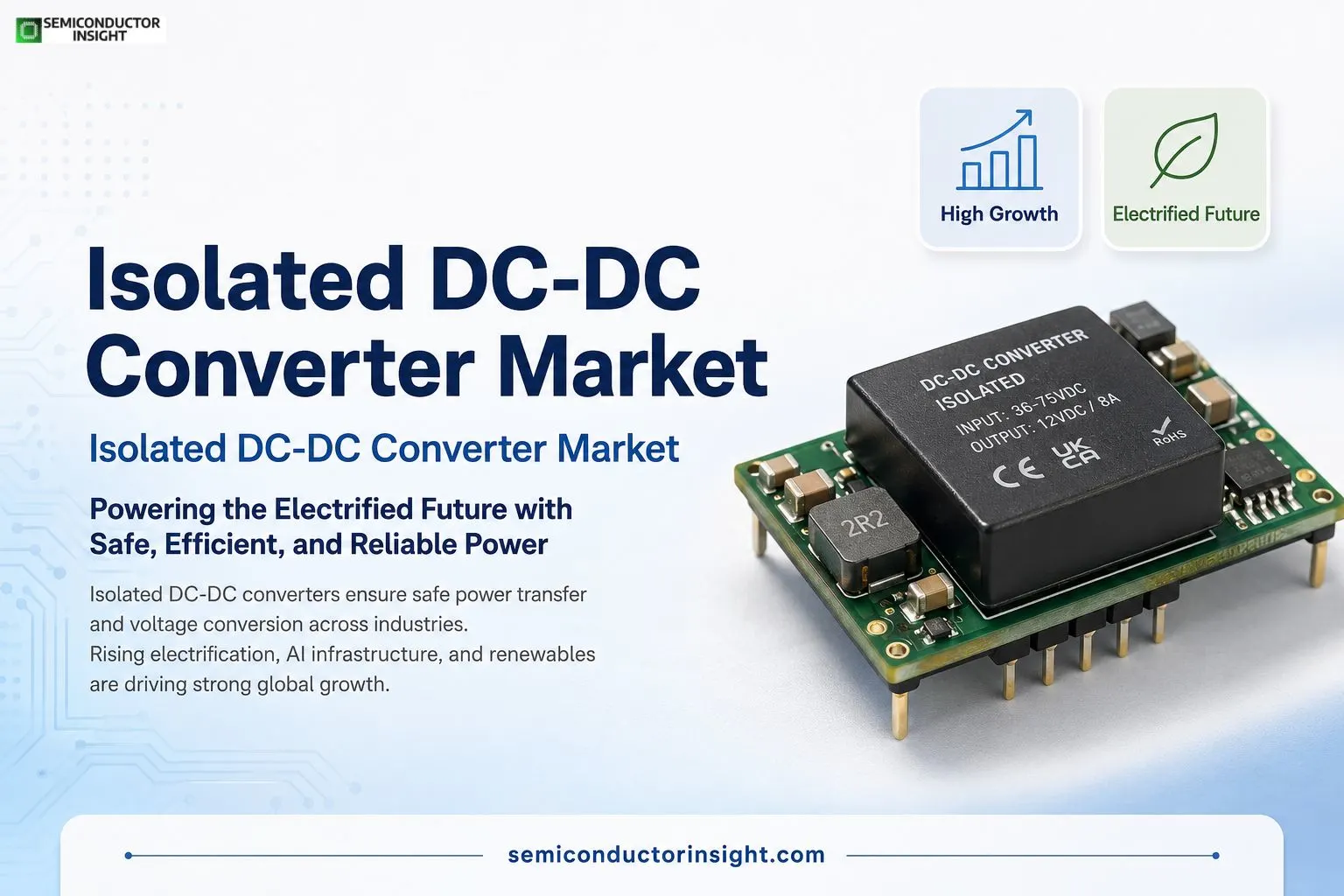
The global industry devoted to the development, production, and implementation of DC-DC power conversion devices that offer electrical isolation between the input and output circuits while changing one direct current (DC) voltage level is known as isolated DC-DC Converter Market.
While processors, memory chips, and AI accelerators often dominate semiconductor headlines, isolated DC-DC converters are quietly becoming one of the most important building blocks in modern electronic systems.
- These devices transfer electrical power between circuits while maintaining galvanic isolation, a critical requirement in applications where safety, signal integrity, and equipment protection are essential.
- As industries move toward higher voltages, denser electronics, and connected infrastructures, isolated power conversion has shifted from a niche engineering requirement to a strategic technology enabler across multiple sectors.
Why AI Infrastructure Is Increasing the Need for Isolated Power Designs?
The rapid construction of AI data centres has created demand for advanced power architectures capable of supporting thousands of high-performance processors.
According to the International Energy Agency, global data centre electricity consumption reached approximately 460 terawatt-hours annually and is expected to continue rising as AI workloads expand. Servers handling AI inference and training require stable, isolated power rails to protect sensitive electronics and maintain operational reliability.
Power supply manufacturers are increasingly integrating isolated DC-DC converter modules into server racks, networking equipment, and accelerator platforms to improve efficiency and reduce electrical interference within densely packed computing environments.
Electric Vehicles Create a New Generation of Converter Applications
- Electric vehicles represent one of the fastest-growing deployment areas for isolated DC-DC converter technologies.
- A modern battery electric vehicle may contain dozens of power conversion circuits supporting battery management systems, onboard chargers, traction controls, infotainment systems, and advanced driver assistance technologies.
- According to the International Energy Agency, global electric vehicle sales surpassed 17 million units in 2024. Every vehicle requires multiple isolated power systems to safely separate high-voltage battery domains from low-voltage electronic controls.
- Automotive manufacturers are increasingly adopting compact converter modules capable of operating under extreme temperatures, vibration conditions, and demanding safety standards.
The Rise of Silicon Carbide and Gallium Nitride Integration
One of the most significant shifts within power electronics is the adoption of wide bandgap semiconductor materials.
Silicon carbide and gallium nitride devices allow power converters to operate at higher switching frequencies while reducing energy losses. This enables isolated DC-DC converters to become smaller, lighter, and more efficient.
Recent industrial power supplies now achieve efficiencies exceeding 95% in many operating conditions while occupying significantly less board space than conventional designs. The combination of advanced magnetic materials and wide bandgap semiconductors is redefining converter performance expectations across industrial and transportation markets.
Renewable Energy Installations Depend on Electrical Isolation
- Renewable energy projects are creating another major opportunity for isolated power conversion systems.
The International Renewable Energy Agency reports that global renewable power capacity exceeded 4,400 gigawatts, with solar and wind accounting for the majority of new installations.
- Within solar farms, battery storage facilities, and smart grid infrastructure, isolated DC-DC converters help manage communication interfaces, monitoring equipment, protection circuits, and control systems. Electrical isolation becomes especially important when integrating high-voltage energy storage systems with low-voltage digital electronics.
- As nations continue investing in grid modernization programs, the demand for reliable isolated power technologies is expected to expand alongside renewable deployments.
Medical Electronics Raise the Reliability Standard
Medical equipment manufacturers operate under some of the strictest safety requirements in the electronics industry.
Devices such as patient monitoring systems, diagnostic imaging platforms, portable ventilators, and infusion pumps rely heavily on isolated power architectures to prevent electrical leakage and ensure patient safety.
Hospitals increasingly demand compact, highly reliable electronic systems capable of operating continuously with minimal maintenance. As healthcare facilities expand digital monitoring capabilities, isolated DC-DC converters remain essential components supporting both safety compliance and operational performance.
You Can Freely Surf Our Latest Updated Report Here: https://semiconductorinsight.com/report/isolated-dc-dc-converter-market/
Factories Are Becoming More Electrified and Intelligent
Industrial automation is entering a new phase driven by robotics, machine vision, industrial IoT networks, and predictive maintenance systems.
The International Federation of Robotics reported more than 4 million industrial robots operating worldwide, with installations continuing to grow across manufacturing sectors. Every robotic controller, sensor network, and industrial communication interface requires stable isolated power delivery.
Factory operators are prioritizing equipment uptime, cybersecurity resilience, and operational efficiency, creating strong demand for power architectures that can withstand electrical noise and harsh industrial environments.
How Power Conversion Is Becoming a Strategic Semiconductor Segment?
The semiconductor industry is increasingly recognizing that innovation extends beyond computing performance. Reliable power delivery has become equally important as processing capability.
As electric mobility, renewable energy, AI infrastructure, industrial automation, and medical electronics continue expanding, isolated DC-DC converters are emerging as critical technologies that enable safer, smarter, and more efficient electronic systems.
Rather than serving as a supporting component, isolated power conversion is becoming a defining factor in the design of next-generation electronic platforms worldwide.

Comments (0)