

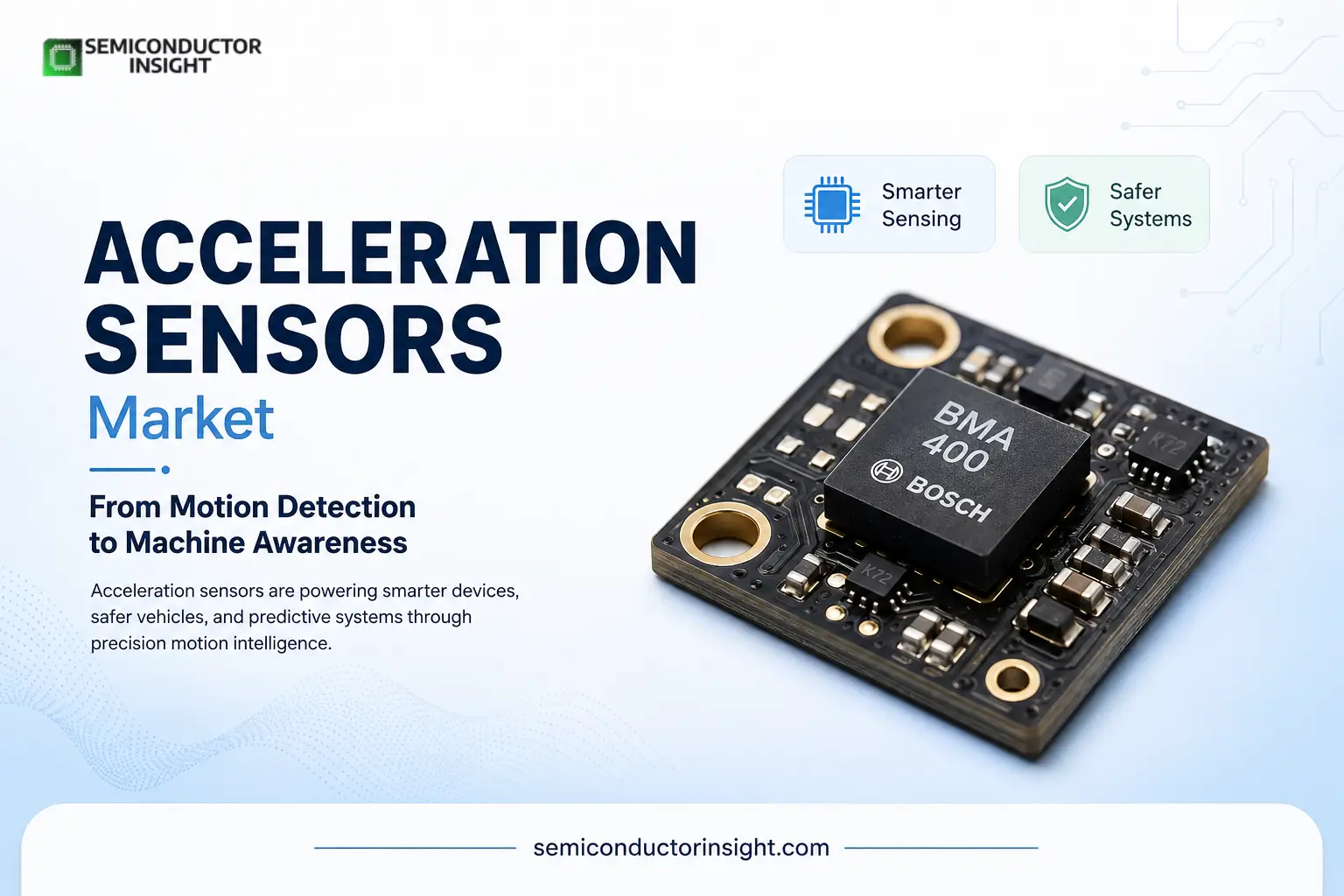
Global Acceleration Sensors Market 2026: From Compact 2 mm Sensors to Safety Critical Automotive Systems
Acceleration sensors have become almost invisible inside modern electronics, yet they continuously measure changes in movement, vibration, orientation and shock. In a MEMS accelerometer, microscopic structures move when acceleration occurs. That mechanical movement changes an electrical signal, allowing the semiconductor system to translate physical motion into digital information. Bosch describes the sensing structure as tiny interlocking silicon fingers whose movement changes capacitance and produces a measurable electrical signal.
That basic principle now supports applications ranging from smartphones and wearables to airbags, industrial machinery and advanced driver assistance systems.
The Market Is Splitting Into Very Different Sensor Personalities
- One of the most interesting developments is the widening gap between ordinary motion sensing and precision sensing.
- A smartwatch may prioritize extremely low power consumption and compact packaging. An industrial vibration-monitoring system needs bandwidth and long-term stability. An automotive safety system requires predictable operation across temperature, vibration and electrical disturbances.
- STMicroelectronics, for example, offers accelerometers spanning ultra-low-power consumer devices, automotive-qualified sensors and industrial products designed for applications such as predictive maintenance. Some of its compact accelerometers use packages measuring just 2 × 2 × 1 mm.
- The result is not one acceleration sensor market, but an increasingly specialized collection of sensing architectures.
Automotive Is Turning Acceleration into a Safety Signal
The vehicle is becoming one of the most technically demanding environments for accelerometers.
Acceleration information can be used for airbag deployment, electronic stability systems, rollover detection, chassis control, navigation and ADAS. Bosch states that its automotive MEMS portfolio has surpassed 26 billion sensors produced, demonstrating how deeply MEMS sensing has become embedded in vehicle electronics.
The technical requirements are also becoming more demanding. Bosch’s SMI970 automotive inertial sensor, for example, operates from -40°C to +125°C, supports acceleration ranges of 6g or 8g, and is designed for applications including ESP, rollover sensing and ADAS.
This is where acceleration sensors move beyond simple motion detection and become part of a vehicle’s safety architecture.
Six Dimensions Are Rewriting the Sensor Architecture
The growing use of inertial measurement units is another major shift. Instead of relying on acceleration data alone, modern IMUs combine accelerometers with gyroscopes to capture multiple dimensions of movement.
Bosch describes its automotive IMUs as measuring up to six dimensions, including longitudinal, transverse and vertical acceleration together with yaw, pitch and roll rates.
This becomes particularly valuable when cameras, GPS or other external sensing systems temporarily lose reliable information. In a tunnel, during a sharp maneuver or when satellite positioning becomes unavailable, inertial data can help maintain an understanding of vehicle movement.
You can freely browse our most recent updated report to learn more about it before scrolling further: https://semiconductorinsight.com/report/acceleration-sensors-market/
Edge Intelligence Is Moving Into the Sensor
- The next change is happening inside the sensor itself.
- Traditional architectures send raw motion information to a microcontroller or application processor for interpretation. Newer devices increasingly perform part of that processing locally.
- STMicroelectronics has integrated machine-learning cores and finite-state-machine capabilities into parts of its MEMS portfolio, allowing motion-related processing to happen directly on the sensing device. The company positions this approach for activity recognition, always-on sensing and reduced processor workload.
- This matters because continuous sensor data can consume both processing resources and energy. Local event detection allows the main processor to remain asleep until something meaningful happens.
The Automotive Sensor Race Is Moving Toward Lower Noise
For automated driving, detecting acceleration is only the beginning. The system also needs to know whether the measurement can be trusted.
Bosch’s newer SMU300 high-performance inertial sensor is aimed at ADAS and autonomous driving applications, with 16/20-bit data resolution, acceleration ranges of 6g or 8g, operation from -40°C to +125°C, and a specified calibrated gyro offset error below 0.1°/s.
Such specifications illustrate where the market is heading. Sensor suppliers are competing not simply on sensitivity, but on noise, drift, temperature stability, package size, diagnostics and functional safety.
Vibration Monitoring Opens another Semiconductor Door
Acceleration sensors are also becoming important outside mobility.
Industrial equipment generates vibration signatures that can reveal mechanical wear before a component fails. ST’s IIS3DWB10IS, for instance, combines high-precision vibration sensing with on-device processing capabilities intended for real-time industrial analytics and predictive maintenance.
This creates a useful intersection between MEMS, edge computing and industrial AI. The sensor is no longer just collecting information. It can increasingly help determine what information deserves attention.
From Motion Detection to Machine Awareness
- The acceleration sensors market is therefore moving through a subtle but important transition. The hardware is becoming smaller, while the intelligence around the hardware is becoming greater.
- Consumer electronics continue to demand low-power motion sensing.
- Vehicles require increasingly precise inertial information for safety and automated driving. Industrial systems are turning vibration into predictive maintenance data.
The next generation of acceleration sensors will likely be judged less by whether they can detect movement and more by how accurately, efficiently and intelligently they can interpret that movement at the point where it occurs.

Comments (0)