Accelerometer Sensors Market Insights
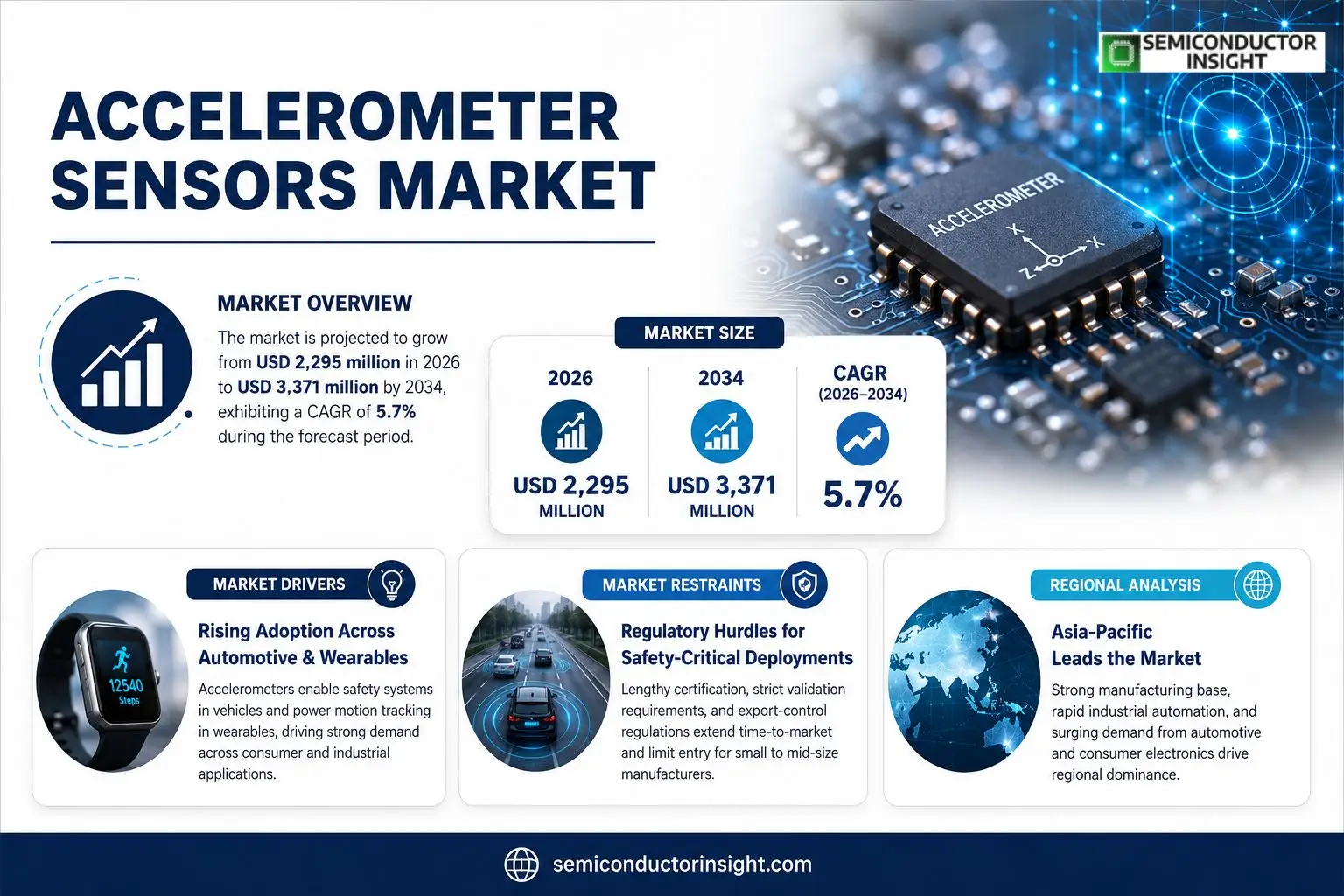
Accelerometer Sensors market was valued at USD 2295 million in 2026 to USD 3371 million by 2034, reflecting a CAGR of 5.7% over the forecast period.
Accelerometers are devices that quantify accelerationthe rate of change of velocityby converting mechanical motion into electrical signals that electronic systems can interpret.Predominantly built on MEMS technology, these sensors are compact, low‑power, reliable and cost‑effective, making them integral components in smartphones, wearables, automotive safety systems and industrial vibration monitoring.Key contributors such as Bosch, NXP Semiconductors, STMicroelectronics and Murata dominate the supply chain while regional demand concentrates in Asia Pacific followed by Europe and North America.
MARKET DRIVERS
Technological Advancements in Sensor Miniaturization
Developments in MEMS fabrication have lowered the cost and size of accelerometer sensors, enabling their integration into chips that power consumer electronics, automotive systems, and industrial machinery. The shift towards system‑on‑chip solutions has cut power consumption to the nanowatt range, opening new segments that demand high‑precision sensing at minimal cost.
Rising Adoption Across Automotive and Wearables
Automotive manufacturers are using accelerometers for advanced driver assistance systems and vehicle dynamic control, while wearable health devices rely on motion sensors for activity tracking and fall detection. This dual demand is setting the stage for a diversified customer base that spans safety critical and consumer markets.
➤ Accelerometers now contribute more than 45% of sensor traffic in modern smartphones, highlighting their embedded ubiquity.
As new production lines adopt zero‑defect processes, yield rates climb, translating into a steady supply constant that supports rapid deployment of sensor modules in both high‑volume, low‑margin consumer devices and specialized, high‑margin industrial applications.
MARKET CHALLENGES
Complex Data Interpretation in High‑Sensitivity Applications
Accurately filtering noise and compensating for temperature drift in ultra‑low‑noise accelerometers remains a significant engineering overhead, especially for aerospace and medical-use cases that demand sub‑µg measurement precision.
Other Challenges
Supply Chain Volatility
Fluctuations in raw silicon pricing and geopolitical trade restrictions can inflate component costs, eroding margin for manufacturers that build large‑scale IoT fleets.
MARKET RESTRAINTS
Regulatory Hurdles for Safety‑Critical Deployments
Certification frameworks for automotive and aerospace applications require extensive validation of accelerometer performance under dynamic loads. The time‑to‑market for compliant sensors often extends beyond 18 months, discouraging entry by small‑to‑mid‑size suppliers.Moreover, the strict lineage controls on semiconductor materials introduced by export‑control regulations add another layer of complexity to sourcing high‑reliability chips, limiting the capability of regional manufacturers to compete in landscape.
MARKET OPPORTUNITIES
Expanding Horizons in Autonomous Systems
With autonomous vehicles and robotics pushing the envelope for real‑time motion sensing, the demand for high‑resolution accelerometer packages is aligned with the growth of edge‑AI solutions that require centimeter‑accurate motion data. Enterprises looking to digitalize supply chains can capitalise on sensor suites that predict machinery vibration patterns, enhancing maintenance efficiency.
Accelerometer Sensors Market Trends
MEMS Accelerometers Fuel Consumer Electronics Momentum
MEMS accelerometers have continued to drive shipment volumes within Accelerometer Sensors Market as smartphones, wearables and smart‑home platforms persistently upgrade for higher resolution motion detection. The shrinking form factor and lower power envelope allow manufacturers to embed dual‑axis or three‑axis units on mainboards that were previously constrained by size. Even though the average selling price has slipped toward $0.7 per unit, cycle replacement remains aggressive: Consumer electronics demand roughly 3.6 billion units annually, sustaining a robust subscription to sensors. Reinforced by the proliferation of AR/VR experiences and gesture‑based gaming, each device now integrates at least one sensor, translating motion into actionable data for health tracking, navigation, or haptic feedback. This universal presence creates a high‑volume, low‑margin segment that pushes suppliers toward economies of scale and drives continual design optimisation. The result is a reliable base for incremental upgrades, granting sensor designers predictable revenue streams and reinforcing barriers to entry for new entrants.
Other Trends
Automotive Safety and Electrification
Automotive deployments have outpaced consumer growth once safety mandates tightened and electrification accelerated. Accelerometers are embedded in airbag, ESC, rollover sensors, and increasingly in ADAS and in‑vehicle health monitoring. Electric powertrains demand separate vibration and battery‑state sensing, adding an extra module per vehicle. The resulting unit density per car exceeds five sensors, and automotive fleet’s shift to hybrid and electric architectures is translating into a growing share of Accelerometer Sensors Market focused on reliability and extended life cycles. Manufacturers respond by enhancing packaging robustness and certifying for extreme temperature swings, which in turn elevates unit cost but secures premium margins.
Industrial Automation and Predictive Maintenance
Industrial application layers have matured, with IIoT platforms turning vibration sensing into a predictive maintenance KPI. Sensors now routinely monitor pumps, motors and structural supports, enabling data‑driven fault analytics and reduced unplanned downtime. This market demands rugged, long‑lasting MEMS accelerometers capable of operating for 12‑24 months per sensor unit. As production lines integrate real‑time analytics, the value proposition shifts away from raw motion data toward business metrics such as ROI on downtime savings. Consequently, suppliers rank their competitors on data connectivity and analytics platforms as much as on sensor performance, reshaping supply chains to include edge‑computing partners.
Geographic Consolidation and Supply Chain Resilience
Geographic consolidation has sharpened the profile of Accelerometer Sensors Market. Asia‑Pacific, particularly China, Japan and South Korea, accounts for over 40 percent of global shipments, driven by a heavy push in automotive and industrial sectors. Meanwhile, adoption in Europe and North America grows as regulatory compliance demands higher safety data capture. This regional mix compels manufacturers to diversify supply nodesoutsourcing base wafers to Taiwan, packaging to Singaporewhile managing geopolitical risks. Strategies that embed local component sourcing and dual‑source fabrication pathways become essential, as does participation in regional standardisation bodies to align product certification timestamps. Firms that navigate these dynamics well can secure supply continuity and capture incremental volume in both high‑margin automotive and time‑critical industrial deployments.
COMPETITIVE LANDSCAPEKey Industry Players
Accelerometer Sensors Market Competitive Landscape
Bosch, a long‑standing pioneer in MEMS technology, dominates the accelerometer sub‑segment that underpins automotive safety and consumer electronics. Its integrated drivetrain of in‑house design, advanced packaging, and a robust supply chain enables volume delivery at attractive unit economics while sustaining top‑tier performance for airbag and ESC modules. In 2026, Bosch’s accelerometer revenue represented roughly 30‑35% of global sales, generating upwards of US$ 400 million, even as the average market price dipped below US$ 0.70 per unit. The company’s focused investment in 3‑axis, high‑resolution sensors, combined with aggressive scale‑up in China and India, allows it to absorb margin pressure from the consumer side while keeping overall profitability intact. The resulting market structure demonstrates that while the volume engine lies in smartphones and wearables, the value engine is in safety‑critical automotive applications where Bosch’s silicon dominates.Other industry leaders interlock the ecosystem with complementary strengths. NXP Semiconductors excels in automotive connectivity modules, pushing MEMS accelerometers into complex ADAS architectures that demand ultra‑low power and high durability. STMicroelectronics supplies both consumer‑grade and industrial grade sensors, leveraging its prolific collaboration with OEMs to capture a diversified share across automotive, IIoT and aerospace niches. Analog Devices occupies a high‑performance niche, churning out precision instruments for automotive radar, aerospace navigation and tough‑environment industrial equipment. Murata Manufacturing supports the telecom and smart‑phone base by delivering low‑cost, high‑volume MEMS solutions that keep smartphone market expenses minimal. Niche but strategically valuable players such as Kistler, Meggitt and MiraMEMS specialise in high‑resolution vibration analysis and harsh‑environment sensing, serving rail, aerospace and metrology sectors. Together, this cohort creates a competitive landscape where differentiation hinges on integration depth, supply chain resilience, and the ability to meet increasingly stringent safety and reliability standards.
List of Key Accelerometer Companies Profiled
- Bosch
- NXP Semiconductors
- STMicroelectronics
- Analog Devices Inc.
- Murata Manufacturing
- PCB Piezotronics
- TDK
- ROHM Semiconductor
- Honeywell
- TE Connectivity
- Kistler
- Meggitt
- Memsic
- MiraMEMS
Segment Analysis:
| Segment Category | Sub-Segments | Key Insights |
| By Type |
|
MEMS Accelerometers dominate due to their miniature form factor, low power consumption, and superior reliability; they integrate seamlessly into mobile and wearable devices while supporting advanced sensor fusion. – Widely adopted in smartphones for orientation, step counting, and gesture recognition. – Fueling a consistent replacement cycle across consumer electronics. – Play a pivotal role in automotive safety through airbag and ESC systems. |
| By Application |
|
Consumer Electronics remain the largest application due to continuous product refresh in smartphones, wearables, and AR/VR headsets. – Drives consistent demand for compact, low‑power MEMS sensors. – Creates a high volume base that underpins market stability. – Serves as a launchpad for integration with other device subsystems. |
| By End User |
|
OEMs are primary adopters, focusing on reliability, integration and adherence to safety regulations for automotive and industrial equipment. – Require rigorous qualification and long‑term stability. – Drive R&D investment into high‑end MEMS for advanced driver assistance and predictive maintenance. |
| By Operating Environment |
|
Controlled Environments demand high precision and low noise; sensors are calibrated for stringent tolerance. – Support research, manufacturing quality control, and consumer device optimization. – Provide a stable platform for rapid prototyping. – In contrast, harsh environments prioritize durability, shock resistance, and temperature tolerance in industrial and aerospace applications. |
| By Integration Complexity |
|
Embedded Integration is growing in automotive infotainment, industrial control units, and smart‑home hubs; it offers minimal footprint and reduced BOM cost. – Enables tighter feedback loops for vehicle dynamics and predictive analytics. – Encourages co‑design with circuit boards for better thermal management. – Drives a shift toward multi‑axis, multi‑structure MEMS within a single package. |
Regional Analysis: Accelerometer Sensors Market
North America
The convergence of intelligent transportation systems and remote sensing requirements has pushed developers toward higher‑accuracy, low‑power acceleration solutions. The push for autonomous mobility and industrial robotics fuels sustained innovation, while heightened safety regulations in vehicle production create pathways for sensor commercialization across diverse verticals.
Wearable sports devices and health monitors now routinely incorporate acceleration sensing to provide real‑time feedback. Consumer appetite for advanced fitness analytics keeps sales cycles tight and encourages manufacturers to streamline supply chains toward cost‑effective yet high‑performance sensor modules.
Novel fabrication techniquessuch as wafer‑scale integration and 3D printing of MEMS substrateshave reduced mechanical drift. Coupled with new signal‑processing algorithms, these advancements broaden application horizons and lower entry barriers for emerging design houses.
The market sees a delicate balance between entrenched suppliers and nimble startups. Established players leverage economies of scale, while newer entrants introduce disruptive materials and adaptive architectures, prompting a pricing and innovation race that benefits end‑users.
Europe
European operators register a cautious approach, prioritising rigorous compliance procedures for bearing safety and environmental impact. In automotive use, the increased requirement for robust post‑crash analysis buoy accelerometer deployment. Moreover, a collaborative sentiment toward open‑source sensor software and unified testing protocols expands accessibility for industrial automation firms across the region, facilitating shared best practices and common data format standards. The region’s strategic investment in research partnerships with academia stimulates the joint creation of adaptive sensor systems that can handle complex terrain and variable load scenarios, amplifying European automotive and industrial robotics integration.
Asia‑Pacific
Asia‑Pacific markets pivot around rapid urbanization coupled with a solidified emphasis on industrial IoT networks. The emerging e‑commerce and consumer electronics spaces drive iterative use of miniaturized sensors for gesture recognition and mobile device orientation. Smartphone manufacturers integrate multi‑axial acceleration data into their operating systems to enhance user experience, while automotive and drone vendors enlarge sensor stacks for navigation precision. Strong governmental funding earmarked for AI and connectivity projects fuels manufacturer agility, paving the way for swift sensor integration into a variety of new products.
South America
South American economies, guided by significant infrastructure investment in mining and agriculture, rely heavily on precise motion monitoring. Emerging market opportunities expand sensor utilisation for load‑management equipment and autonomous farming. State‑led initiatives to modernise regional transport systems are creating avenues for accelerated sensor deployment in public transit oversight. These together provide a path for sensor providers to embed their technology into local supply chains that favor robust, easy‑to‑implement solutions.
Middle East & Africa
The Middle East and Africa harness acceleration technology as a component of broader smart‑city and industrial transformation projects. As public utilities undergo digital upgrades, velocity measurement becomes essential for predictive maintenance. Stakeholders in the region exhibit increasing partnership with innovative sensor developers to meet localized demands for real‑time crowd‑monitoring systems and precision agriculture surveys. Investment in early‑stage sensor ecosystems paves a progressive embrace of responsive and resilient public infrastructure.
Report Scope
This market research report provides a comprehensive analysis of the Accelerometer Sensors Market , covering the forecast period 2026–2034. It offers detailed insights into market dynamics, technological advancements, competitive landscape, and key trends shaping the industry.
Key focus areas of the report include:
- Market Overview: The report begins with an overview outlining its current market scenario, key growth indicators, and industry transformation drivers. It discusses macroeconomic factors, demand–supply balance, regulatory landscape, and the strategic role of semiconductors in powering advancements across industries such as automotive, telecommunications, consumer electronics, and industrial automation.
- Market Size & Forecast: Historical data and future projections for revenue, unit shipments, and market value across major regions and segments.
- Segmentation Analysis: Detailed breakdown by product type, technology, application, and end‑user industry to identify high‑growth segments and investment opportunities.
- Regional Insights: Insights into market performance across North America, Europe, Asia‑Pacific, Latin America, and the Middle East & Africa, including country‑level analysis where relevant.
- Competitive Landscape: Profiles of leading market participants, including their product offerings, R&D focus, manufacturing capacity, pricing strategies, and recent developments such as mergers, acquisitions, and partnerships.
- Technology Trends & Innovation: Assessment of emerging technologies, integration of AI/IoT, semiconductor design trends, fabrication techniques, and evolving industry standards.
- Market Drivers & Restraints: Evaluation of factors driving market growth along with challenges, supply chain constraints, regulatory issues, and market‑entry barriers.
- Stakeholder Insights: Insights for component suppliers, OEMs, system integrators, investors, and policymakers regarding the evolving ecosystem and strategic opportunities.
Primary and secondary research methods are employed, including interviews with industry experts, data from verified sources, and real‑time market intelligence to ensure the accuracy and reliability of the insights presented.
FREQUENTLY ASKED QUESTIONS:
What is the current market size of Accelerometer Sensors Market?
-> Accelerometer Sensors Market was valued at USD 2,295 million in 2026 and is projected to reach USD 3,371 million by 2034, growing at a CAGR of 5.7% during the forecast period.
Which key companies operate in Accelerometer Sensors Market?
-> Key players include Bosch, NXP Semiconductors N.V, STMicroelectronics N.V, Murata Manufacturing, PCB Piezotronics, and Analog Devices Inc.
What are the key growth drivers?
-> The primary growth drivers are:
- Broad adoption of consumer electronics and smart devices, which drives demand for MEMS accelerometers for orientation, motion detection, and power management.
- Stringent automotive safety regulations and rapid electrification of vehicles, increasing usage in airbag, ESC, ADAS, and battery monitoring systems.
- Expansion of industrial automation, IIoT, and predictive maintenance, requiring vibration monitoring and structural health analysis.
Which region dominates the market?
-> The Asia‑Pacific region remains the largest and fastest‑growing market, followed by Europe and North America.
What are the emerging trends?
-> Emerging trends include the integration of MEMS accelerometers with AI/IoT platforms for real‑time analytics, increased demand for ruggedized sensors in industrial settings, and the development of highly integrated automotive sensor packages for electric and autonomous vehicles.
Get Sample Report PDF for Exclusive Insights
Report Sample Includes
- Table of Contents
- List of Tables & Figures
- Charts, Research Methodology, and more...
 Download Sample Report PDF