
Generative AI for Chip Design Market Developments Influencing AI Accelerator Manufacturing Worldwide
Chip manufacturing has always depended on precision, scale, and engineering speed. But as artificial intelligence workloads continue expanding across cloud computing, smartphones, autonomous vehicles, and industrial automation, semiconductor companies are facing enormous pressure to design more powerful chips within shorter timelines. This is where the generative AI for chip design market is beginning to change the direction of semiconductor engineering.
- Instead of relying entirely on manual workflows, engineering teams are now integrating generative AI systems into electronic design automation environments.
- These systems can generate optimised layouts, identify power efficiency improvements, and recommend architecture modifications in significantly less time than traditional approaches.
- The conversation is no longer limited to experimental research labs. Major semiconductor firms, cloud infrastructure companies, and chip start-ups are actively integrating generative AI into production-level development pipelines.
AI Hardware Demand Is Pushing Semiconductor Timelines to the Edge
The global surge in AI applications has dramatically increased demand for high-performance semiconductors. According to data from the Semiconductor Industry Association, worldwide semiconductor sales crossed 600 billion dollars in recent years, with AI-related infrastructure becoming one of the fastest-growing contributors.
Generative AI tools are increasingly helping engineers optimise transistor placement, thermal management, and interconnect structures. Some design stages that previously required weeks of manual analysis can now be shortened dramatically using AI-assisted simulations.
A Brief Look at Our Detailed Analysis Related Report: https://semiconductorinsight.com/report/generative-ai-for-chip-design-market/
Custom ASIC vs. GPU shipment growth
Hyperscalers are increasingly moving away from standard GPU purchases and toward designing their own custom ASICs, signalling a major shift in cloud infrastructure strategy. In 2026E, custom ASIC shipments are expected to grow by 44.6%, outpacing GPU shipments, which are projected to rise by 16.1%. This trend is being reinforced by advanced in-house chips such as Google’s TPU v7 Ironwood, which delivers 4,614 TFLOPS, and AWS Trainium 3, which is already in 3nm production.
Engineering Teams Are Rebuilding Electronic Design Automation Workflows
Electronic design automation platforms are evolving rapidly because of generative AI integration. Semiconductor engineers traditionally spent substantial time validating layouts, fixing timing issues, and reducing power leakage. AI-driven design systems are now capable of recommending multiple optimised configurations simultaneously.
In 2025, several semiconductor software providers introduced AI copilots designed specifically for chip architects and verification engineers. These systems can interpret hardware design prompts, automate repetitive coding tasks, and assist in identifying design bottlenecks earlier in the development cycle.
The shift is particularly important as modern chips contain tens of billions of transistors. Managing this level of complexity manually has become increasingly difficult, even for experienced engineering teams.
Data Centre Expansion Is Creating New Pressure on Chip Innovation
- One major reason the generative AI for chip design market is receiving global attention is the rapid expansion of hyperscale data centres.
- The International Energy Agency reported that electricity demand from data centres and AI systems continues rising sharply due to the growth of generative AI applications. This has created urgency around designing processors that deliver higher performance per watt.
- AI-assisted semiconductor engineering is helping companies explore unconventional chip layouts and packaging strategies aimed at reducing energy use. Some manufacturers are also using generative AI models to simulate cooling efficiency before physical prototypes are produced.
- In advanced packaging environments, engineers are experimenting with chiplet architectures and 3D stacking techniques where AI tools can accelerate design verification.
The Start-up Ecosystem around AI Native Chip Design Is Expanding
Another noticeable trend is the rise of semiconductor start-ups developing AI-native design platforms. These companies are building software environments where engineers collaborate directly with generative AI systems during architecture planning.
Venture capital investment in semiconductor AI tools has increased steadily as hardware innovation becomes closely tied to artificial intelligence growth. Smaller firms are particularly interested in reducing development costs because traditional chip design can require hundreds of millions of dollars before manufacturing even begins.
By automating parts of verification, simulation, and layout optimisation, generative AI platforms may help emerging semiconductor companies compete more effectively with larger established players.
Next-Gen AI Architecture Pipeline
- The next generation of AI architecture is being shaped by major platform developments already announced or moving into production.
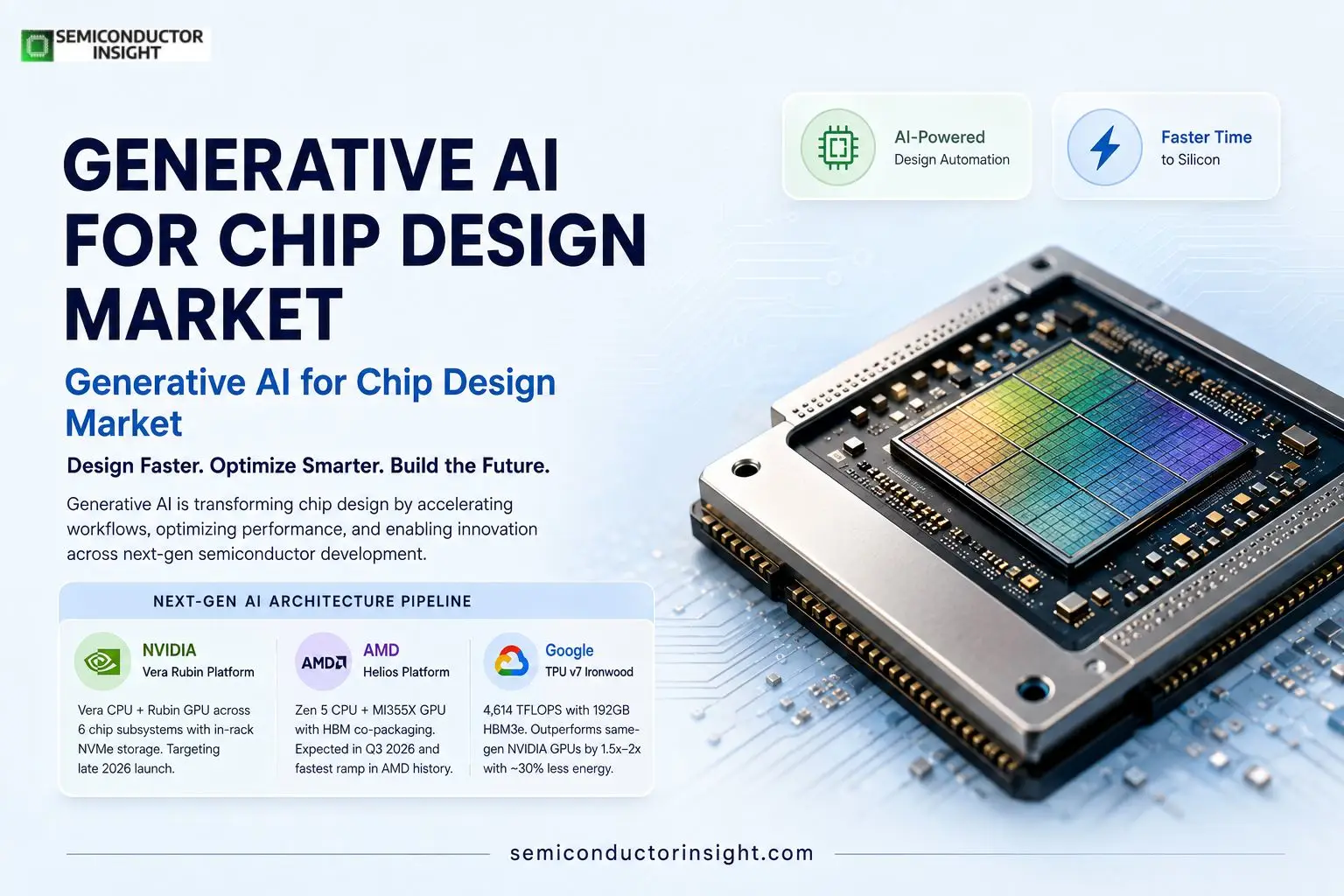
- NVIDIA’s Vera Rubin platform combines Vera CPU and Rubin GPU across six chip subsystems with in-rack NVMe storage, supporting long-context AI workloads and targeting a late 2026 launch.
- AMD’s Helios rack-scale platform, expected in Q3 2026, brings together the Zen 5 CPU and MI355X GPU with a strong focus on HBM co-packaging, and is positioned as the fastest-ramping product in AMD’s history.
- Google’s TPU v7 Ironwood, announced in November 2025, delivers 4,614 TFLOPS with 192GB of HBM3e, and early benchmarks suggest it can outperform same-generation NVIDIA GPUs by 1.5x to 2x on selected AI models while using about 30% less energy.

Comments (0)