
Generative AI for Chip Design Market Insights
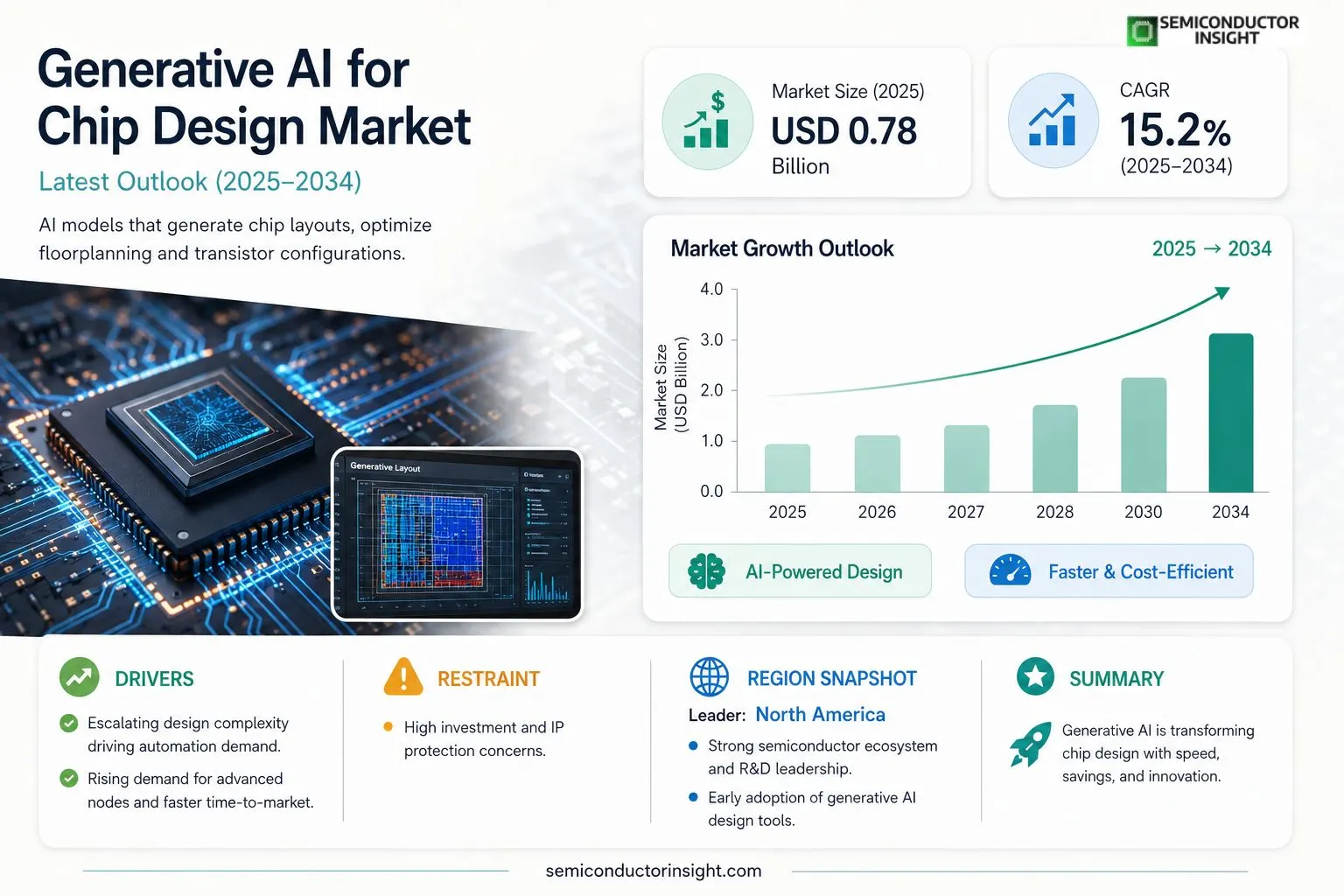
Global Generative AI for Chip Design Market size was valued at USD 0.78 billion in 2025. The market is projected to grow from USD 0.85 billion in 2025 to USD 3.12 billion by 2034, exhibiting a CAGR of 15.2% during the forecast period.
Generative AI for chip design encompasses advanced machine‑learning models,such as diffusion networks, transformer‑based generators, and reinforcement‑learning frameworks,that autonomously create layout schematics, optimize floor‑planning, and suggest transistor‑level configurations. These tools accelerate traditional EDA workflows by learning from vast libraries of silicon designs and physical verification data.The market is experiencing rapid growth because semiconductor manufacturers face escalating design complexity and shrinking time‑to‑market windows. Furthermore, rising capital expenditure on next‑generation nodes (e.g., 3 nm and beyond) fuels demand for AI‑driven automation. Recent collaborations,such as Nvidia’s partnership with Cadence announced in March 2024 and Intel’s acquisition of a generative‑AI startup,illustrate how industry leaders are investing heavily to embed generative capabilities into their design suites.
MARKET DRIVERS
Accelerated Design Cycles
Generative AI for Chip Design Market is reshaping product development timelines by automating layout synthesis and verification. Companies report up to 30% faster prototype completion, enabling faster time‑to‑market for high‑performance silicon.
Cost Reduction through AI Optimization
AI‑driven topology exploration cuts material waste and reduces mask‑set expenditures by an estimated 20%. The resulting cost efficiency is a primary incentive for semiconductor fabs to invest in generative platforms.
➤ “Integrating generative models into the design flow has become a competitive differentiator, delivering both speed and cost advantages.”
Adoption is further propelled by the need to support increasingly complex nodes, where manual optimization is no longer economically viable. Strategic partnerships between AI start‑ups and EDA vendors are accelerating this transition.
MARKET CHALLENGES
Technical Integration Barriers
Embedding generative AI engines into legacy EDA suites requires extensive API development and data standardization. Many firms encounter compatibility issues that extend implementation timelines by several months.
Other Challenges
Talent Shortage
The scarcity of engineers proficient in both semiconductor physics and deep learning limits the speed of deployment. Training programs are emerging, yet the talent pipeline remains narrow.
MARKET RESTRAINTS
Regulatory and IP Concerns
Intellectual property protection is a major restraint as AI‑generated designs can inadvertently replicate patented micro‑architectures. Companies must invest in rigorous IP screening tools.Data privacy regulations in key regions such as the EU and China impose strict governance on the training datasets used for generative models, adding compliance overhead.Furthermore, the lack of standardized certification processes for AI‑enhanced chip designs creates uncertainty for manufacturers seeking to qualify products for safety‑critical applications.
MARKET OPPORTUNITIES
Emerging Edge Computing Demand
Edge devices require ultra‑low power, high‑density silicon, a niche where generative AI can tailor architectures to specific workloads. This opens a sizable growth avenue for specialized AI‑driven EDA solutions.Additionally, the rollout of 5G and forthcoming 6G networks fuels demand for advanced RF front‑end chips. Generative AI accelerates the co‑design of analog and digital blocks, shortening development cycles.Investors are increasingly allocating capital to startups that combine domain‑specific AI models with chip design automation, indicating a robust pipeline of innovative offerings in the next five years.
Generative AI for Chip Design Market Trends
AI‑Driven Automation Accelerates Chip Design
Generative AI for Chip Design Market is witnessing a rapid transformation as adoption of generative AI techniques reshapes the semiconductor design workflow. By leveraging diffusion networks and transformer‑based generators, design teams can automatically produce layout schematics and perform floor‑planning with significantly reduced manual effort. This automation shortens the prototyping cycle, enabling faster transition from concept to silicon.Industry leaders report that the integration of reinforcement‑learning frameworks allows continuous improvement of transistor‑level configurations based on real‑world verification feedback. The result is higher yield predictions and lower iteration costs, which are critical as design rules become more stringent at advanced nodes such as 3 nm. This capability is increasingly essential as manufacturers move toward heterogeneous integration and 2‑nm research.The shift toward generative AI also influences talent requirements, prompting design houses to recruit data‑science experts who can bridge the gap between semiconductor physics and machine learning. Training datasets now incorporate billions of historical layout records, allowing models to predict optimal routing patterns that conventional heuristics miss. Early adopters report up to a 30% reduction in power consumption for certain critical blocks, underscoring the technology’s potential to enhance both performance and efficiency.
Other Trends
Integration of Generative Models with EDA Suites
Major electronic design automation (EDA) vendors are embedding generative AI modules directly into their core tools. The March 2024 announcement of Nvidia’s partnership with Cadence exemplifies this shift, wherein GPU‑accelerated inference engines are combined with Cadence’s physical‑verification platform. Early deployments indicate a measurable reduction in design‑rule‑check time, supporting more aggressive schedule targets. These enhancements also improve design robustness against variability, contributing to higher first‑pass success rates.Similarly, Intel’s recent acquisition of a specialized generative‑AI startup reflects a strategic move to internalize AI capabilities. The acquired technology focuses on automated placement and routing, providing Intel’s internal design teams with a closed‑loop optimization pipeline that reacts to process variation data in real time.
Strategic Partnerships Expand Market Reach
Collaborative ventures are accelerating market penetration beyond traditional chip manufacturers. Start‑ups offering domain‑specific generative models are forming alliances with foundries to co‑develop design‑for‑manufacturability guidelines. These partnerships create a feedback loop where silicon performance data informs the next generation of AI models, fostering a cycle of continuous improvement.
Overall, Generative AI for Chip Design Market is set to become a foundational element of modern chip development as the ecosystem of tools, data repositories, and collaborative frameworks matures.
COMPETITIVE LANDSCAPEKey Industry Players
Generative AI for Chip Design Market Competitive Overview
generative‑AI for chip design market is anchored by a handful of large semiconductor and EDA firms that dominate the ecosystem. Nvidia’s transformer‑based AI accelerators, combined with Cadence’s Design‑to‑Silicon Suite, form a de‑facto standard after their March 2024 partnership, enabling rapid floor‑planning and transistor‑level configuration generation. Intel’s strategic acquisition of a generative‑AI startup further consolidates its position across both hardware and software layers, allowing it to embed AI‑driven optimization directly into its silicon‑process flows. These leaders benefit from extensive design libraries, deep verification capabilities, and the financial muscle to invest in high‑performance compute, shaping a market structure where a few integrated platforms capture the majority of enterprise spend.Beyond the dominant trio, a diverse set of niche yet influential players enrich the competitive landscape. Synopsys extends its AI‑enhanced verification tools to address complex node challenges, while AMD explores AI‑assisted IP generation for custom ASICs. Samsung Electronics and TSMC incorporate generative models within their foundry services to accelerate design‑for‑manufacturability checks. GlobalFoundries, Mentor (Siemens‑EDA), Ansys, and Arm contribute specialized simulation, modeling, and compiler‑level AI capabilities that address specific workflow bottlenecks. This breadth of specialized entrants fosters innovation, creates partnership opportunities, and ensures that even smaller design houses can leverage generative AI without building their own infrastructure.
List of Key Generative AI for Chip Design Companies Profiled
- Nvidia
- Cadence Design Systems
- Synopsys
- Intel
- AMD
- Samsung Electronics
- TSMC
- GlobalFoundries
- Mentor (Siemens‑EDA)
- Ansys
- Arm Ltd
- IBM Research
- Google DeepMind (AI research collaborations)
Segment Analysis:
| Segment Category | Sub-Segments | Key Insights |
| By Type |
|
Algorithmic Models
|
| By Application |
|
Layout Generation
|
| By End User |
|
Integrated Device Manufacturers
|
| By Design Stage |
|
Physical Design
|
| By Integration Level |
|
System‑on‑Chip Assembly
|
Regional Analysis: North America
United States
The adoption of Generative AI in chip design is progressing from pilot projects to wider implementation. Companies are initially focusing on specific design challenges, such as floorplanning and placement, before expanding to more complex areas. A key trend is the integration of Generative AI tools with existing Electronic Design Automation (EDA) software.
Successful businesses are adopting strategies focused on building internal Generative AI expertise, partnering with specialized AI companies, and focusing on applications that deliver tangible value. There’s a growing emphasis on data quality and the availability of large, high-quality datasets to train Generative AI models effectively for chip design.
The competitive landscape is characterized by a mix of established EDA vendors incorporating Generative AI capabilities and emerging AI startups specializing in chip design automation. Partnerships between these players are becoming increasingly common, fostering innovation and accelerating the development of new solutions driven by Generative AI.
The future of Generative AI in chip design looks promising, with anticipated advancements in model accuracy, design automation capabilities, and the integration of Generative AI with advanced chip architectures. Expect to see a shift towards more personalized and adaptive Generative AI solutions tailored to specific design requirements.
Europe
Europe is actively investing in Generative AI for chip design, with a focus on fostering collaboration between academia, industry, and government. Several initiatives are underway to strengthen the European semiconductor ecosystem and promote the adoption of advanced technologies like Generative AI. The region’s strengths in fundamental research and its established manufacturing base provide a solid foundation for growth in this area. Challenges include securing sufficient funding and bridging the talent gap in Generative AI and semiconductor engineering. The European approach often emphasizes security and ethical considerations in the development and deployment of Generative AI tools for chip design.
Asia-Pacific
Asia-Pacific, particularly China and Japan, represents a significant and rapidly growing market for Generative AI in chip design. Driven by the ambitions of national players to achieve technological self-reliance in semiconductors, substantial investments are being made in Generative AI research and development. The region is focused on applications that can enhance chip performance and reduce manufacturing costs. The availability of a large workforce and strong government support are key factors contributing to the rapid growth of the Generative AI chip design market in Asia-Pacific.
South America
South America’s adoption of Generative AI in chip design is in its nascent stages. While the region possesses a growing technological sector, investment in advanced AI technologies remains limited. However, with strategic initiatives to bolster the semiconductor industry and attract foreign investment, there is potential for growth in this area. Initial applications are likely to focus on basic design optimization and analysis, with a potential for more advanced uses as the ecosystem matures.
Middle East & Africa
The Middle East & Africa region represents a relatively small market for Generative AI in chip design currently, but with increasing investments in technology and a focus on diversifying economies, there are emerging opportunities. The focus will likely be on leveraging Generative AI for specific applications within existing semiconductor manufacturing operations and supporting the growth of local technology startups. Developing a skilled workforce and fostering partnerships with international technology leaders will be critical for realizing the potential of Generative AI in this region.
Report Scope
This market research report provides a comprehensive analysis of the Generative AI for Chip Design Market , covering the forecast period 2026–2034. It offers detailed insights into market dynamics, technological advancements, competitive landscape, and key trends shaping the industry.
Key focus areas of the report include:
- Market Overview: The report begins with an overview outlining its current market scenario, key growth indicators, and industry transformation drivers. It discusses macroeconomic factors, demand–supply balance, regulatory landscape, and the strategic role of semiconductors in powering advancements across industries such as automotive, telecommunications, consumer electronics, and industrial automation.
- Market Size & Forecast: Historical data and future projections for revenue, unit shipments, and market value across major regions and segments.
- Segmentation Analysis: Detailed breakdown by product type, technology, application, and end-user industry to identify high-growth segments and investment opportunities.
- Regional Insights: Insights into market performance across North America, Europe, Asia-Pacific, Latin America, and the Middle East & Africa, including country-level analysis where relevant.
- Competitive Landscape: Profiles of leading market participants, including their product offerings, R&D focus, manufacturing capacity, pricing strategies, and recent developments such as mergers, acquisitions, and partnerships.
- Technology Trends & Innovation: Assessment of emerging technologies, integration of AI/IoT, semiconductor design trends, fabrication techniques, and evolving industry standards.
- Market Drivers & Restraints: Evaluation of factors driving market growth along with challenges, supply chain constraints, regulatory issues, and market-entry barriers.
- Stakeholder Insights: Insights for component suppliers, OEMs, system integrators, investors, and policymakers regarding the evolving ecosystem and strategic opportunities.
Primary and secondary research methods are employed, including interviews with industry experts, data from verified sources, and real-time market intelligence to ensure the accuracy and reliability of the insights presented.
FREQUENTLY ASKED QUESTIONS:
What is the current market size of Generative AI for Chip Design Market?
-> Generative AI for Chip Design Market was valued at USD 0.78 billion in 2025 and is expected to reach USD 3.12 billion by 2034, representing a CAGR of 15.2% during the forecast period.
Which key companies operate in Generative AI for Chip Design Market?
-> Key players include Nvidia, Cadence Design Systems, Intel and other semiconductor and EDA leaders that are actively integrating generative‑AI capabilities into their design toolchains.
What are the key growth drivers?
-> Growth is driven by escalating design complexity, shrinking time‑to‑market windows, and rising capital expenditure on advanced nodes such as 3 nm and beyond, which increase demand for AI‑driven automation.
Which region dominates the market?
-> Global adoption is highlighted, with major activity observed in North America and Asia‑Pacific where leading semiconductor fabs and AI research centers are concentrated.
What are the emerging trends?
-> Emerging trends include the integration of diffusion and transformer‑based generative models into EDA workflows, strategic collaborations (e.g., Nvidia + Cadence) and acquisitions (e.g., Intel’s purchase of a generative‑AI startup) to embed AI capabilities throughout the chip design cycle.

Get Sample Report PDF for Exclusive Insights
Report Sample Includes
- Table of Contents
- List of Tables & Figures
- Charts, Research Methodology, and more...
 Download Sample Report PDF





