
GaN Flash Chargers Market Emerging as the Power Backbone of Modern Devices
GaN flash chargers market is rapidly redefining how power flows through modern electronics. At the heart of this transformation lies gallium nitride, a compound semiconductor that is steadily replacing silicon in power electronics.
GaN devices function at greater voltages and switching frequencies than conventional silicon-based chargers, allowing for faster energy transfer with noticeably fewer heat losses. This change is not merely gradual; it is changing the size, performance, and design of chargers in both consumer and industrial ecosystems.
Why Gallium Nitride is changing the Semiconductor Equation?
Gallium nitride brings a fundamental material advantage. Its wide band gap allows devices to handle higher electric fields, which translates into improved power density and efficiency. In practical terms, this means chargers can deliver higher wattage in smaller form factors.
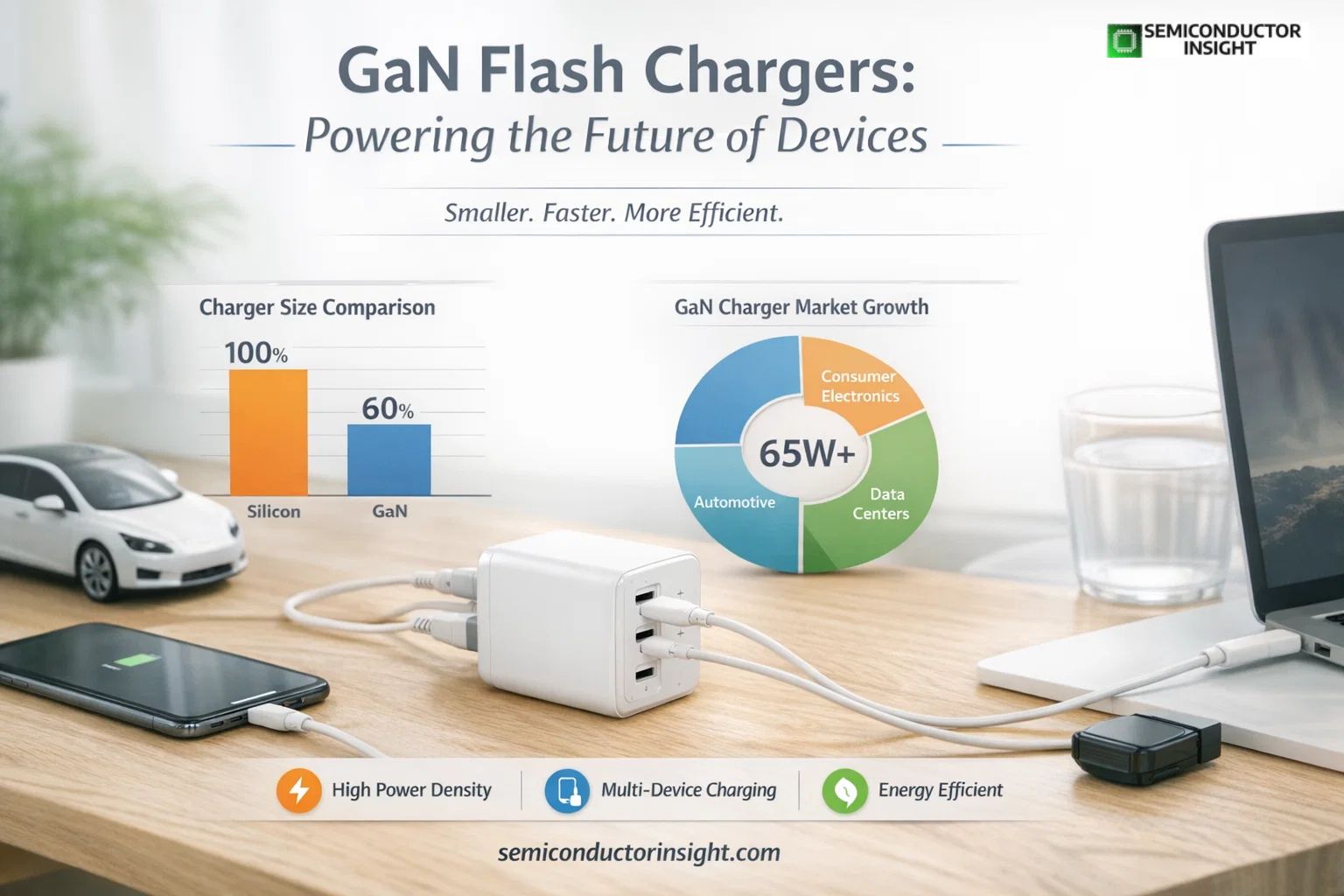
For example, modern GaN chargers can deliver 65W to 140W output while being nearly 40-50% smaller than equivalent silicon chargers. This efficiency stems from reduced energy losses and lower heat generation, enabling compact circuit designs and fewer passive components.
Go through the complete report here for more details: https://semiconductorinsight.com/report/gan-flash-chargers-market/
Miniaturization Meets High Power Delivery
- One of the most visible impacts of GaN technology is the shrinking size of charging adapters.
- The rise of ultra-portable devices has created demand for compact yet powerful chargers capable of handling multiple devices simultaneously.
Silicon Chargers → Bulky Design → Limited Power Density GaN Chargers → Compact Design → Multi-device Fast Charging
- Multi-port GaN chargers have become especially popular, allowing users to charge smartphones, laptops, and wearable’s from a single unit.
- This trend accelerated after major smartphone brands stopped including chargers in the box, pushing consumers toward high-performance third-party solutions.
Market Ready Ideas Accelerating User Interest
The commercial ecosystem is evolving rapidly with brands pushing the limits of GaN-based charging. Chargers with 100W+ output, multi-port configurations, and intelligent power distribution are becoming standard.
Recent product innovations include desktop GaN chargers capable of powering multiple high-load devices simultaneously, along with smart monitoring features that dynamically allocate wattage. Laptop manufacturers are also beginning to integrate GaN-based power adapters, signalling a deeper shift into mainstream electronics.
At the same time, advancements in GaN transistor design such as those developed by leading research institutions are improving efficiency and reliability, opening doors for applications beyond consumer charging, including data centres and electric vehicles.
Semiconductor Supply Chain Dynamics Shaping the Market
The GaN ecosystem is deeply tied to the global semiconductor supply chain. Production of GaN wafers is concentrated in regions like Japan, Taiwan, and the United States, while large-scale assembly occurs in Asia.
However, recent geopolitical and material supply disruptions have influenced pricing. Gallium, a key raw material, has seen sharp price increases due to export controls and supply constraints, impacting production costs across the value chain. Despite this, manufacturers are investing in larger wafer technologies and improved fabrication techniques to reduce costs over time.
Expanding Market Reach into New Application Segments
While smartphones and laptops remain the primary drivers, GaN flash chargers are moving into broader applications. Automotive charging systems, industrial power supplies, and renewable energy interfaces are increasingly adopting GaN-based designs.
Consumer Electronics → Multi-port Chargers → High-Speed Charging Automotive → On board Charging Units → Compact Power Modules Data Centres → Efficient Power Supplies → Reduced Heat Load
A Shift toward Energy-Efficient Charging Ecosystems
Energy efficiency is becoming a central theme in power electronics. GaN chargers consume less energy during conversion, reducing overall power loss. This aligns with global sustainability goals, especially as electricity consumption from digital devices continues to rise.
In large-scale deployments such as offices and data centres, even marginal efficiency gains can translate into significant energy savings. This is why enterprises are beginning to evaluate GaN-based charging infrastructure as part of broader energy optimization strategies.
Innovation Pipeline Defining the Next Phase
- Innovation in semiconductors will have a significant impact on the market for GaN flash chargers.
- Performance is anticipated to be further improved by innovations like GaN-on-silicon substrates, advanced packaging, and integration with AI-based power management systems.
- Emerging designs are already pushing beyond 200W charging thresholds, while maintaining compact form factors. As manufacturing scales and costs decline, GaN technology is expected to become the default standard for fast-charging solutions.
GaN flash chargers are essentially more than just accessories; they are a significant advancement in semiconductor-driven power delivery, influencing how gadgets are powered in a globe growing more interconnected by the day.

Comments (0)