Key Statistics
Key Takeaways
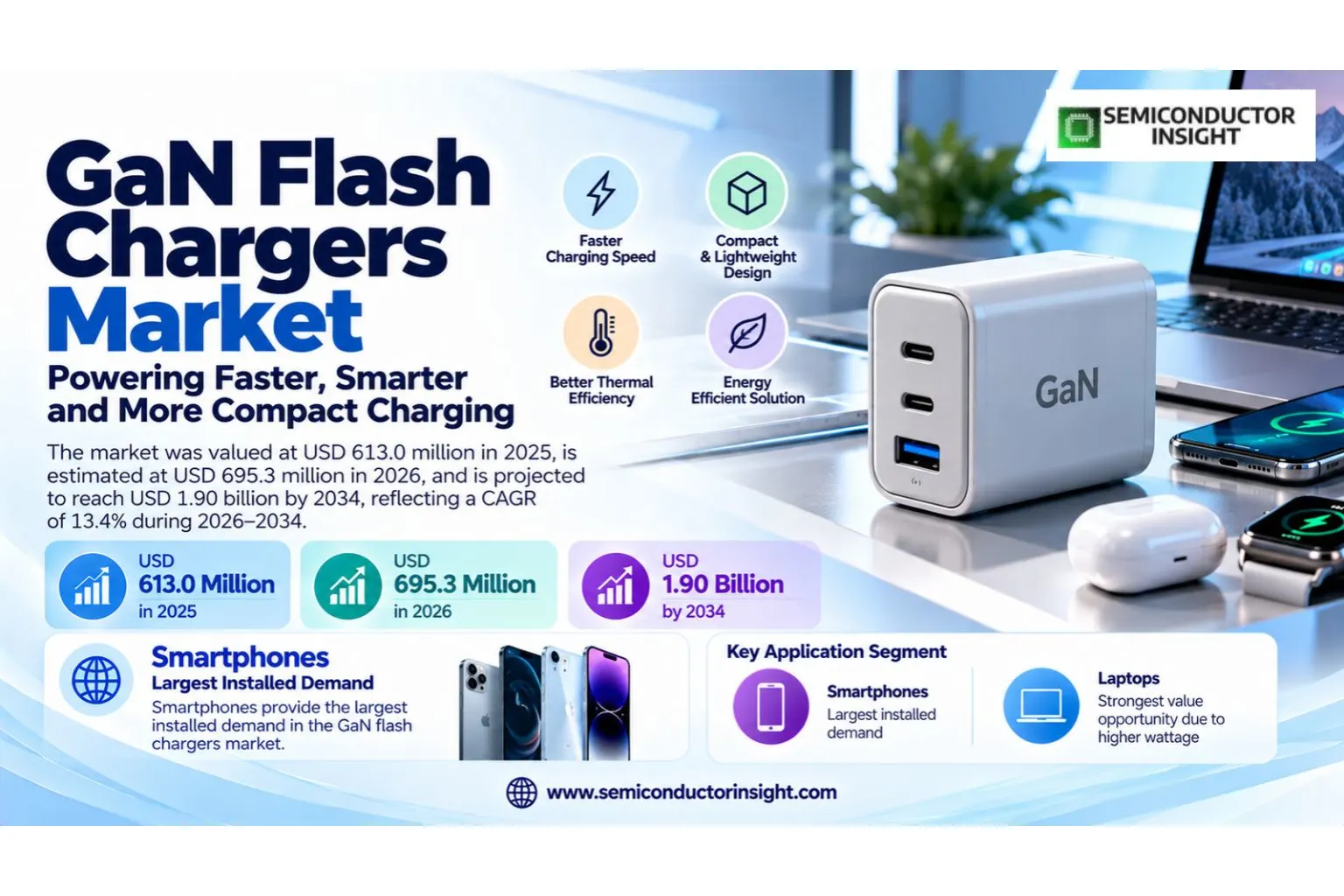
- The market is valued at USD 613.0 million in 2025 and is projected to reach USD 1.90 billion by 2034, representing a 13.4% CAGR over 2026–2034.
- 30W & Below is a major product segment, while adjacent technology variants are expanding as performance, integration and cost requirements evolve.
- Smartphones is a leading application area, supported by rising deployment across Tablets, Laptops.
- Asia Pacific is the largest market in 2025, reflecting the current concentration of demand, manufacturing capacity and ecosystem maturity.
GaN Flash Chargers Market Overview
GaN Flash Chargers use gallium-nitride power devices in compact AC-DC adapters to deliver higher switching frequency, lower losses and greater power density than conventional silicon designs. The resulting chargers can provide smartphone and notebook-class output from smaller enclosures while reducing heat and enabling more ports in a travel-friendly footprint. Commercial adoption of GaN Flash Chargers products therefore depends on how effectively suppliers translate core device performance into compact, manufacturable systems that meet application-specific reliability, cost and integration requirements.
Demand is moving upward in wattage as USB-C becomes the common charging interface for phones, tablets and laptops. The strongest commercial trend is consolidation: consumers increasingly replace multiple adapters with one 65W, 100W or higher multi-port GaN charger that supports USB Power Delivery, PPS and device-specific charging profiles. Across the value chain, customers are placing greater weight on lifecycle support, interoperability and predictable production quality, which is shifting competition away from headline specifications alone and toward complete platform performance.
Segment Analysis: By Type
The 31–65W class remains the broadest consumer segment, while 66–100W and above-100W products are expanding as one adapter increasingly charges both phones and laptops. Within this segmentation axis, purchasing decisions are increasingly shaped by qualification requirements, integration complexity, power or thermal constraints, and the ability of suppliers to support several product generations without forcing major system redesigns.
| Type | Market relevance |
|---|---|
| 30W & Below | Compact phone and accessory charging. |
| 31–65W | High-volume phone, tablet and ultrabook charging. |
| 66–100W | Premium laptop and multi-device charging. |
| Above 100W | High-power desktop, gaming and workstation use. |
Segment Analysis: By Application
Smartphones provide the largest installed demand, but laptop charging is the strongest value opportunity because higher wattage magnifies GaN’s size and thermal advantages. Within this segmentation axis, purchasing decisions are increasingly shaped by qualification requirements, integration complexity, power or thermal constraints, and the ability of suppliers to support several product generations without forcing major system redesigns.
| Application | Market relevance |
|---|---|
| Smartphones | Largest unit base and frequent replacement cycle. |
| Tablets | Portable productivity and education use. |
| Laptops | Higher ASP and wattage demand. |
| Gaming & Other Consumer Electronics | Gaming handhelds, cameras and other devices broaden use. |
Segment Analysis: By Port Configuration
Multi-port chargers are gaining share because users increasingly expect one compact adapter to power a phone, tablet, notebook and accessories simultaneously. Within this segmentation axis, purchasing decisions are increasingly shaped by qualification requirements, integration complexity, power or thermal constraints, and the ability of suppliers to support several product generations without forcing major system redesigns.
| Port Configuration | Market relevance |
|---|---|
| Single-Port | Lowest cost and smallest footprint. |
| Dual-Port | Balances portability and multi-device use. |
| Multi-Port | Fastest-growing value segment for travel and desks. |
Segment Analysis: By Charging Standard
USB Power Delivery is the common interoperability layer, while PPS and brand-specific protocols add dynamic voltage control for faster smartphone charging. Within this segmentation axis, purchasing decisions are increasingly shaped by qualification requirements, integration complexity, power or thermal constraints, and the ability of suppliers to support several product generations without forcing major system redesigns.
| Charging Standard | Market relevance |
|---|---|
| USB Power Delivery | Broad cross-brand compatibility. |
| PPS / Super Fast Charging | Optimized dynamic voltage/current control. |
| Proprietary Fast-Charging Protocols | Maintains brand-specific fast-charge performance. |
Regional Analysis
Asia Pacific leads through charger manufacturing, consumer-electronics scale and a broad GaN power-device supply chain, while North America and Europe provide high-value demand for premium multi-device adapters. Regional share is influenced not only by end-market demand but also by local manufacturing depth, component qualification, engineering support and the speed with which new GaN Flash Chargers platforms move from design-in to volume deployment.
| Region | 2025 Position | Growth Outlook | Demand Profile |
|---|---|---|---|
| Asia Pacific | Largest | Very strong | Manufacturing and consumer electronics led |
| North America | High-value demand market | Strong | Premium electronics and multi-device charging led |
| Europe | Large premium market | Strong | USB-C standardization and travel led |
| South America | Emerging | Strong | Smartphone and notebook led |
| Middle East & Africa | Developing | Strong from smaller base | Premium mobile and travel led |
Detailed Regional Blocks
Why is Asia Pacific important to this market?
Asia Pacific leads because China and surrounding electronics hubs manufacture a large share of chargers, power adapters and consumer devices. The region combines high-volume ODM capability with rapid adoption of USB-C and high-wattage charging. In Asia Pacific, buyers also weigh supplier responsiveness, certification, logistics and long-term availability, so ecosystem maturity can be as important as nominal product performance when programs move into sustained production.
| Country / Subregion | Role | Market Context |
|---|---|---|
| China | Manufacturing and brand hub | Anker, Baseus, Ugreen and large ODM ecosystems support global supply. |
| South Korea | Premium device demand | Samsung devices and accessory ecosystems support PPS charging. |
| Japan | High-value consumer market | Compact certified adapters have strong premium appeal. |
- Anker currently offers a 100W three-port GaN charger with two USB-C ports and a compact enclosure aimed at multi-device charging.
- Infineon’s 2026 USB-C charger portfolio continues to pair CoolGaN power devices with controllers for compact adapters.
- Higher-wattage travel chargers benefit most from GaN because switching efficiency reduces enclosure and cooling requirements.
Why is North America important to this market?
North America is a major demand market because laptop, smartphone and tablet ownership is high and users increasingly standardize on USB-C accessories. Premium brands compete on compact size, port count and thermal protection. In North America, buyers also weigh supplier responsiveness, certification, logistics and long-term availability, so ecosystem maturity can be as important as nominal product performance when programs move into sustained production.
| Country / Subregion | Role | Market Context |
|---|---|---|
| United States | Largest regional market | High notebook and premium smartphone use supports 65W–140W chargers. |
| Canada | Premium accessory market | Cross-device USB-C adoption supports demand. |
| Mexico | Manufacturing and retail | Electronics assembly and retail channels support volume. |
- Anker’s 100W GaN charger provides full 100W output from a USB-C port and multi-port charging from a compact body.
- USB-C PD 3.1 expands addressable notebook and high-power accessory charging above legacy smartphone wattages.
- Retailers increasingly position GaN adapters as cross-device replacements rather than phone-only accessories.
Why is Europe important to this market?
Europe benefits from broad USB-C adoption and consumer preference for compact multi-device adapters. Device interoperability and energy efficiency are important purchase factors across notebooks, phones and tablets. In Europe, buyers also weigh supplier responsiveness, certification, logistics and long-term availability, so ecosystem maturity can be as important as nominal product performance when programs move into sustained production.
| Country / Subregion | Role | Market Context |
|---|---|---|
| Germany | Large premium accessory market | Notebook and smartphone use supports higher-wattage chargers. |
| United Kingdom | Travel and laptop demand | Multi-port USB-C adapters are widely adopted. |
| France | Consumer electronics demand | Universal charging increases cross-brand accessory use. |
- Common USB-C charging makes universal GaN adapters more valuable across device brands.
- Compact multi-port designs are especially attractive for travel where users want one adapter for several devices.
- Higher energy efficiency reduces waste heat and supports smaller enclosures.
Why is South America important to this market?
South America is an emerging market led by Brazil, with demand concentrated in smartphone replacement accessories and increasingly in laptop-class USB-C chargers. In South America, buyers also weigh supplier responsiveness, certification, logistics and long-term availability, so ecosystem maturity can be as important as nominal product performance when programs move into sustained production.
| Country / Subregion | Role | Market Context |
|---|---|---|
| Brazil | Largest regional market | Smartphone scale and notebook adoption drive demand. |
| Chile | Premium consumer niche | High-end devices support GaN accessories. |
| Argentina | Selective demand | Price sensitivity favors 30W–65W products. |
- Price remains more important than maximum wattage in mainstream channels.
- Multi-device chargers can justify their premium by replacing several lower-power adapters.
- E-commerce helps specialist GaN brands reach consumers without broad physical retail distribution.
Why is Middle East & Africa important to this market?
Middle East and Africa demand is strongest in Gulf markets where premium phones and laptops are widely used. Broader African adoption is more price sensitive but benefits from increasing USB-C standardization. In Middle East & Africa, buyers also weigh supplier responsiveness, certification, logistics and long-term availability, so ecosystem maturity can be as important as nominal product performance when programs move into sustained production.
| Country / Subregion | Role | Market Context |
|---|---|---|
| United Arab Emirates | Premium travel market | High-end consumer electronics support compact GaN chargers. |
| Saudi Arabia | Growing electronics demand | Smartphone and notebook use supports higher wattage. |
| South Africa | Regional retail hub | Premium accessory channels provide selective demand. |
- Travel-oriented multi-port chargers have strong appeal in Gulf markets.
- Lower-priced 30W–65W products are the main entry point in more price-sensitive markets.
- Universal USB-C compatibility reduces the need to stock many device-specific adapters.
Competitive Landscape
Competition spans consumer-accessory brands and semiconductor suppliers. Anker, Belkin, Ugreen and Baseus differentiate at the finished-product level, while Infineon, Navitas and other power-semiconductor companies compete through switching performance, controller integration and reference designs that enable smaller, cooler adapters.
| Company | Position | Relevant capability |
|---|---|---|
| Anker Innovations | Key participant | Broad GaN portfolio from compact phone chargers to high-power multi-port products. |
| Belkin International | Key participant | Premium consumer charging accessories across phone and laptop ecosystems. |
| Ugreen Group | Key participant | Competes through product breadth, integration capability, qualification and customer support. |
| Baseus | Key participant | Competes through product breadth, integration capability, qualification and customer support. |
| Samsung Electronics | Key participant | Competes through product breadth, integration capability, qualification and customer support. |
| Apple | Key participant | Competes through product breadth, integration capability, qualification and customer support. |
| Zendure | Key participant | Competes through product breadth, integration capability, qualification and customer support. |
| Aukey | Key participant | Competes through product breadth, integration capability, qualification and customer support. |
| Infineon Technologies | Key participant | CoolGaN devices and charger-controller ecosystem for USB-C adapters. |
| Navitas Semiconductor | Key participant | Competes through product breadth, integration capability, qualification and customer support. |
Production Capacity Analysis
Production capacity depends on GaN power-device availability, controller ICs, magnetics, USB-C connectors, thermal materials and high-volume adapter assembly. Finished chargers can scale quickly, but new power stages still require safety, EMC and protocol validation before mass production. Scaling output without degrading quality requires disciplined process control, stable upstream materials and test coverage that catches performance drift before products reach customers.
China and Southeast Asia dominate adapter assembly, while GaN device production is distributed across specialized semiconductor suppliers. Capacity expansion increasingly focuses on integrated power stages and reference platforms that reduce the engineering effort required for each new wattage class. Regional supply resilience is therefore increasingly tied to second-source planning, local technical support and the ability to qualify alternate production routes without changing system behavior.
Market Dynamics
The market is shifting from technology-led novelty toward mainstream accessory economics. GaN is no longer confined to a small premium niche; it is increasingly used wherever higher power density enables fewer adapters, more ports or laptop-class output from a compact enclosure. This changes how vendors position products: system-level value, integration simplicity and operating efficiency increasingly determine design wins alongside the core semiconductor or component specification.
Growth nevertheless depends on relative cost against mature silicon solutions. In low-power single-port chargers, silicon remains highly competitive, so GaN’s strongest economics occur at higher wattage, tighter form factors and multi-port designs where efficiency and thermal headroom produce visible product benefits. Customers are consequently evaluating total ownership cost and qualification risk over a full product lifecycle, rather than focusing only on the initial purchase price or a single benchmark.
Market Drivers
| Factor | Analyst Interpretation |
|---|---|
| USB-C convergence | One charging standard across phones, tablets and laptops increases demand for universal higher-wattage adapters. |
| Higher power density | GaN switching allows smaller magnetics and less cooling for a given output level. |
| Multi-device ownership | Consumers increasingly want one charger to power several devices at once. |
| Laptop fast charging | 65W–140W notebook charging expands the high-value portion of the market. |
Market Restraints
| Factor | Analyst Interpretation |
|---|---|
| Higher semiconductor cost | GaN power stages remain more expensive than mature silicon in basic low-wattage chargers. |
| Safety and thermal certification | Compact high-power adapters require rigorous insulation, temperature and EMC validation. |
| Protocol fragmentation | Brand-specific fast-charging behavior can complicate universal compatibility. |
| Intense accessory competition | Many brands compete on price, port count and claimed wattage, compressing margins. |
Market Opportunities
| Factor | Analyst Interpretation |
|---|---|
| 140W+ compact chargers | USB PD 3.1 enables higher-power notebook and workstation charging in smaller adapters. |
| Integrated power stages | Combining GaN switches and control can reduce component count and design time. |
| Travel consolidation | One multi-port adapter can replace several phone, tablet and laptop chargers. |
| Smarter thermal management | Temperature sensing and dynamic power allocation can improve safety and user experience. |
Supply Chain Analysis
The supply chain combines wide-bandgap semiconductor fabrication with conventional high-volume power-adapter manufacturing. Differentiation is created at both the semiconductor level and in magnetics, mechanical design, firmware and safety certification. Quality assurance, traceability and coordination between component makers, module integrators and OEMs are critical because failures discovered late in the chain can be far more expensive than the underlying component itself.
| Supply Chain Stage | Role in the Market |
|---|---|
| GaN devices and controllers | Power semiconductors and control ICs create the high-frequency conversion stage. |
| Magnetics and passive components | Transformers, capacitors and filters are optimized for compact high-frequency operation. |
| Adapter assembly and certification | ODM/OEM factories assemble chargers and complete safety, EMC and protocol testing. |
| Retail and device ecosystem | Brands sell chargers through direct, retail and e-commerce channels. |
Recent Developments
| Date | Development | Source |
|---|---|---|
| 2026 | Infineon continues to expand USB-C charger and adapter solutions pairing CoolGaN power devices with controllers for compact high-efficiency designs. | Infineon Technologies |
| 2026 | Anker's 100W three-port GaN charger combines two USB-C ports, one USB-A port and a compact travel-oriented design. | Anker |
| 2025 | Infineon published an updated USB-PD semiconductor offering for USB-C chargers and adapters, reinforcing the move toward complete GaN-enabled power platforms. | Infineon Technologies |
Report Scope & Segmentation
| Scope Item | Coverage |
|---|---|
| Base Year | 2025 |
| Estimated Year | 2026 |
| Forecast Period | 2026–2034 |
| 2025 Market Size | USD 613.0 million |
| 2026 Estimated Size | USD 695.3 million |
| 2034 Forecast Size | USD 1.90 billion |
| CAGR (2026–2034) | 13.4% |
| Largest Market in 2025 | Asia Pacific |
| Category | Consumer Electronics / Power Adapters / GaN Chargers |
| By Type | 30W & Below, 31–65W, 66–100W, Above 100W |
| By Application | Smartphones, Tablets, Laptops, Gaming & Other Consumer Electronics |
| By Port Configuration | Single-Port, Dual-Port, Multi-Port |
| By Charging Standard | USB Power Delivery, PPS / Super Fast Charging, Proprietary Fast-Charging Protocols |
Frequently Asked Questions
What is the 2025 market size of the GaN Flash Chargers market?
The market is valued at USD 613.0 million in 2025.
What is the projected 2034 market size of the GaN Flash Chargers market?
The market is projected to reach USD 1.90 billion by 2034.
What is the CAGR of the GaN Flash Chargers market from 2026 to 2034?
The market is expected to expand at a CAGR of 13.4% during 2026–2034.
Which region leads the GaN Flash Chargers market?
Asia Pacific is the largest market in 2025 based on the current demand, manufacturing and deployment structure.
Which type segment is important in the GaN Flash Chargers market?
30W & Below is a major segment, while adjacent product variants are gaining share as performance and integration requirements evolve.
What is the main application for GaN Flash Chargers products?
Smartphones is a leading application, with additional growth coming from Tablets, Laptops.
What drives growth in the GaN Flash Chargers market?
One charging standard across phones, tablets and laptops increases demand for universal higher-wattage adapters.
What is a key restraint for the GaN Flash Chargers market?
GaN power stages remain more expensive than mature silicon in basic low-wattage chargers.
Which companies participate in the GaN Flash Chargers market?
Key participants include Anker Innovations, Belkin International, Ugreen Group, Baseus, Samsung Electronics, alongside other specialized suppliers and system companies.
What technology trend is shaping the GaN Flash Chargers market?
USB PD 3.1 enables higher-power notebook and workstation charging in smaller adapters.
Research Sources & Evidence Base
View research sources used for this overview.
- Infineon Technologies — USB-C Chargers and Adapters: GaN-enabled charger architecture and current product ecosystem. Source
- Anker — Prime Charger 100W GaN: Current multi-port GaN charger specifications and use cases. Source
- Infineon Technologies — USB-C Charging Solutions: Current power-device and controller resources for charger designs. Source

Get Sample Report PDF for Exclusive Insights
Report Sample Includes
- Table of Contents
- List of Tables & Figures
- Charts, Research Methodology, and more...
 Download Sample Report PDF