Key Statistics
Key Takeaways
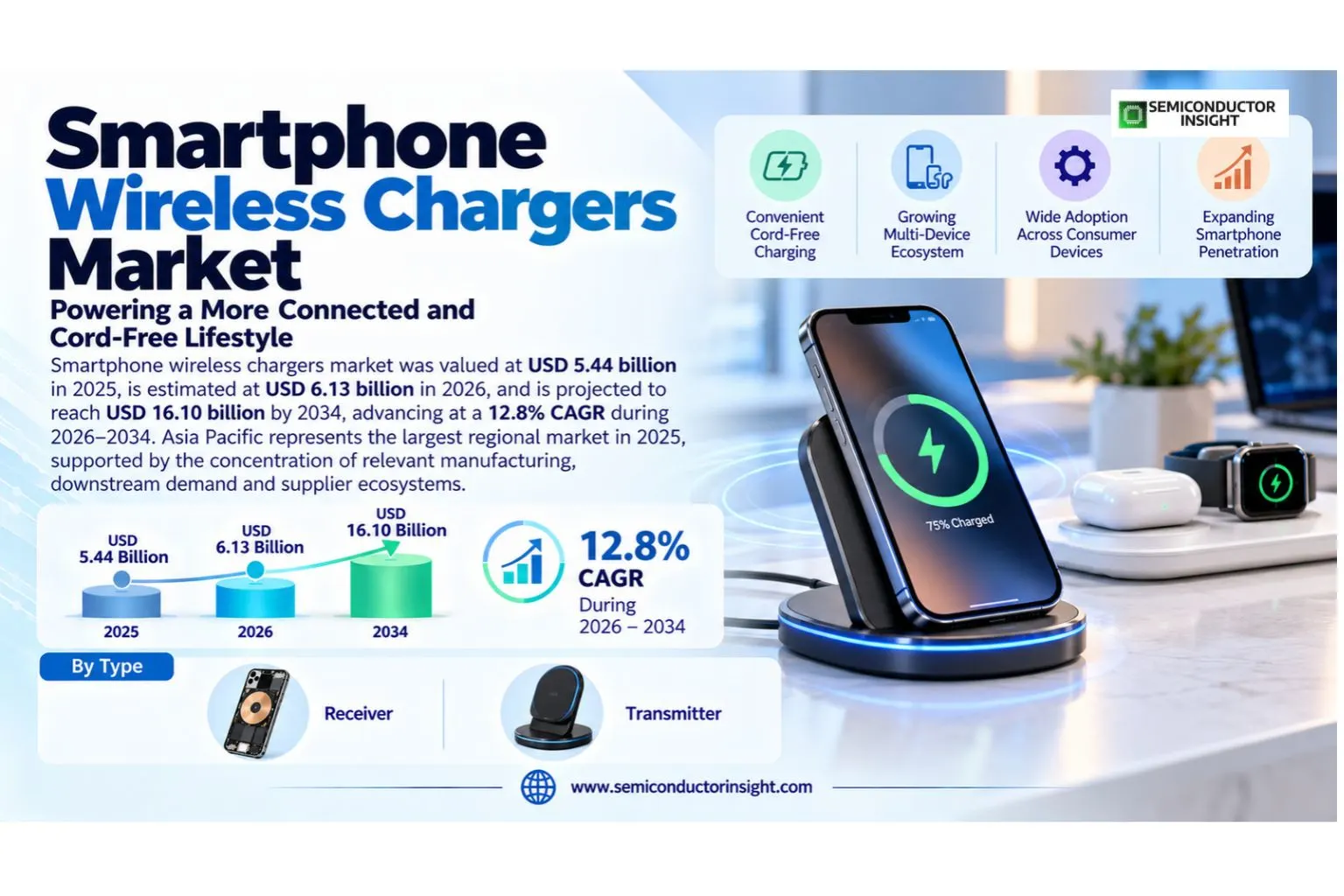
- Smartphone wireless chargers market was valued at USD 5.44 billion in 2025 and is projected to reach USD 16.10 billion by 2034, representing a 12.8% CAGR over 2026–2034.
- Qi2 and Qi2 25W are shifting the market from basic cable-free convenience toward faster, magnetically aligned charging with tighter interoperability and safety expectations.
- Transmitter products such as pads, stands and magnetic docks account for most visible accessory spending, while receiver integration is increasingly embedded directly in premium and upper-midrange smartphones.
- Online channels are structurally important because wireless chargers are standardized accessories with high product-comparison intensity, although retail remains relevant for brand-led ecosystem products and immediate replacement purchases.
- Asia Pacific is the largest market by manufacturing and unit demand, while North America remains a high-value market for premium ecosystem accessories and rapid adoption of new Qi profiles.
- Power output is becoming a clearer product discriminator as the market moves from 5W-15W charging toward 25W and higher proprietary or certified implementations.
Smartphone Wireless Chargers Market Overview
Smartphone wireless chargers market was valued at USD 5.44 billion in 2025, is estimated at USD 6.13 billion in 2026, and is projected to reach USD 16.10 billion by 2034, advancing at a 12.8% CAGR during 2026–2034. Asia Pacific represents the largest regional market in 2025, supported by the concentration of relevant manufacturing, downstream demand and supplier ecosystems.
Smartphone wireless chargers transfer power without a physical charging connector, typically through magnetic induction between a transmitter coil in the charging accessory and a receiver coil in the handset. The commercial market includes charging pads, stands, magnetic docks, integrated receivers and related accessory formats designed primarily around Qi interoperability, thermal management, foreign-object detection and increasingly precise magnetic alignment.
The value proposition is evolving from convenience to system performance. Consumers now compare wireless charging speed, alignment reliability, thermal behavior, multi-device support and compatibility with cases or magnetic accessories. The launch of Qi2 and Qi2 25W creates a common certification path for faster charging and magnetic attachment, reducing the fragmentation that previously separated proprietary fast-charging ecosystems from broadly interoperable Qi accessories.
The commercial structure of the smartphone wireless chargers market is shaped by design qualification, production economics and the interaction between component performance and downstream system requirements. Suppliers that can combine consistent manufacturing, application engineering and supply assurance are better positioned to convert technical eligibility into repeat business. Customer decisions increasingly account for lifecycle continuity, geographic resilience and integration cost, which makes proven process control and ecosystem compatibility as important as nominal product capability.
Segment Analysis: By Type
By type, the Smartphone Wireless Chargers market is segmented into Receiver, Transmitter. Transmitter accessories form the most visible revenue pool because consumers purchase pads, stands, magnetic pucks and multi-device docks separately from the handset, while receiver functionality is increasingly integrated at the smartphone design stage. Purchasing decisions vary by performance requirement, qualification burden, integration complexity and lifecycle economics, so suppliers compete on application fit rather than on a single technical specification.
| Type | Role in the market | Demand characteristics |
|---|---|---|
| Receiver | Receiver addresses a distinct part of the product and process mix. Its commercial position depends on technical fit, manufacturing maturity, integration requirements and customer qualification rather than on headline specifications alone. | Demand is strongest where the segment aligns with established customer designs, predictable supply, and measurable system-level performance. Suppliers that can document repeatability, compatibility and lifecycle support are better placed to defend design wins. |
| Transmitter | Transmitter addresses a distinct part of the product and process mix. Its commercial position depends on technical fit, manufacturing maturity, integration requirements and customer qualification rather than on headline specifications alone. | Demand is strongest where the segment aligns with established customer designs, predictable supply, and measurable system-level performance. Suppliers that can document repeatability, compatibility and lifecycle support are better placed to defend design wins. |
Segment Analysis: By Technology
By technology, the Smartphone Wireless Chargers market is segmented into Qi Standard, PMA Standard, Others. Qi is the central interoperability standard, and Qi2 extends the ecosystem with magnetic alignment and higher-power profiles that can reduce positioning losses and improve user experience. Purchasing decisions vary by performance requirement, qualification burden, integration complexity and lifecycle economics, so suppliers compete on application fit rather than on a single technical specification.
| Technology | Role in the market | Demand characteristics |
|---|---|---|
| Qi Standard | Qi Standard represents a relevant purchasing and deployment pathway within this market. Commercial attractiveness depends on how well it aligns with customer architecture, supply-chain constraints and required performance. | Growth is linked to design-in activity, installed-base transitions and the ability of suppliers to meet qualification, cost and availability requirements over the full product lifecycle. |
| PMA Standard | PMA Standard represents a relevant purchasing and deployment pathway within this market. Commercial attractiveness depends on how well it aligns with customer architecture, supply-chain constraints and required performance. | Growth is linked to design-in activity, installed-base transitions and the ability of suppliers to meet qualification, cost and availability requirements over the full product lifecycle. |
| Others | Others represents a relevant purchasing and deployment pathway within this market. Commercial attractiveness depends on how well it aligns with customer architecture, supply-chain constraints and required performance. | Growth is linked to design-in activity, installed-base transitions and the ability of suppliers to meet qualification, cost and availability requirements over the full product lifecycle. |
Segment Analysis: By Application
By application, the Smartphone Wireless Chargers market is segmented into Retail Stores, Online Sales, Others. Online sales are gaining share because buyers can compare power ratings, form factors, certifications and prices quickly, while retail channels remain important for branded accessories, device bundles and immediate replacement purchases. Purchasing decisions vary by performance requirement, qualification burden, integration complexity and lifecycle economics, so suppliers compete on application fit rather than on a single technical specification.
| Application | Role in the market | Demand characteristics |
|---|---|---|
| Retail Stores | Retail Stores creates demand when the underlying system requires the market’s core function at production scale. Procurement is normally tied to platform launches, equipment upgrades, capacity expansion or replacement cycles. | Buyers evaluate reliability, qualification time, integration cost and vendor support alongside unit economics. Adoption accelerates when the solution removes a system bottleneck or supports a new performance tier without creating disproportionate redesign risk. |
| Online Sales | Online Sales creates demand when the underlying system requires the market’s core function at production scale. Procurement is normally tied to platform launches, equipment upgrades, capacity expansion or replacement cycles. | Buyers evaluate reliability, qualification time, integration cost and vendor support alongside unit economics. Adoption accelerates when the solution removes a system bottleneck or supports a new performance tier without creating disproportionate redesign risk. |
| Others | Others creates demand when the underlying system requires the market’s core function at production scale. Procurement is normally tied to platform launches, equipment upgrades, capacity expansion or replacement cycles. | Buyers evaluate reliability, qualification time, integration cost and vendor support alongside unit economics. Adoption accelerates when the solution removes a system bottleneck or supports a new performance tier without creating disproportionate redesign risk. |
Segment Analysis: By Power Capacity
By power capacity, the Smartphone Wireless Chargers market is segmented into Standard Charging (5W-10W), Fast Charging (15W-30W), Super Fast Charging (Above 30W). The market is shifting upward from 5W-10W legacy charging toward 15W-25W certified products and higher-power proprietary implementations, increasing requirements for thermal design, power adapters and device-side charging control. Purchasing decisions vary by performance requirement, qualification burden, integration complexity and lifecycle economics, so suppliers compete on application fit rather than on a single technical specification.
| Power Capacity | Role in the market | Demand characteristics |
|---|---|---|
| Standard Charging (5W-10W) | Standard Charging (5W-10W) represents a relevant purchasing and deployment pathway within this market. Commercial attractiveness depends on how well it aligns with customer architecture, supply-chain constraints and required performance. | Growth is linked to design-in activity, installed-base transitions and the ability of suppliers to meet qualification, cost and availability requirements over the full product lifecycle. |
| Fast Charging (15W-30W) | Fast Charging (15W-30W) represents a relevant purchasing and deployment pathway within this market. Commercial attractiveness depends on how well it aligns with customer architecture, supply-chain constraints and required performance. | Growth is linked to design-in activity, installed-base transitions and the ability of suppliers to meet qualification, cost and availability requirements over the full product lifecycle. |
| Super Fast Charging (Above 30W) | Super Fast Charging (Above 30W) represents a relevant purchasing and deployment pathway within this market. Commercial attractiveness depends on how well it aligns with customer architecture, supply-chain constraints and required performance. | Growth is linked to design-in activity, installed-base transitions and the ability of suppliers to meet qualification, cost and availability requirements over the full product lifecycle. |
Regional Analysis
Asia Pacific leads the smartphone wireless chargers market in 2025, while regional growth patterns differ according to manufacturing concentration, customer investment cycles, regulation, product mix and supply-chain access. The most important regional distinction is not simply market size; it is the mechanism that converts local investment and end-market demand into qualified purchases.
How does regional demand differ across the smartphone wireless chargers market?
Regional demand for smartphone wireless chargers is structurally uneven because manufacturing assets, design centers, downstream customers and qualification ecosystems are not distributed evenly. Asia Pacific typically has the deepest electronics manufacturing base, North America combines technology development with capital investment, Europe emphasizes reliability and industrial requirements, and emerging regions are more dependent on imported systems. These differences influence vendor selection, inventory policy, service expectations and the pace at which new technologies are adopted.
| Region | Market position | Growth outlook | Demand profile | Supplier-selection gate |
|---|---|---|---|---|
| Asia Pacific | Largest | High | Manufacturing and unit-volume led | Certification, cost and OEM compatibility |
| North America | High-value market | High | Premium ecosystem and early-adoption led | Qi certification and brand trust |
| Europe | Mature | Positive | Standards and sustainability led | Safety, efficiency and compliance |
| South America | Emerging | High from smaller base | Price-sensitive accessory led | Landed cost and channel reach |
| Middle East & Africa | Developing | Selective high growth | Premium Gulf plus value-market split | Distribution and device mix |
Detailed Regional Blocks
Competitive Landscape
Competition in the smartphone wireless chargers market is determined by technical qualification, manufacturing consistency, customer relationships and the ability to support product lifecycles. Price matters, but it rarely overrides reliability, integration effort or switching cost once a supplier has been designed into a production platform.
The competitive field includes Samsung Electronics, Anker Innovations, Belkin International, Yootech, TOZO, Logitech, alongside other specialized suppliers. Market share can shift when a vendor gains access to a new platform, expands qualified capacity or introduces a technology that materially improves system performance. Because customer validation can be lengthy, incumbent suppliers often benefit from continuity, while challengers need a clear technical or supply-chain advantage to displace an approved source.
Competitive strategy is increasingly multi-dimensional. Leading suppliers invest in process or product development, application engineering and regional support at the same time, while customers seek second-source options where technically feasible. This creates a market in which differentiation is sustained through documented performance, manufacturing yield, quality systems, responsiveness and the ability to support future roadmap transitions without forcing unnecessary redesigns.
| Company | Competitive position | Primary basis of competition |
|---|---|---|
| Samsung Electronics | Established global / strategic supplier | Competes through product capability, qualification, account access and supply execution. |
| Anker Innovations | Established global / strategic supplier | Competes through product capability, qualification, account access and supply execution. |
| Belkin International | Established global / strategic supplier | Competes through product capability, qualification, account access and supply execution. |
| Yootech | Specialist / regional competitor | Competes through product capability, qualification, account access and supply execution. |
| TOZO | Specialist / regional competitor | Competes through product capability, qualification, account access and supply execution. |
| Logitech | Specialist / regional competitor | Competes through product capability, qualification, account access and supply execution. |
| Eggtronic | Focused challenger / niche participant | Competes through product capability, qualification, account access and supply execution. |
| WAITIEE | Focused challenger / niche participant | Competes through product capability, qualification, account access and supply execution. |
Production Capacity Analysis
Wireless charger capacity is comparatively flexible because production is distributed across electronics manufacturing services, accessory brands and specialist power-product factories. The constraint is less about factory floor space than about access to qualified control ICs, coils, magnetic assemblies, thermal materials and certification capacity. New Qi profiles can temporarily create bottlenecks in test labs and component supply as many brands launch products at the same time.
China and the wider Asian electronics supply chain dominate high-volume accessory manufacturing. This concentration supports fast product iteration and low unit cost, but it also means brands often compete using similar component platforms. Certification, firmware tuning, industrial design, thermal performance and channel trust become the main sources of differentiation once core transmitter hardware is widely available.
Capacity should therefore be evaluated on a qualified-output basis rather than as nominal installed capability. A supplier may possess equipment or production lines that appear suitable but still require customer-specific validation, process tuning, test correlation or upstream material qualification. This distinction becomes especially important during demand spikes, when headline capacity can overstate the volume that is immediately available for a particular application, technology generation or reliability class.
Market Dynamics
The smartphone wireless chargers market is being shaped by rising performance requirements and technology transitions on the demand side, while qualification complexity, supply concentration and cost discipline constrain the pace of adoption. The balance of these forces favors suppliers that can solve a measurable system problem without increasing integration risk.
Demand expansion is not uniform across all product variants or customer groups. New technology creates attractive design opportunities, but buyers typically require a clear economic or performance case before changing a qualified architecture. At the same time, supply-chain localization, capacity investment and tighter quality requirements are changing procurement behavior. As a result, growth is likely to concentrate around applications where performance upgrades, manufacturing scale and lifecycle value reinforce one another.
Market Drivers
Four forces provide the strongest support for demand in the smartphone wireless chargers market: performance-driven technology upgrades, expansion of relevant downstream applications, investment in manufacturing or infrastructure, and the need for more resilient supply. Their importance varies by segment, but each creates a direct reason for customers to qualify or purchase additional solutions.
| Driver | Impact | Commercial mechanism |
|---|---|---|
| Qi2 25W improves speed and magnetic alignment | High | The 25W Qi2 profile raises certified charging power while retaining a common interoperability framework. Magnetic alignment reduces coil-position errors, which can improve efficiency and user satisfaction and make wireless charging more competitive with fast wired charging for routine top-ups. |
| Premium smartphones normalize built-in wireless charging | High | Wireless charging is now standard or common across many flagship devices, expanding the installed base of compatible receivers. Each compatible phone can support multiple transmitter purchases for home, office, travel and vehicle use. |
| Multi-device ecosystems increase charger value per household | Medium-High | Consumers increasingly own phones, earbuds and watches that can share charging stations. Multi-device pads and stands raise average selling prices and shift competition toward thermal management, power allocation and ecosystem integration. |
| E-commerce accelerates accessory replacement and price discovery | Medium-High | Online channels make charger specifications, reviews and certification claims easy to compare. This expands market reach for specialist accessory brands while forcing suppliers to differentiate beyond basic inductive charging. |
Qi2 25W improves speed and magnetic alignment
The 25W Qi2 profile raises certified charging power while retaining a common interoperability framework. Magnetic alignment reduces coil-position errors, which can improve efficiency and user satisfaction and make wireless charging more competitive with fast wired charging for routine top-ups. The commercial effect is strongest where customers can link the technology change to higher throughput, lower power, improved reliability, reduced lifecycle cost or access to a new end-market requirement.
Premium smartphones normalize built-in wireless charging
Wireless charging is now standard or common across many flagship devices, expanding the installed base of compatible receivers. Each compatible phone can support multiple transmitter purchases for home, office, travel and vehicle use. The commercial effect is strongest where customers can link the technology change to higher throughput, lower power, improved reliability, reduced lifecycle cost or access to a new end-market requirement.
Multi-device ecosystems increase charger value per household
Consumers increasingly own phones, earbuds and watches that can share charging stations. Multi-device pads and stands raise average selling prices and shift competition toward thermal management, power allocation and ecosystem integration. The commercial effect is strongest where customers can link the technology change to higher throughput, lower power, improved reliability, reduced lifecycle cost or access to a new end-market requirement.
E-commerce accelerates accessory replacement and price discovery
Online channels make charger specifications, reviews and certification claims easy to compare. This expands market reach for specialist accessory brands while forcing suppliers to differentiate beyond basic inductive charging. The commercial effect is strongest where customers can link the technology change to higher throughput, lower power, improved reliability, reduced lifecycle cost or access to a new end-market requirement.
Market Restraints
Growth is moderated by qualification burden, cyclical purchasing, technology substitution and supply-chain risk. These restraints do not eliminate demand, but they can extend sales cycles, limit supplier switching and reduce the speed at which technically superior solutions convert into production revenue.
| Restraint | Impact | Commercial consequence |
|---|---|---|
| Wired fast charging remains faster in many use cases | High | USB-C and proprietary wired systems can deliver higher peak power with lower thermal losses. Consumers who prioritize fastest possible charging may continue to use cables, particularly for gaming, travel or rapid emergency charging. |
| Thermal limits constrain sustained wireless power | High | Inductive charging generates heat in coils, shielding and device batteries. Higher power levels require better thermal design and control algorithms, raising product cost and sometimes reducing sustained charging speed under warm conditions. |
| Low-cost uncertified products create quality and safety concerns | Medium | Commodity chargers can suffer from poor alignment, weak foreign-object detection or inconsistent power delivery. Negative experiences can slow category trust and increase the importance of certified products. |
| Compatibility fragmentation persists above common standards | Medium | Some smartphone vendors offer proprietary high-power wireless charging that exceeds broadly certified Qi levels. Consumers may need brand-specific chargers to reach peak speeds, limiting full ecosystem interoperability. |
Wired fast charging remains faster in many use cases
USB-C and proprietary wired systems can deliver higher peak power with lower thermal losses. Consumers who prioritize fastest possible charging may continue to use cables, particularly for gaming, travel or rapid emergency charging. Suppliers can mitigate part of this pressure through stronger qualification support, transparent lifecycle planning, dual-source strategies and better alignment between product roadmaps and customer production schedules.
Thermal limits constrain sustained wireless power
Inductive charging generates heat in coils, shielding and device batteries. Higher power levels require better thermal design and control algorithms, raising product cost and sometimes reducing sustained charging speed under warm conditions. Suppliers can mitigate part of this pressure through stronger qualification support, transparent lifecycle planning, dual-source strategies and better alignment between product roadmaps and customer production schedules.
Low-cost uncertified products create quality and safety concerns
Commodity chargers can suffer from poor alignment, weak foreign-object detection or inconsistent power delivery. Negative experiences can slow category trust and increase the importance of certified products. Suppliers can mitigate part of this pressure through stronger qualification support, transparent lifecycle planning, dual-source strategies and better alignment between product roadmaps and customer production schedules.
Compatibility fragmentation persists above common standards
Some smartphone vendors offer proprietary high-power wireless charging that exceeds broadly certified Qi levels. Consumers may need brand-specific chargers to reach peak speeds, limiting full ecosystem interoperability. Suppliers can mitigate part of this pressure through stronger qualification support, transparent lifecycle planning, dual-source strategies and better alignment between product roadmaps and customer production schedules.
Market Opportunities
The most attractive opportunities in the smartphone wireless chargers market occur where a technology transition creates measurable value and where suppliers can enter before the customer architecture is locked. Early engagement, application-specific engineering and credible supply planning can convert these windows into durable design positions.
Qi2 25W accessories for Android and iPhone ecosystems
A common magnetic standard gives accessory suppliers a larger cross-brand addressable market for stands, pucks, travel chargers and vehicle mounts. The opportunity is strongest for suppliers that can demonstrate performance with production-relevant data, provide engineering support during qualification and maintain a roadmap that gives customers confidence in long-term availability.
Multi-device charging stations
Households with phones, earbuds and watches create demand for higher-value desktop and bedside charging systems with intelligent power allocation. The opportunity is strongest for suppliers that can demonstrate performance with production-relevant data, provide engineering support during qualification and maintain a roadmap that gives customers confidence in long-term availability.
Automotive wireless charging accessories
Magnetic alignment and certified power profiles can improve in-vehicle charging reliability, creating opportunities for mounts, consoles and aftermarket systems. The opportunity is strongest for suppliers that can demonstrate performance with production-relevant data, provide engineering support during qualification and maintain a roadmap that gives customers confidence in long-term availability.
Travel and compact GaN-integrated charging systems
Combining compact power adapters with wireless charging surfaces can reduce cable clutter and create premium travel products for frequent device users. The opportunity is strongest for suppliers that can demonstrate performance with production-relevant data, provide engineering support during qualification and maintain a roadmap that gives customers confidence in long-term availability.
Supply Chain Analysis
Power ICs, coils, magnets and thermal materials
Semiconductor controllers manage power negotiation, foreign-object detection and protection. Copper coils, ferrite shielding, magnets and thermal interfaces determine efficiency, alignment and temperature behavior. Value capture at this stage depends on quality consistency, technical differentiation and the difficulty of substitution. Bottlenecks can propagate downstream when qualification or material compatibility prevents customers from shifting quickly to an alternative supplier.
Charger module and PCB assembly
Manufacturers integrate transmitter coils, power electronics, magnetic structures and firmware into pads, stands, vehicle mounts and multi-device platforms. Value capture at this stage depends on quality consistency, technical differentiation and the difficulty of substitution. Bottlenecks can propagate downstream when qualification or material compatibility prevents customers from shifting quickly to an alternative supplier.
Certification and brand integration
Qi testing, device compatibility, safety validation and industrial design convert a generic power module into a retail-ready accessory with lower interoperability risk. Value capture at this stage depends on quality consistency, technical differentiation and the difficulty of substitution. Bottlenecks can propagate downstream when qualification or material compatibility prevents customers from shifting quickly to an alternative supplier.
Retail, e-commerce and device ecosystems
Accessory brands, smartphone OEMs, online marketplaces and electronics retailers capture final consumer demand and influence pricing, warranty expectations and product visibility. Value capture at this stage depends on quality consistency, technical differentiation and the difficulty of substitution. Bottlenecks can propagate downstream when qualification or material compatibility prevents customers from shifting quickly to an alternative supplier.
Recent Developments
Recent developments show how technology roadmaps, manufacturing investment and standards are changing the competitive requirements of the smartphone wireless chargers market. The entries below are selected for their direct relevance to product capability, capacity, qualification or downstream adoption rather than for general corporate activity.
The Wireless Power Consortium launched Qi2 25W, raising certified wireless charging power to 25W and stating that the new profile delivers nearly 70% more power than the original 15W Qi2 specification. The higher-power standard strengthens the case for wireless charging as a primary daily charging method rather than only a convenience feature. Source
WPC’s Qi v2.2 specification added support for power transfer up to 25W together with updated power modes, gain measurement and improved foreign-object detection above 15W. These technical changes increase the engineering requirements for transmitter hardware and thermal control while widening the performance envelope for certified chargers. Source
WPC reported more than 13,000 Qi Certified products in the market. The size of the certified installed ecosystem supports replacement demand and encourages accessory suppliers to design products that work across multiple smartphone brands and device generations. Source
Report Scope & Segmentation
| Report attribute | Coverage |
|---|---|
| Market | Smartphone Wireless Chargers |
| Base Year | 2025 |
| Estimated Year | 2026 |
| Forecast Period | 2026–2034 |
| 2025 Market Size | USD 5.44 billion |
| 2026 Estimated Size | USD 6.13 billion |
| 2034 Forecast Size | USD 16.10 billion |
| CAGR (2026–2034) | 12.8% |
| Largest Market in 2025 | Asia Pacific |
| By Type | Receiver, Transmitter |
| By Application | Retail Stores, Online Sales, Others |
| By Technology | Qi Standard, PMA Standard, Others |
| By Power Capacity | Standard Charging (5W-10W), Fast Charging (15W-30W), Super Fast Charging (Above 30W) |
| Companies Profiled | Samsung Electronics, Anker Innovations, Belkin International, Yootech, TOZO, Logitech, Eggtronic, WAITIEE |
Frequently Asked Questions
What was the smartphone wireless chargers market size in 2025?
The global smartphone wireless chargers market was valued at USD 5.44 billion in 2025. The 2025 value is the base-year reference used throughout this overview and provides the starting point for comparing the 2026 estimate and the 2034 forecast.
What is the projected smartphone wireless chargers market size in 2034?
The global market is projected to reach USD 16.10 billion by 2034. The forecast reflects the interaction of downstream adoption, technology transitions, production investment and the qualification requirements that shape commercial conversion across the market.
What is the CAGR of the smartphone wireless chargers market from 2026 to 2034?
The smartphone wireless chargers market is expected to expand at a 12.8% CAGR during 2026–2034. Growth will not be uniform across every product or region because customer qualification, capital cycles, supply constraints and application-specific performance requirements differ materially.
Which region is the largest smartphone wireless chargers market?
Asia Pacific is the largest regional market in 2025. Its position is supported by the concentration of relevant manufacturing, customers, technology ecosystems and downstream demand, although the precise commercial mechanism differs by country and application.
How is the smartphone wireless chargers market segmented by type?
By type, the market is segmented into Receiver, Transmitter. These categories address different performance, cost and integration requirements, so supplier selection depends on application fit, qualification history and lifecycle economics rather than a single specification.
What are the main applications for smartphone wireless chargers?
By application, the market covers Retail Stores, Online Sales, Others. Demand in each application is linked to platform launches, capacity expansion, equipment replacement and the degree to which the technology improves system performance or manufacturing economics.
What are the principal growth drivers for the smartphone wireless chargers market?
Key drivers include qi2 25w improves speed and magnetic alignment and premium smartphones normalize built-in wireless charging. These forces increase demand when customers can translate technical improvements into higher performance, lower cost, greater reliability or access to new applications.
What are the main restraints in the smartphone wireless chargers market?
Important restraints include wired fast charging remains faster in many use cases and thermal limits constrain sustained wireless power. The resulting qualification burden, purchasing cyclicality and technology risk can extend sales cycles and limit rapid supplier substitution even when new solutions offer clear technical advantages.
Which companies participate in the smartphone wireless chargers market?
Companies profiled in this market include Samsung Electronics, Anker Innovations, Belkin International, Yootech, TOZO, Logitech, Eggtronic, WAITIEE. Competition centers on qualification, product or process performance, manufacturing consistency, customer support and the ability to maintain supply across the required product lifecycle.
What should buyers evaluate when selecting a smartphone wireless chargers supplier?
Buyers should evaluate demonstrated performance, qualification history, manufacturing consistency, lifecycle support, supply resilience and integration cost. A technically strong product can still face adoption barriers if it increases redesign risk, lacks regional support or cannot meet the customer’s production and quality requirements.
Research Sources & Evidence Base
View research sources used for this overview.
- Wireless Power Consortium. Qi wireless charging standard overview — Qi, Qi2 and Qi2 25W ecosystem, certification and interoperability context.
- Wireless Power Consortium. History of the Qi Specifications — Qi v2.0, v2.2 and later technical evolution, including magnetic alignment and 25W support.
- Wireless Power Consortium. Qi2 25W launch announcement — July 2025 launch, certified-device queue and power increase versus original Qi2.

Get Sample Report PDF for Exclusive Insights
Report Sample Includes
- Table of Contents
- List of Tables & Figures
- Charts, Research Methodology, and more...
 Download Sample Report PDF