
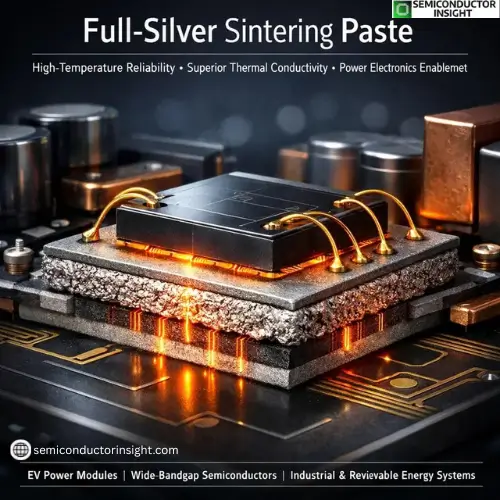
Full-Silver Sintering Paste Market Analysis: Supporting the Future of Power Electronics
In the semiconductor world, innovation is often associated with chips, architectures, and fabrication nodes. Yet beneath these visible advancements sits a class of materials that quietly determines reliability, lifespan, and thermal stability.
Full-silver sintering paste belongs firmly in this category. It is not a consumer-facing product, nor a headline-grabbing technology but it is increasingly becoming indispensable wherever high power, elevated temperatures, and long operational cycles intersect.
Before Proceeding, Feel Free to Overlook Our Updated Report:
https://semiconductorinsight.com/report/global-full-silver-sintering-paste-market/
What Full-Silver Sintering Paste Actually Does?
At its core, full-silver sintering paste functions as a die-attach material. Unlike traditional solders, it forms a porous silver network during sintering that creates an exceptionally strong metallurgical bond. This structure allows heat and electrical current to move efficiently while maintaining mechanical integrity under stress.
The shift toward wide-band gap semiconductors such as silicon carbide and gallium nitride has amplified the importance of this paste. Conventional interconnect materials struggle at the higher junction temperatures these devices reach, while silver sintering remains stable and conductive.
Manufacturing Shifts Influencing Material Choices
Another force shaping this market comes from changes inside semiconductor assembly lines. Automation, thinner die designs, and compact module layouts leave little margin for material failure. Sintering paste supports these trends by enabling thinner bond lines without compromising strength.
At the same time, pressure-assisted and pressure-less sintering techniques are becoming more refined. This allows manufacturers to integrate silver sintering into existing production flows without excessive capital upgrades, accelerating adoption.
Why Power Electronics Are Driving Market Momentum?
Power modules used in electric vehicles, renewable energy inverters, and industrial motor drives operate in demanding conditions. They face repeated thermal cycling, vibration, and continuous high current loads. Manufacturers are increasingly prioritizing materials that extend module lifetime rather than merely meeting baseline performance requirements.
Full-silver sintering paste aligns with this priority. Its ability to withstand temperatures beyond 250°C, combined with low electrical resistance, makes it well suited for next-generation power devices where reliability directly impacts safety and efficiency.
Supply Considerations and Cost Sensitivity
Silver is a precious metal, and pricing volatility naturally affects procurement decisions. However, buyers increasingly view full-silver sintering paste through a total-cost-of-ownership lens. Reduced failure rates, longer device lifespans, and improved thermal efficiency often outweigh the initial material expense.
From a supply perspective, paste formulation consistency and particle size control are critical. Semiconductor manufacturers tend to favor suppliers that offer stable quality, technical collaboration, and long-term sourcing reliability rather than spot-market pricing advantages.
For a more thorough report, please contact us using our most recent report:
https://semiconductorinsight.com/report/global-full-silver-sintering-paste-market/
Performance Attributes Valued by End Users
While specifications vary by application, certain performance characteristics consistently influence purchasing decisions:
- Strong thermal conductivity supporting efficient heat dissipation
- Mechanical resilience under repeated temperature cycling
- Compatibility with high-power semiconductor substrates
- Stable electrical performance over extended operating periods
These attributes are particularly important in automotive power electronics, where component failure can trigger costly recalls and reputational damage.
Emerging Applications Expanding the Market Scope
Beyond automotive and industrial uses, full-silver sintering paste is finding increasing relevance in renewable energy systems, rail traction modules, and aerospace electronics. These sectors demand materials that perform reliably over decades rather than years.
As energy efficiency regulations tighten and system voltages increase, the need for robust interconnect materials continues to grow, indirectly supporting market expansion.
Regulatory and Environmental Considerations
Environmental compliance is another subtle but meaningful factor. Compared with some traditional soldering materials, silver sintering aligns better with lead-free and high-temperature reliability requirements. While sustainability discussions rarely centre on die-attach materials, regulatory alignment still influences long-term material strategy for semiconductor manufacturers.
Strategic Insight: Why This Market Matters
The Full-Silver Sintering Paste Market is not driven by volume growth alone. Its relevance stems from how closely it is tied to the future of power electronics. As devices become more powerful, compact, and thermally demanding, the materials that hold them together become just as critical as the silicon itself.
Companies that invest early in sintering-compatible designs and reliable paste formulations are positioning themselves for long-term competitiveness as power electronics move into more demanding environments.
Closing Perspective
Full-silver sintering paste may never appear on a consumer specification sheet, but its role is foundational. It supports the silent performance gains behind electric mobility, renewable energy infrastructure, and advanced industrial automation. As semiconductor packaging requirements continue to intensify, this material’s importance is set to deepen rather than fade.

Comments (0)