
From Interface to Integration: USB Bridge ICs Market Trends and Strategic Insights
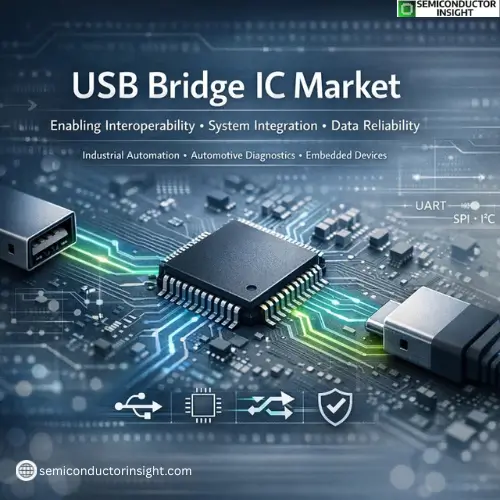
Every modern electronic system relies on seamless data exchange between components that do not naturally speak the same digital language. USB bridge integrated circuits quietly perform this translation, enabling communication between USB ports and protocols such as UART, SPI, I²C, or parallel interfaces.
As industrial equipment, consumer electronics, automotive modules, and test instruments continue to converge around USB as a universal interface, these ICs have moved from peripheral components to critical system enablers. Their role is no longer limited to connectivity it directly influences device compatibility, data reliability, and user experience.
Functional Definition and Industry Scope
- A USB bridge IC acts as an intermediary silicon solution that converts USB signals into alternative communication standards used by microcontrollers, sensors, and embedded systems.
- This function simplifies system architecture, reduces firmware complexity, and accelerates product development timelines.
- The aimed market spans high-volume consumer electronics, precision industrial automation, diagnostic medical devices, and configuration tools used during semiconductor validation and testing.
- Demand growth mirrors the broader expansion of embedded systems across connected environments.
Structural Demand Drivers across Sectors
The adoption curve of USB Bridge ICs is shaped by practical engineering needs rather than short-term trends. Developers favor these devices because they lower design risk and improve interoperability.
Industrial automation continues to rely on USB-enabled configuration tools and gateways. Automotive electronics increasingly use USB bridges during diagnostics and calibration stages. In consumer products, USB bridge ICs support firmware updates, data logging, and peripheral connectivity without complex redesign.
Technology Evolution Pathway
Legacy Interface Devices → USB Adoption Standardization → Protocol Translation Need → USB Bridge IC Integration → Simplified System Design → Faster Product Deployment
Import & Export and Global Trade Considerations
USB Bridge ICs participate in a globally distributed semiconductor supply chain. Design leadership often resides in North America and parts of Europe, while fabrication, assembly, and testing are largely concentrated in East Asia.
Export controls related to semiconductor components rarely target USB bridge ICs directly, yet compliance with broader electronics trade regulations remains essential. Manufacturers shipping to automotive or medical markets must also navigate destination-specific certification requirements, influencing sourcing and logistics strategies.
Tariff structures, regional trade agreements, and component traceability expectations increasingly shape supplier selection, especially for OEMs serving regulated industries.
Regulatory and Compliance Framework
Although USB Bridge ICs are not safety devices themselves, their deployment inside regulated systems subjects them to strict compliance expectations. Electrical safety standards, electromagnetic compatibility norms, and environmental regulations govern their use.
Producers align designs with RoHS and REACH directives while ensuring compatibility with USB-IF certification guidelines. For applications embedded in medical or automotive electronics, adherence to additional quality and reliability standards becomes a prerequisite for adoption.
Design Advantages That Influence Adoption
From an engineering standpoint, USB bridge ICs offer tangible benefits that extend beyond basic connectivity.
- Reduced firmware development effort
- Faster debugging and device configuration
- Improved cross-platform compatibility
These advantages translate into shorter development cycles and predictable system behavior, especially valuable in high-volume manufacturing environments.
Limitations and Design Trade-Offs
Despite their advantages, USB Bridge ICs are not universal solutions. Bandwidth limitations can restrict suitability for data-intensive applications. Latency sensitivity may also affect real-time systems where deterministic timing is critical.
Designers must balance simplicity against performance requirements, particularly in applications where native USB microcontrollers could offer tighter integration at a higher cost.
Don’t Forget to Surf Our Updated Report for More Detailed Analysis:
https://semiconductorinsight.com/report/usb-bridge-ics-market/
Competitive Positioning and Differentiation
Market participants differentiate through driver support, operating system compatibility, power efficiency, and long-term availability. Extended lifecycle guarantees have become a decisive factor for industrial and automotive buyers seeking component stability over multiple product generations.
Vendor support quality and documentation clarity often influence purchasing decisions as much as silicon performance, reinforcing the service dimension of competition.
Application Enablement Flow
Embedded Device Design → Interface Mismatch Identified → USB Bridge IC Selection → System Integration → Field Configuration & Data Access → End-User Functionality
Final Statement
USB Bridge ICs Market represents a foundational segment within the semiconductor ecosystem quietly essential, technically precise, and structurally resilient. Its growth reflects the ongoing need for interoperability in an increasingly connected world, making it a strategic consideration for device manufacturers, system integrators, and component suppliers alike.

Comments (0)