
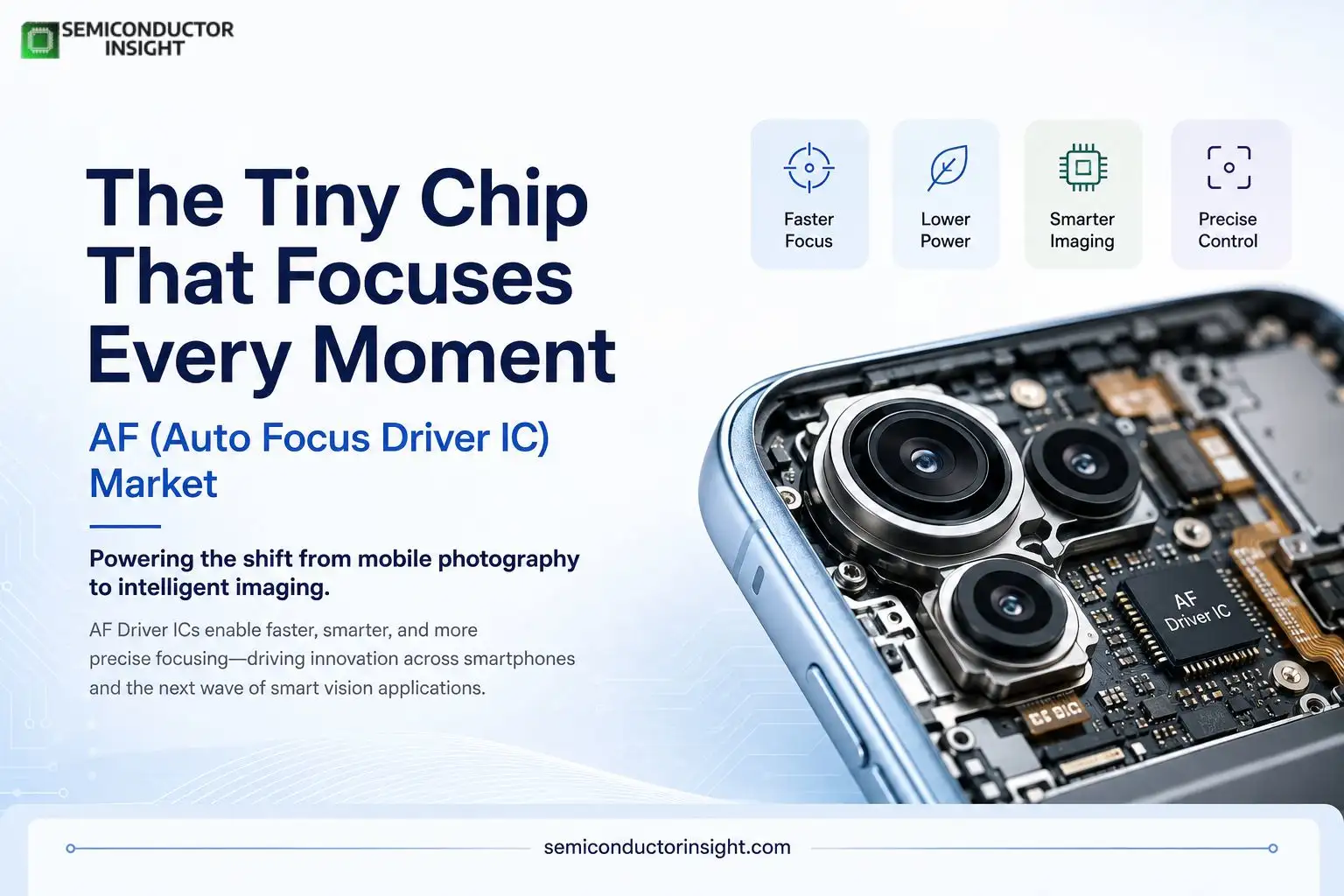
Foldable Device Expansion Creates New Momentum for the AF (Auto Focus) Driver IC Market
Every smartphone photo begins with a fraction of a second decision made inside the camera module. Before image processing software enhances colors or removes noise, the autofocus driver integrated circuit determines how quickly and accurately the camera lens reaches its focal point. As mobile photography evolves into computational imaging, AF Driver ICs have become one of the most important semiconductor components behind modern cameras.
The latest generation of autofocus driver ICs supports faster lens movement, lower power consumption, and improved compatibility with AI based imaging algorithms. Beyond smartphones, these chips are now being integrated into automotive vision systems, industrial inspection cameras, drones, medical imaging devices, and augmented reality hardware, making them a critical part of the global semiconductor ecosystem.
Why Camera Hardware Is Becoming Smarter Than Ever?
Consumers increasingly expect DSLR level image quality from pocket sized devices. This demand has pushed manufacturers to combine high resolution sensors with sophisticated autofocus technologies capable of tracking moving subjects within milliseconds.
Recent flagship smartphones now integrate multiple autofocus mechanisms including phase detection autofocus, laser autofocus, and continuous autofocus. These systems rely on dedicated AF Driver ICs that precisely control voice coil motors or piezoelectric actuators to position camera lenses with exceptional accuracy.
The Silent Semiconductor inside Every Multi Camera Smartphone
- Modern smartphones no longer depend on a single camera. Premium devices commonly include wide, ultra wide, telephoto, macro, and periscope lenses.
- Each autofocus enabled camera module requires its own driver circuitry to regulate lens positioning.
- A flagship smartphone containing four autofocus cameras may integrate four dedicated AF Driver IC channels working simultaneously with image processors.
For example, recent flagship devices from Apple, Samsung, Xiaomi, OPPO, and vivo combine optical image stabilization, autofocus, and AI image enhancement into tightly synchronized camera architectures where autofocus speed directly affects image quality during burst photography and 4K or 8K video recording.
Tiny Components Making a Big Difference in AI Photography
Artificial intelligence has transformed smartphone photography, but AI cannot compensate for inaccurate focus. This makes AF Driver IC performance increasingly valuable.
Today’s advanced driver ICs offer
- High precision motor current control
- Closed loop feedback mechanisms
- Low noise operation
- Faster lens positioning
- Reduced battery consumption
- Improved thermal efficiency
As AI engines process billions of image operations every second, autofocus hardware provides the stable optical foundation needed for computational photography features such as portrait mode, real time object tracking, night photography, and macro imaging.
Don’t Forget to Surf Our Updated Report for More Detailed Analysis: https://semiconductorinsight.com/report/af-auto-focus-driver-ic-market/
New Application Areas Expanding Beyond Consumer Electronics
Autofocus technology is rapidly moving beyond smartphones into industries where imaging precision directly impacts operational performance.
Medical endoscopes use miniature autofocus mechanisms to improve visualization during minimally invasive procedures.
Industrial machine vision cameras rely on autofocus for automated inspection of semiconductor wafers, printed circuit boards, and precision manufactured components.
Delivery drones and autonomous robots use autofocus enabled cameras to improve navigation and obstacle recognition.
Automotive driver monitoring systems increasingly integrate autofocus cameras to accurately monitor driver attention under changing lighting conditions.
These expanding applications are creating new demand for compact, energy efficient AF Driver ICs across multiple semiconductor sectors.
Engineering Priorities Changing Chip Design Strategies
- Chip designers are no longer focused solely on reducing component size. The current emphasis is on increasing responsiveness while lowering overall system power consumption.
- Recent semiconductor packaging advances enable driver ICs to occupy extremely compact footprints while supporting higher operating frequencies and better heat management.
- Manufacturers are also developing highly integrated camera control solutions combining autofocus, optical image stabilization, EEPROM management, and power regulation into fewer semiconductor packages. This integration simplifies smartphone motherboard layouts while reducing manufacturing complexity.
Manufacturing Momentum Supporting Camera Innovation
The semiconductor supply chain continues investing heavily in advanced imaging technologies.
TSMC expanded specialty semiconductor manufacturing capacity supporting image sensor related chips, while Sony Semiconductor Solutions continues increasing CMOS image sensor production for global smartphone manufacturers. At the same time, actuator manufacturers continue improving miniature voice coil motor designs capable of faster and quieter lens movement.
Industry organizations including JEITA and CIPA continue reporting steady innovation across camera components, reflecting ongoing investments in mobile imaging hardware rather than software alone.
Technology Watch
- Several developments are expected to define the next generation of AF Driver IC innovation.
- Liquid lens technologies are moving closer to commercial adoption for compact cameras.
- Periscope zoom modules continue requiring increasingly sophisticated autofocus control algorithms.
- Edge AI processors are reducing autofocus latency through on device image recognition.
- Ultra-thin foldable smartphones are encouraging the development of compact autofocus solutions that occupy less internal space without sacrificing optical performance.
As camera systems become more intelligent and imaging expectations continue rising, AF Driver ICs will remain one of the essential semiconductor building blocks enabling faster, sharper, and more reliable visual experiences across consumer electronics and industrial imaging platforms.

Comments (0)