AF (Auto Focus) Driver IC Market Insights
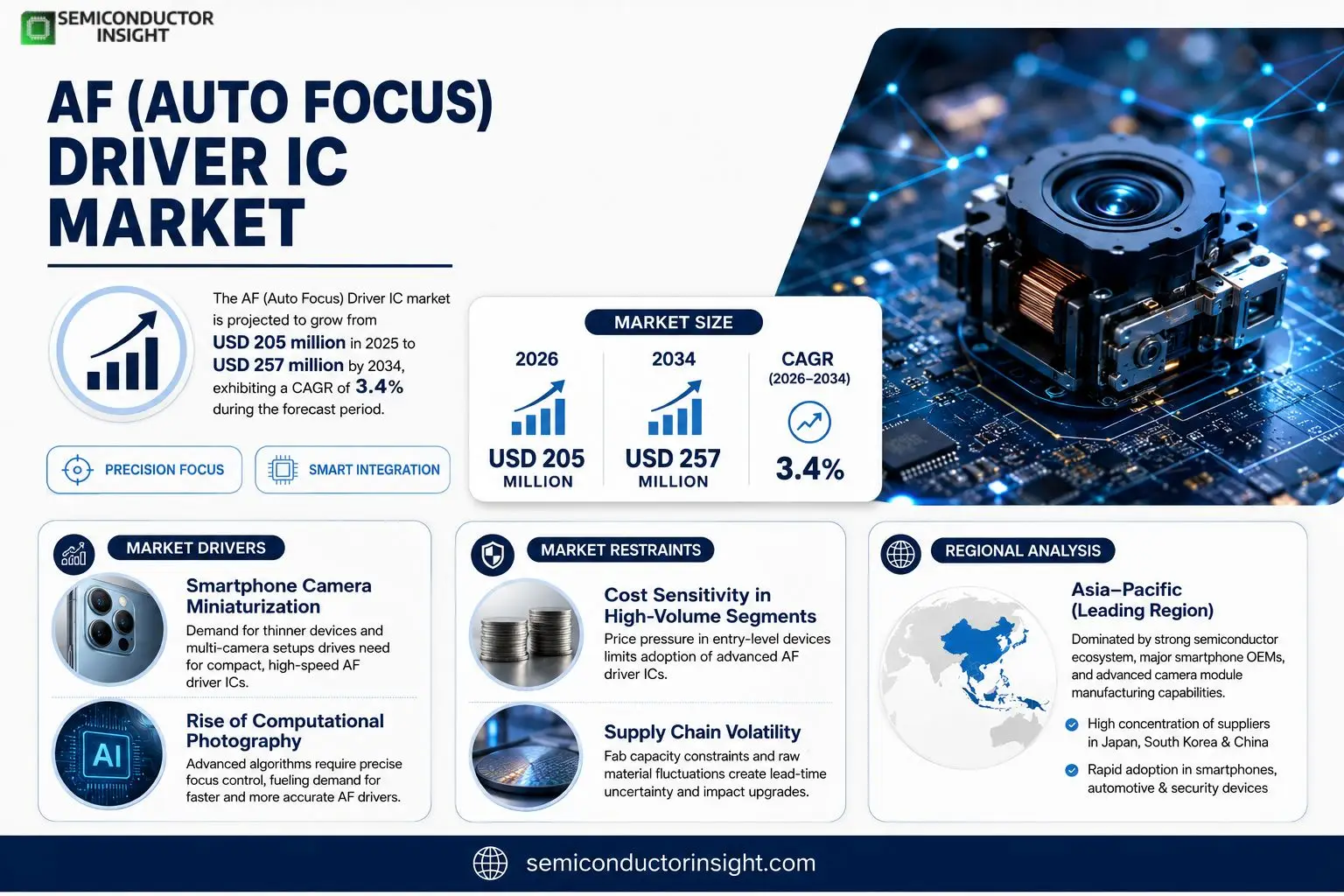
AF (Auto Focus) Driver IC market size was valued at USD 205 million in 2025. The market is projected to grow from USD 205 million in 2025 to USD 257 million by 2034, exhibiting a CAGR of 3.4% during the forecast period.
AF Driver IC is a dedicated chip used to control camera module actuators. Its core role is to drive voice‑coil motors, stepper motors, or other miniature actuators under tight power and package constraints so as to move the lens, achieve fast focus lock, provide soft landing, and suppress ringing, thereby improving image sharpness, focusing speed, and shooting stability. Product architectures have evolved from early open‑loop AF drivers to layered solutions that support bidirectional VCM control, embedded EEPROM, closed‑loop Hall feedback,and integrated AF plus OIS control and processing. Typical functions include DAC current setting,I²C control,mechanical ringing suppression,position correction,temperature compensation,and multi‑camera switching support.The market expands because smartphone camera modules continue demanding higher focus speed while keeping power consumption low. Simultaneously,the rise of tablets,digital cameras,security cameras,web cameras,and emerging AR devices or drones adds fresh demand streams. Leading vendors such as Renesas Electronics Corporation,ZINITIX Co., Ltd.,Shanghai Awinic Technology Co., Ltd.,Giantec Semiconductor Corporation,and Texas Instruments Incorporated are integrating AF with OIS or on‑chip processingshifting competition from basic driver performance toward system‑level precision control.
MARKET DRIVERS
Smart‑Phone Camera Miniaturization
The relentless push for thinner smartphones forces camera modules to shrink while retaining performance. AF (Auto Focus) Driver ICs that deliver high‑speed lens actuation in a compact footprint become essential components, allowing manufacturers to meet consumer demand for slim profiles without compromising image quality.
Rise of Computational Photography
Algorithms that blend multiple exposures rely on precise focus control to capture the raw data needed for post‑processing. This technical requirement fuels demand for driver ICs capable of sub‑millisecond response times, directly influencing the competitive edge of flagship devices.
➤ Manufacturers that integrate next‑generation AF driver ICs can shorten product development cycles, because fewer mechanical iterations are required to achieve target focus accuracy.
Beyond mobile, automotive ADAS cameras and surveillance systems are adopting higher‑resolution optics. The same focus‑control logic that powers consumer gadgets now underpins safety‑critical applications, expanding the addressable market for specialized driver ICs.
MARKET CHALLENGES
Cost Sensitivity in High‑Volume Segments
While premium devices can absorb advanced driver IC pricing, volume‑driven segments such as entry‑level tablets and IoT cameras operate under tight margin constraints. Suppliers must balance performance gains with unit‑cost reductions, a tension that slows adoption of cutting‑edge silicon.
Other Challenges
Supply‑Chain Volatility
Fluctuations in semiconductor fab capacity and raw‑material pricing introduce lead‑time uncertainty. OEMs facing unpredictable component availability may defer upgrades, limiting short‑term market acceleration.
MARKET RESTRAINTS
Regulatory and Safety Standards
Automotive and medical imaging applications impose stringent certification processes. Achieving compliance often requires additional testing cycles, raising development costs and extending time‑to‑market for driver ICs intended for these regulated domains.In regions where electromagnetic interference (EMI) standards are tightening, designers must incorporate extra shielding or filtering within the driver IC package. This design overhead can deter some manufacturers from pursuing the most advanced focus‑control architectures.
MARKET OPPORTUNITIES
Integration of AI‑Assisted Focus Algorithms
Embedding lightweight neural‑network inference directly into the driver IC opens pathways for on‑chip predictive focusing. Such integration reduces latency, conserves power, and creates a compelling value proposition for devices that need real‑time scene adaptation.Emerging form factorsfoldable phones, AR glasses, and compact dronesrequire driver ICs that can operate across wider temperature ranges while maintaining sub‑micron precision. Companies that engineer robust, low‑power solutions for these niches stand to capture a growing slice of AF (Auto Focus) Driver IC Market.
AF (Auto Focus) Driver IC Market Trends
Architectural Convergence and Functional Integration
Product designs have moved from simple open‑loop drivers to layered solutions that combine bidirectional voice‑coil control, on‑chip EEPROM, Hall‑sensor feedback and integrated optical‑image‑stabilization (OIS) processing. The added functionscurrent DAC setting, I2C command handling, mechanical ringing suppression and temperature compensationallow a single chip to manage multiple camera modules in premium smartphones. This shift reflects manufacturers’ response to tighter space budgets, stricter power envelopes and the market’s demand for faster focus lock and smoother lens landing. As a result, AF (Auto Focus) Driver IC Market now values system‑level precision more than raw transistor count.
Other Trends
Diversifying Application Base
While smartphones remain the dominant destination, the driver pool is spilling over into tablets, security cameras, web‑cams, action cameras, augmented‑reality headsets and unmanned aerial vehicles. Each new segment imposes distinct mechanical tolerancese.g., rugged vibration in drones or low‑light performance in security systemsprompting vendors to offer configurable firmware and multi‑camera switching support. The broadened portfolio mitigates reliance on smartphone shipment cycles and creates incremental revenue streams from niche but growing device categories.
Regional Competitive Landscape
Supply concentration persists in East Asia, with Japanese and Korean firms leading high‑performance closed‑loop designs, while Chinese companies such as Awinic, Giantec and Chipsemicorp have accelerated product roll‑outs for mid‑tier modules. Domestic subsidies and a strategic push for semiconductor localization give Chinese suppliers a foothold in regional OEM supply chains, especially for cost‑sensitive devices. Nevertheless, premium smartphone makers still favor the proven reliability of Japanese and Korean silicon, preserving a bifurcated market where high‑end and volume‑oriented segments are serviced by different regional champions.
Strategic Implications for OEMs and Suppliers
The market is forecast to reach US$ 257 million by 2034, up from US$ 205 million in 2025, with a compound annual growth of roughly 3.4 %. Growth will be driven less by unit volume and more by value‑added features such as closed‑loop stability, thermal drift control and seamless multi‑camera coordination. OEMs that embed these capabilities can command higher bill‑of‑materials pricing and lock in supply agreements with tier‑1 silicon providers. For suppliers, building expertise in algorithmic lens control and offering turnkey tuning services will differentiate them in a segment where technical margins matter more than sheer sales volume.
COMPETITIVE LANDSCAPE
Key Industry Players
Competitive Dynamics in the AF Driver IC Market
Renesas Electronics dominates the premium segment, leveraging its deep heritage in precision motor control to deliver bidirectional VCM drivers with integrated Hall feedback. Its ability to marry low‑power operation with high‑accuracy positioning has secured design wins in flagship smartphones and advanced tablet cameras. Texas Instruments follows with a broad portfolio that emphasizes modularity, allowing OEMs to scale from entry‑level to high‑end modules without redesigning the driver architecture. ROHM’s strength lies in its compact packaging, a decisive factor for ultra‑thin devices, while ZINITIX differentiates itself through on‑chip EEPROM that supports field‑tunable focus curves, a feature increasingly demanded by multi‑camera platforms.Smaller yet agile firms are reshaping the competitive landscape. Shanghai Awinic Technology and Giantec Semiconductor have accelerated their market share in China by offering open‑loop VCM drivers that integrate seamlessly with local camera module suppliers. Shenzhen Chipsemicorp Technology targets niche applications such as AR headsets and drones, where rapid focus lock and vibration tolerance are critical. Dongwoon Anatech, Weltrend Semiconductor, and Himax provide hybrid solutions that combine AF and OIS functions, enabling system‑level optimization for premium imaging. Analog Devices and STMicroelectronics, although not traditional players in this niche, are entering the space with highly integrated sensor‑processor combos that embed AF driver logic, hinting at a consolidation trend toward multifunctional imaging chips.
List of Key AF Driver IC Companies Profiled
- Renesas Electronics Corporation
- Texas Instruments Incorporated
- ROHM Co., Ltd.
- ZINITIX Co., Ltd.
- Dongwoon Anatech Co., Ltd.
- Shanghai Awinic Technology Co., Ltd.
- Giantec Semiconductor Corporation
- Shenzhen Chipsemicorp Technology Co., Ltd.
- Weltrend Semiconductor, Inc.
- Himax Technologies, Inc.
- Analog Devices, Inc.
- STMicroelectronics
Segment Analysis:
| Segment Category | Sub-Segments | Key Insights |
| By Type |
|
Closed Loop VCM Driver IC
|
| By Application |
|
Smartphones and Tablets
|
| By End User |
|
Camera Module Manufacturers
|
| By Integration Level |
|
AF‑OIS Combined Drivers
|
| By Competitive Landscape |
|
Japanese & Korean Premium Suppliers
|
Regional Analysis: AF (Auto Focus) Driver IC Market
North America
The concentration of design talent in Silicon Valley and surrounding tech corridors fuels a continuous pipeline of novel driver architectures. Companies exploit close proximity between silicon engineers and optical specialists to co‑develop ICs that trim latency while preserving image fidelity, a combination prized by premium device makers.
Recent geopolitical shifts prompted North American firms to diversify sourcing, reinforcing domestic wafer capacity and establishing strategic inventories of key substrates. This approach cushions the market from external disruptions, ensuring steady component flow for volume manufacturers.
Stringent safety standards for automotive cameras and electromagnetic compliance for consumer electronics drive meticulous qualification processes. Firms that embed compliance early in the design stage gain faster certification timelines and stronger brand credibility.
End‑users increasingly favor devices that deliver instant focus across a broader range of lighting conditions. This demand pressures driver IC suppliers to improve low‑light performance and power‑efficiency, prompting a wave of algorithmic and circuit‑level refinements.
Europe
European manufacturers leverage a strong heritage in precision optics, translating into a nuanced market for AF (Auto Focus) Driver ICs that prioritize accuracy over raw speed. Collaborative research programs across Germany, France and the Nordics align semiconductor capabilities with emerging augmented‑reality applications, where focus fidelity directly influences user immersion. Policy incentives for green electronics also nudge firms toward driver designs with reduced power draw, supporting the region’s broader sustainability agenda. While the volume of units trails North America, European players compensate with high‑margin, technologically differentiated solutions that command premium pricing in specialty camera segments.
Asia‑Pacific
Asia‑Pacific remains the most diversified arena for AF (Auto Focus) Driver ICs, driven by a blend of mass‑market smartphone manufacturers and a burgeoning automotive camera ecosystem. The region’s cost‑effective fab landscape enables rapid scaling of new node designs, allowing suppliers to respond to fierce price competition without sacrificing core performance attributes. Emerging markets in Southeast Asia are expanding the consumer base for mid‑tier devices, prompting firms to balance feature sets with affordability. Simultaneously, Japan and South Korea continue to push the envelope on high‑resolution sensor integration, influencing driver IC development toward higher data rates and tighter thermal envelopes.
South America
In South America, modest device penetration rates create a market where price sensitivity dominates purchasing decisions for AF (Auto Focus) Driver ICs. Local assemblers often rely on imported driver modules, but a growing interest in regional design capability is sparking modest R&D investments in Brazil and Argentina. These initiatives focus on adapting existing driver architectures to operate efficiently under the region’s diverse climate conditions, thereby extending product lifespans. Although the overall market share is limited, strategic partnerships with North American firms provide technology transfer pathways that could accelerate capability building over the next decade.
Middle East & Africa
The Middle East & Africa exhibits a fragmented landscape for AF (Auto Focus) Driver ICs, where niche demand arises from defense‑grade imaging systems and premium mobile segments in affluent Gulf states. Companies operating in this space prioritize ruggedness and reliability, tailoring driver specifications to withstand extreme temperature fluctuations and dust exposure. In Africa, a slow but steady rise in smartphone adoption fuels a modest need for cost‑effective driver solutions, encouraging suppliers to explore localized assembly hubs to reduce logistics costs. The region’s regulatory environment remains fluid, prompting vendors to adopt flexible compliance strategies that can adapt to evolving standards.
Report Scope
This market research report provides a comprehensive analysis of the AF (Auto Focus) Driver IC Market , covering the forecast period 2026–2034. It offers detailed insights into market dynamics, technological advancements, competitive landscape, and key trends shaping the industry.
Key focus areas of the report include:
- Market Overview: The report begins with an overview outlining its current market scenario, key growth indicators, and industry transformation drivers. It discusses macroeconomic factors, demand–supply balance, regulatory landscape, and the strategic role of semiconductors in powering advancements across industries such as automotive, telecommunications, consumer electronics, and industrial automation.
- Market Size & Forecast: Historical data and future projections for revenue, unit shipments, and market value across major regions and segments.
- Segmentation Analysis: Detailed breakdown by product type, technology, application, and end-user industry to identify high-growth segments and investment opportunities.
- Regional Insights: Insights into market performance across North America, Europe, Asia-Pacific, Latin America, and the Middle East & Africa, including country-level analysis where relevant.
- Competitive Landscape: Profiles of leading market participants, including their product offerings, R&D focus, manufacturing capacity, pricing strategies, and recent developments such as mergers, acquisitions, and partnerships.
- Technology Trends & Innovation: Assessment of emerging technologies, integration of AI/IoT, semiconductor design trends, fabrication techniques, and evolving industry standards.
- Market Drivers & Restraints: Evaluation of factors driving market growth along with challenges, supply chain constraints, regulatory issues, and market-entry barriers.
- Stakeholder Insights: Insights for component suppliers, OEMs, system integrators, investors, and policymakers regarding the evolving ecosystem and strategic opportunities.
Primary and secondary research methods are employed, including interviews with industry experts, data from verified sources, and real-time market intelligence to ensure the accuracy and reliability of the insights presented.
FREQUENTLY ASKED QUESTIONS:
What is the current market size of AF (Auto Focus) Driver IC Market?
-> AF (Auto Focus) Driver IC Market was valued at USD 205 million in 2025 and is expected to reach USD 257 million by 2034, at a CAGR of 3.4% during the forecast period.
Which key companies operate in AF (Auto Focus) Driver IC Market?
-> Key players include Texas Instruments Incorporated, Renesas Electronics Corporation, ROHM Co., Ltd., ZINITIX Co., Ltd., Dongwoon Anatech Co., Ltd., Shanghai Awinic Technology Co., Ltd., Giantec Semiconductor Corporation, Shenzhen Chipsemicorp Technology Co., Ltd., Weltrend Semiconductor, Inc..
What are the key growth drivers?
-> Key growth drivers include smartphone camera upgrades, multi‑camera adoption, integration of AF with OIS, higher focus speed and accuracy requirements, and expanding applications in tablets, AR devices, drones, and security cameras.
Which region dominates the market?
-> Asia‑Pacific dominates the market, driven by major semiconductor suppliers in Japan, South Korea, and China and the high concentration of smartphone OEMs.
What are the emerging trends?
-> Emerging trends include bidirectional VCM drive, closed‑loop Hall feedback, ringing suppression and soft‑landing techniques, integration of AF with OIS and on‑chip processing, and AI‑assisted focus algorithms.
Get Sample Report PDF for Exclusive Insights
Report Sample Includes
- Table of Contents
- List of Tables & Figures
- Charts, Research Methodology, and more...
 Download Sample Report PDF