
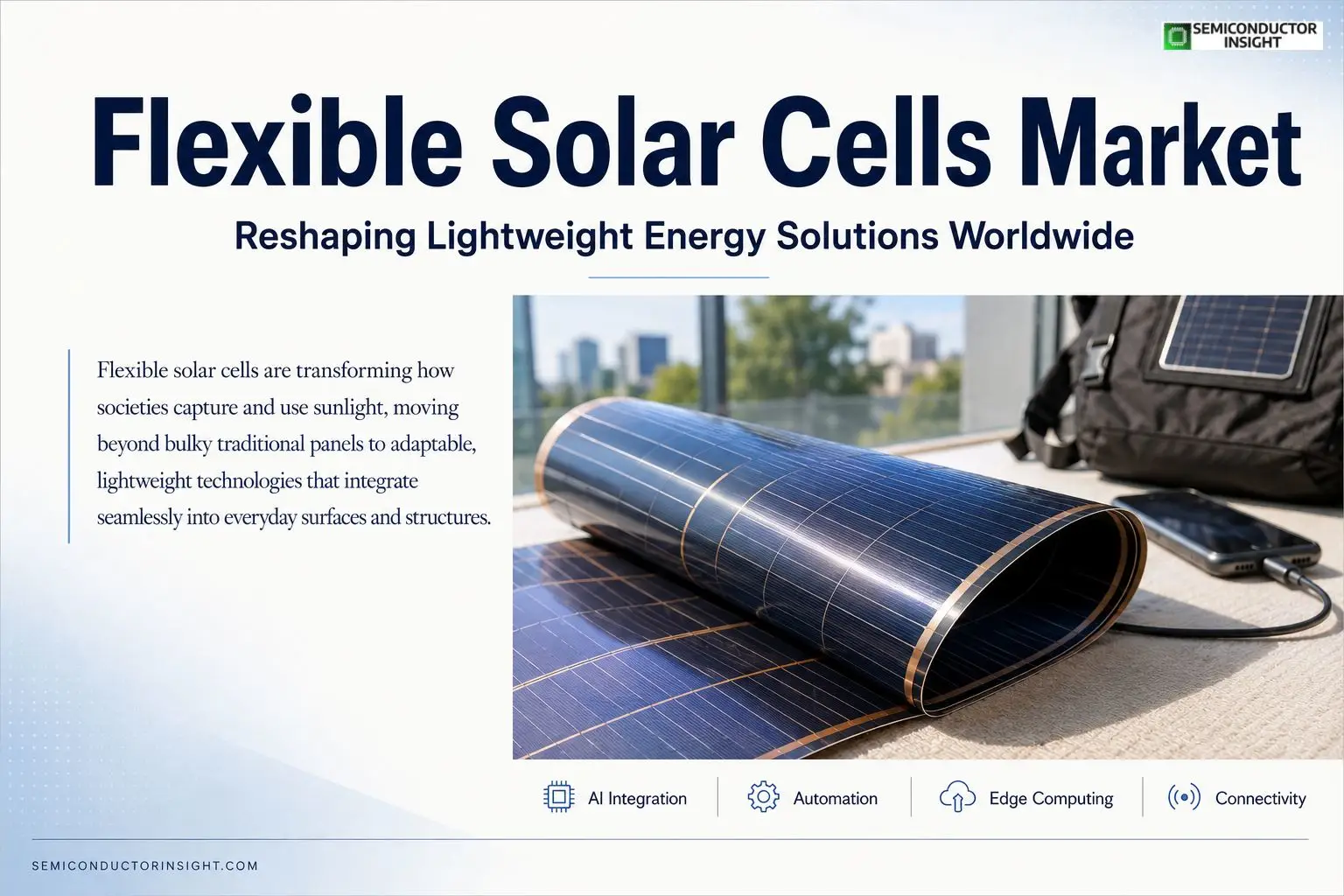
Flexible Solar Cells Market Reshaping Lightweight Energy Solutions Worldwide
Flexible solar cells are transforming how societies capture and use sunlight, moving beyond bulky traditional panels to adaptable, lightweight technologies that integrate seamlessly into everyday surfaces and structures.
These innovations stem from advancements in thin-film materials like CIGS (copper indium gallium selenide), amorphous silicon, and organic photovoltaics, enabling applications that rigid silicon cells cannot match.
Pioneering Fabrication Techniques Driving Adaptability
· Researchers continue pushing boundaries in production methods that allow solar materials to be deposited on unconventional substrates.
· At MIT, engineers developed ultrathin solar cells, thinner than a human hair and about one-hundredth the weight of conventional panels, using scalable techniques with electronic inks and slot-die coating.
· These cells adhere to fabrics or any surface, producing power efficiently while retaining performance after repeated rolling or folding.
· Such approaches lower material use dramatically and open pathways for rapid deployment in scenarios requiring portability or conformity to curved shapes.
· Vapor deposition at low temperatures, under 120°C, even permits printing-like processes on ordinary paper or textiles, making manufacturing potentially as accessible as consumer printing while maintaining functionality after extreme mechanical stress.
Trusted Solutions Driving Results in Tough Conditions
Companies like Ascent Solar Technologies demonstrate practical success with flexible CIGS modules manufactured on thin polyimide substrates via roll-to-roll processes. These panels achieve high specific power around 48 watts per kilogram and extreme bendability, suiting aerospace, military, unmanned vehicles, and off-grid uses where weight and durability matter most. Their Thornton, Colorado facility supports ongoing optimization for demanding conditions, including potential space applications.
In building contexts, thin-film laminates install directly onto roofs or walls without heavy mounting systems, reducing structural loads and installation costs. Historical examples include early integrations in structures like 4 Times Square, where transparent thin-film elements contributed to on-site generation. Modern efforts extend this to curved surfaces, temporary setups, and even clothing for powering portable devices.
Material Innovations Enhancing Durability and Efficiency
ü Thin-film technologies, including CdTe and CIGS on flexible backings, offer inherent advantages in weight and form factor. Wikipedia notes that these second-generation cells use far less active material than wafer-based silicon, supporting lower ecological footprints in production while enabling building-integrated photovoltaics (BIPV). Lab efficiencies for flexible variants have climbed, with some GaAs thin-film cells reaching over 29% in single-junction formats.
ü Ongoing work on foldable crystalline silicon wafers involves surface texturing and blunting techniques to improve mechanical resilience. Treated wafers survived 1,000 fold cycles with no performance loss and efficiencies around 24.5%, showing potential to blend silicon’s reliability with flexibility.
ü Organic and perovskite-based flexible cells further expand options, with research focusing on stability against moisture and oxygen through protective coatings like fluoropolymers. These developments address longevity concerns for outdoor exposure while preserving the core benefits of bendability.
Global Momentum through Policy and Research Collaboration
Government and institutional support accelerates progress. Initiatives from bodies like the U.S. Department of Energy and National Renewable Energy Laboratory back thin-film advancements, aligning with broader renewable goals. International research, including collaborations on high-altitude platforms and satellites, leverages flexible cells’ low mass for aerospace missions.
Case studies from cooperative programs and community projects illustrate deployment in diverse settings, from remote electrification to urban retrofits, where adaptability provides key advantages over fixed installations.
Emerging Integration in Wearable’s, Transportation, and beyond
Imagine solar-powered textiles charging devices on the go or flexible arrays on vehicle surfaces extending range. MIT’s fabric-integrated cells, weighing a fraction of standard modules yet delivering substantial output per kilogram, point toward disaster relief tarps, drone wings, and architectural elements that generate power invisibly.
Aerospace applications benefit from reduced payload weight, while consumer electronics and building facades gain new energy-harvesting potential. These shifts support distributed generation models, enhancing resilience in grids facing variable demand.
At Last, before Ending, Don’t Forget to Browse Our Recent Exclusive Report for Detailed Insights: https://semiconductorinsight.com/report/flexible-solar-cells-market/
Sustainability and Scalability Considerations
Ø Flexible cells often require less energy to produce and generate lower emissions across life cycles compared to some alternatives. Recycling programs for thin-film modules, particularly those handling cadmium or other elements responsibly, are expanding to close material loops. Scalable printing and roll-to-roll methods promise cost reductions as production volumes grow.
Ø Challenges remain in balancing efficiency, stability, and cost at commercial scales, yet cumulative improvements position these technologies as complements to traditional solar in a diversified renewable portfolio.
Pathways Forward for Widespread Adoption
As fabrication matures and real-world performance data accumulates, flexible solar cells are poised to play a larger role in portable power, integrated architecture, and specialized sectors. Continued cross-disciplinary efforts from materials science to system integration will determine how quickly they move from research labs and niche deployments into mainstream energy systems.
This evolution reflects a broader transition toward energy solutions that are not only cleaner but also more adaptable to human needs and environments. The flexible solar cells market continues gaining traction through these tangible innovations and applications.

Comments (0)