

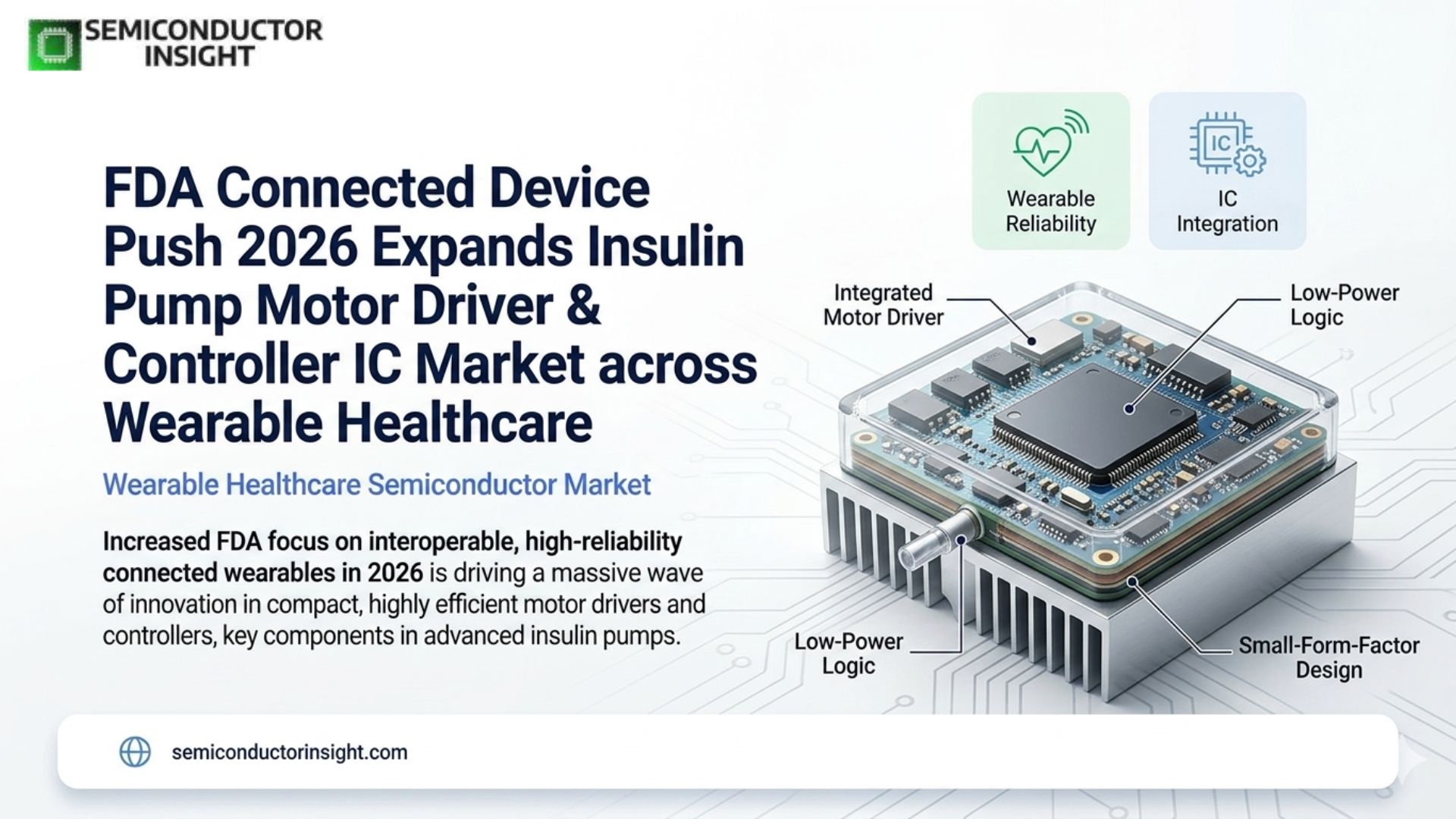
FDA Connected Device Push 2026 Expands Insulin Pump Motor Driver & Controller IC Market across Wearable Healthcare
Insulin pump motor driver & controller IC market is becoming one of the most specialized corners of the semiconductor industry. These chips function in systems where accuracy can directly impact patient safety, in contrast to consumer gadgets, where performance frequently centred on speed and enjoyment. Every micro movement inside an insulin pump depends on compact motor driver ICs and precision controller chips that regulate dosage flow, battery efficiency, pressure sensing, and wireless connectivity.
- The rising adoption of wearable diabetes technologies is placing semiconductor manufacturers in a unique position.
- Medical device makers are no longer looking only for compact chips.
- They want ultra low power architectures, noise resistant analog circuitry, integrated safety systems, and real time communication capability inside miniature packages that can operate continuously for several days.
According to the International Diabetes Federation, more than 537 million adults worldwide were living with diabetes in 2021, while projections indicate this figure may surpass 640 million before 2030. This expanding patient population is increasing demand for wearable insulin delivery systems and indirectly strengthening demand for advanced semiconductor components used inside those devices.
Silicon Innovation Is Now Focused on Microliter Accuracy
- Modern insulin pumps rely on miniature motors capable of delivering extremely small insulin quantities with consistent precision.
- A small error in motor rotation or pulse timing can impact glucose management. This has pushed semiconductor firms to design motor driver ICs capable of ultra fine motion control under strict power constraints.
- Several recent insulin pump platforms now integrate closed loop functionality where glucose monitoring sensors communicate continuously with controller ICs.
- These chips analyze sensor inputs and automatically adjust insulin delivery without requiring constant user intervention.
- In 2025, wearable diabetes systems increasingly adopted low power ARM based microcontrollers combined with highly integrated motor driver chips supporting continuous operation for up to seven days on compact rechargeable batteries.
- Semiconductor suppliers are focusing heavily on reducing heat generation and improving fault detection logic to support medical compliance standards.
Curious about the report? Dive into our newest updated version at no cost: https://semiconductorinsight.com/report/insulin-pump-motor-driver-controller-ic-market/
Ultra Compact Packaging Is Becoming a Competitive Advantage
The race toward smaller wearable medical devices is changing semiconductor packaging strategies. Patients increasingly prefer discreet insulin pumps that can fit comfortably beneath clothing or attach directly to the skin. This demand has encouraged chipmakers to develop wafer level chip scale packaging and advanced system in package designs.
Recent wearable insulin patch pumps entering the North American and European markets contain multiple semiconductor components within extremely compact footprints often smaller than a wristwatch circuit board. These designs combine motor controllers, Bluetooth modules, power management ICs, memory units, and security processors into tightly integrated assemblies.
Medical electronics engineers are also prioritizing electromagnetic interference reduction because insulin delivery systems must maintain stable operation around smartphones, wireless earbuds, and other connected electronics used daily by patients.
Battery Efficiency Has Become a Defining Engineering Battle
Battery performance is now one of the biggest differentiators in insulin pump design. Semiconductor companies are investing heavily in ultra low leakage architectures to extend wearable operating times without increasing battery size.
- Some advanced insulin pumps now consume less than 100 microamps during idle monitoring states. This efficiency allows compact devices to operate continuously while maintaining wireless communication with smartphones and glucose monitoring sensors.
- Texas Instruments and Analog Devices have both expanded low power medical semiconductor portfolios targeting wearable healthcare systems. Meanwhile, manufacturers in Japan and South Korea are focusing on miniature motor control solutions optimized for silent operation inside portable medical devices.
The healthcare wearable sector also continues to expand rapidly. According to data published by the World Health Organization and various healthcare technology publications, wearable medical electronics shipments crossed several hundred million units globally in recent years, creating substantial semiconductor integration opportunities beyond diabetes devices alone.
Artificial Intelligence Is Quietly Entering Pump Electronics
Artificial intelligence is no longer limited to cloud software platforms. Semiconductor companies are increasingly embedding AI assisted processing inside wearable medical electronics.
Some next generation controller ICs can now analyze glucose patterns, detect abnormal delivery behavior, and support predictive insulin adjustments directly on device hardware. Edge AI processing reduces dependence on cloud connectivity while improving response speed for automated insulin systems.
Several diabetes technology companies showcased AI assisted insulin delivery systems during recent healthcare technology exhibitions in the United States and Europe. These systems depend heavily on efficient mixed signal semiconductor architectures capable of balancing analog sensing, motor control, wireless communication, and local data processing simultaneously.
Cybersecurity Chips Are Becoming Essential inside Medical Wearable’s
As insulin pumps become connected devices, cyber security has become a critical semiconductor design priority. Regulatory authorities increasingly expect secure wireless communication and encrypted firmware systems within wearable healthcare products.
Modern controller ICs now integrate hardware security modules capable of secure boot authentication, encrypted Bluetooth communication, and firmware tamper protection. These additions are particularly important because connected insulin pumps often communicate directly with smartphones and cloud monitoring applications.
In 2024 and 2025, several medical device manufacturers expanded investments in cybersecurity validation after global healthcare regulators strengthened connected device security expectations. Semiconductor firms specializing in embedded medical security architectures are expected to benefit significantly from these regulatory changes.

Comments (0)