
Exploring Liquid Delivery System for Semiconductor Market Dynamics
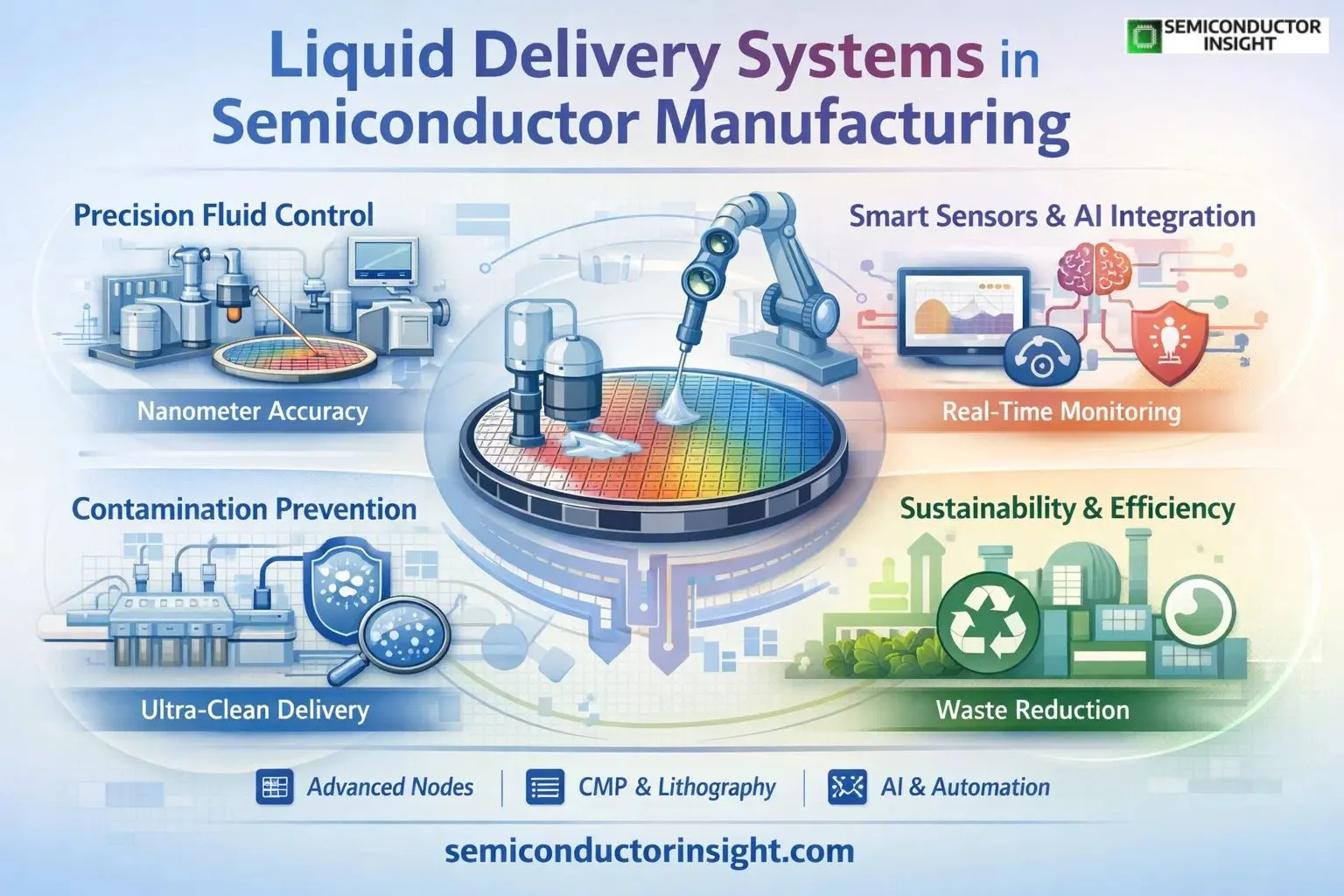
Liquid Delivery System (LDS) technology has become a pivotal cornerstone in the semiconductor fabrication landscape, enabling accurate dispensing of chemicals, dopants, and specialty fluids used during wafer processing. As device geometries shrink and complexity rises, LDS precision is not just a performance advantage it’s a manufacturing necessity.
Today’s semiconductor fabs can process thousands of wafers monthly, where even nanoliter mismatches in fluid delivery can ripple into severe yield loss. Recent advances in automated flow sensors, machine-learning control loops, and contamination-free materials are redefining expectations for what LDS must deliver.
Why LDS Is Critical for Advanced Nodes?
In the era of 3 nm and below technology nodes, integrated circuits demand extreme precision for chemical mechanical polishing (CMP), photolithography coating/developing, and plasma-enhanced processes. LDS provides measured delivery of photoresists, developers, and specialty gases, directly affecting line edge roughness, critical dimension control, and layer uniformity.
A recent feature article in Semiconductor Digest highlighted how a leading fab in Taiwan optimized its CMP slurry delivery using adaptive LDS feedback, resulting in a 15% yield improvement at advanced nodes a gain that can translate to tens of millions of dollars given wafer fabs’ scale.
Smart Sensors and Real-Time Control
Traditional LDS solutions relied on fixed metering pumps or manual calibrations. That paradigm is shifting with smart sensor integration and software automation.
Innovations like ultrasonic flow metering, pressure-compensated delivery heads, and closed-loop control systems ensure fluid volumes are delivered with micron-level accuracy. According to an article in Control Engineering Magazine, some fabs are now deploying LDS systems capable of self-calibration by analysing feedback from inline quality sensors during runs effectively reducing downtime caused by misdispensed fluids.
For Example: Adaptive LDS in Photoresist Application
Photoresist uniformity is a foundational requirement for reliable patterning. A 2025 report in Solid State Technology described how a major fabrication plant in South Korea deployed an LDS setup that dynamically adjusted photoresist delivery based on real-time wafer surface imaging.
The result was a 30% reduction in line edge variations, a breakthrough for deep ultraviolet (DUV) lithography processes where consistency is paramount.
This underscores a broader shift: LDS solutions are no longer passive infrastructure but active participants in process control.
Integration with Industry 4.0 and Smart Manufacturing
LDS technology is increasingly networked into broader manufacturing execution systems (MES) and digital twins. By merging sensor data, historical batch records, and AI-powered predictions, fabs can forecast fluid usage, detect anomalies before process drift occurs, and schedule preventive maintenance preventing costly unplanned downtime.
A Manufacturing Tomorrow article showcased a California fab that reduced fluid-related stoppages by 45% through integrated smart LDS analytics that alerted engineers to fluctuations in viscosity often a precursor to nozzle drifts or seals wear.
Sustainability Gains through Efficiency
Semiconductor manufacturing is resource-intensive, and LDS inherently impacts both waste generation and chemical consumption. Precision LDS systems minimize over-spray, reduce excess usage of hazardous chemistries, and streamline recycling of carrier fluids.
A study featured in Green Tech Magazine reported that optimized LDS solutions in CMP and wet cleaning processes cut chemical usage by up to 22%, slashing both cost and environmental footprint a direct contribution to sustainable fab operations.
To Know More about the Report, You Can Freely Browse Our Latest Updated Report: https://semiconductorinsight.com/report/liquid-delivery-system-lds-for-semiconductor-market/
Addressing Contamination Challenges
Liquid delivery in semiconductor fabs must contend with particulate control at sub-micron levels. Innovative LDS architectures now incorporate inert fluid paths, hermetic sealing, and advanced filtration to eliminate contamination sources a requirement for leading-edge processes where even a single microscopic particle can degrade device performance.
Case studies in Semiconductor International described how advanced LDS platforms reduced contamination events by 60% via sealed fluid lines and proactive purge routines in high-volume production lines.
Customization for Diverse Process Steps
Different fabrication stages from cleaning to deposition, etching, and resist application demand distinct fluid properties and delivery characteristics. Flexible LDS platforms now support quick reconfiguration: temperature-controlled reservoirs, switchable dispense heads, and programmable flow profiles.
For example, an LDS system introduced in 2025 by a major equipment provider can switch between high-viscosity CMP slurries and low-viscosity developer fluids without downtime a key advantage for fabs pursuing high-mix, low-lead-time manufacturing.
The Role of AI in Predictive Fluid Management
AI and machine learning enable predictive analytics that monitor LDS performance signatures such as flow consistency, pressure deviations, and nozzle wear trends to predict maintenance windows and optimize delivery parameters.
An article in AI in Manufacturing Today featured a European microelectronic fab that deployed LDS machine learning models to forecast performance drift up to 50 runs ahead, reducing unplanned maintenance by 30% and improving overall fluid handling stability.
Partnerships Shaping the Future of SDS
- Collaboration between semiconductor companies, equipment providers, and LDS innovators is accelerating advancements.
- Recent insights from Semiconductor show that consortia focused on LDS standardization are gaining traction aiming to streamline interoperability across fabrication lines and reduce integration complexity associated with diverse tool chains.
The Liquid Delivery System for Semiconductor Market is rapidly progressing from calibrated pumps and fixed nozzles into a digitally empowered, precision-driven backbone of chip manufacturing. With smart sensors, AI-enhanced control, sustainability gains, and integration into broader fab ecosystems, LDS is redefining how nodes advance and how fabs optimize performance and resilience.
As semiconductor technologies push into extreme miniaturization and heterogeneous integration, LDS will remain a key enabler linking fluid science with data-driven manufacturing excellence.

Comments (0)