
Exploring AI Chipset Market behind every day artificial intelligence
The goal of the semiconductor industry has always been to create smaller, quicker, and more effective devices. But the rise of AI chipset market marks a deeper shift chips are no longer just processing instructions; they are enabling machines to interpret, learn, and respond. This transition is visible everywhere, from voice assistants responding in milliseconds to recommendation engines predicting user behavior with surprising accuracy.
AI chipsets, in contrast to conventional processors, are made to manage parallel computations at scale, which is crucial for tasks like inference and neural network training. The way computing power is measured is being subtly redefined by this architectural change. The ability of a chip to handle enormous datasets in real time is becoming more important than clock speed.
Take a Quick Glance at Our In-Depth Analysis Related Report: https://semiconductorinsight.com/report/wi-fi-chipsets-market/
The data explosion that changed chip design
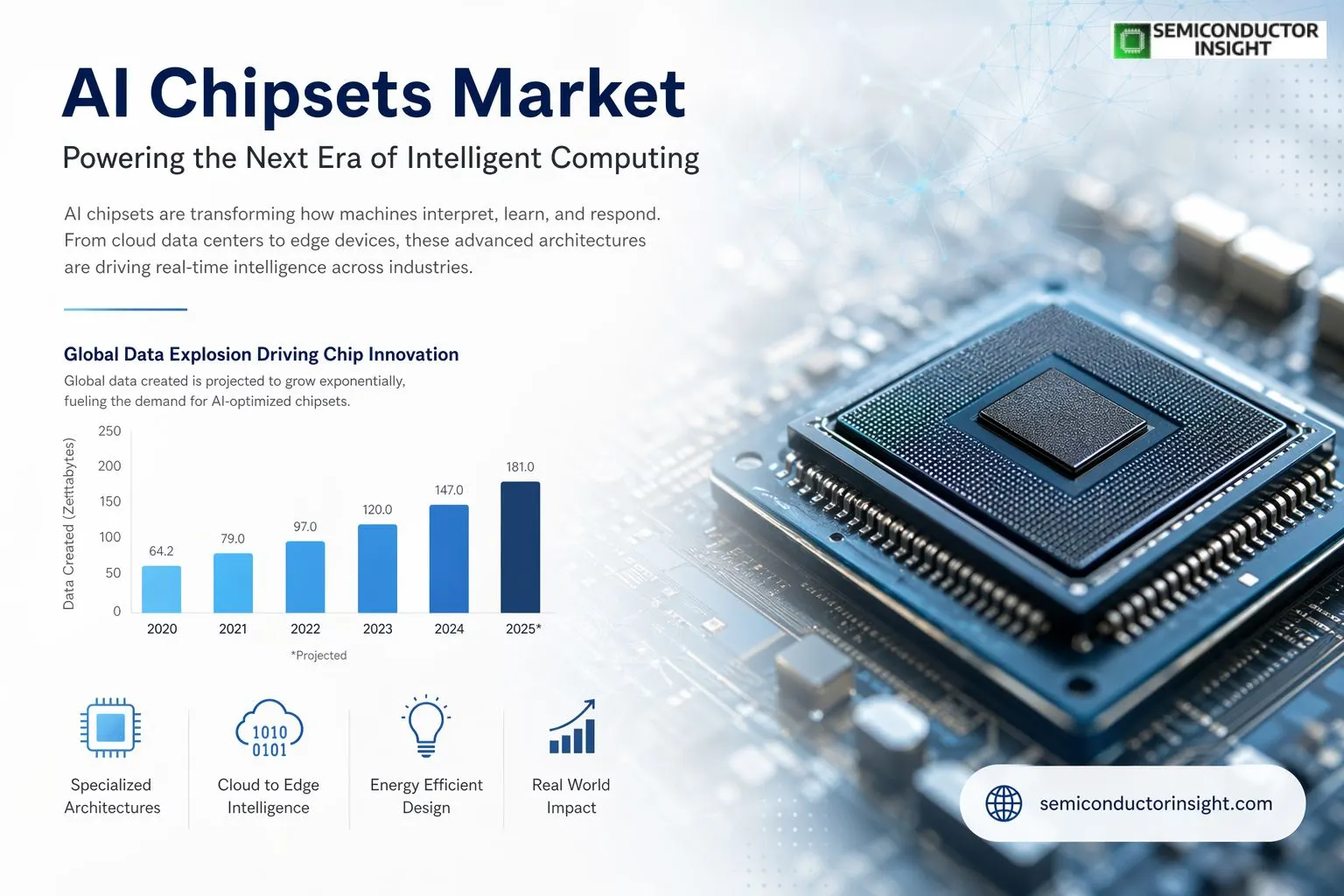
Over the past decade, global data creation has grown exponentially. According to publicly available estimates from organizations like International Data Corporation, the world generated over 120 zettabytes of data in recent years, with projections continuing to rise sharply. This surge has forced chipmakers to rethink design priorities.
AI chipsets are now being optimized for specific workloads such as image recognition, natural language processing, and autonomous decision-making. The demand is not just coming from tech companies but also from healthcare systems analyzing medical scans, financial institutions detecting fraud, and automotive firms building self-driving systems.
From cloud giants to pocket-sized intelligence
A fascinating shift in AI chipset market is how it spans both extremes of computing. On one end, massive data centers operated by companies like Google and Amazon rely on specialized AI accelerators to process billions of queries daily. On the other end, smartphones and wearable devices are now equipped with compact AI chips capable of running sophisticated models locally.
This dual expansion is changing user expectations. People now expect real-time responses without delays, whether they are using a virtual assistant or editing photos with AI-powered enhancements. The ability to process data on-device also addresses growing concerns around privacy, as sensitive information no longer needs to be sent to the cloud for analysis.
The race for smarter architectures meets real world impact
- The semiconductor industry isn’t just about how powerful computers are anymore; it’s also about how well that power is manufactured and used.
- What began as a competition to see who could do the best has turned into a deeper search for efficiency, specialization, and real-world relevance. GPUs, or graphics processing units, were first intended for gaming.
- Now, they are the key engines for AI workloads. Along with them, new architectures like tensor and neural processing units are being built to tackle hard machine learning tasks with even more accuracy.
- The increased focus on energy efficiency makes this change more interesting in 2026. Training complex AI models can take up a lot of computer power, which generally means they use a lot of energy.
- As sustainability becomes a big problem in all fields, chip makers have to find a way to make chips that work well and use less power. This balance is no longer just a matter of technical preference; it is a key issue that affects the adoption, scalability, and long-term viability of AI technology.
- These architectural improvements, on the other hand, aren’t just for research labs or high-end computers. Their presence is becoming more and more obvious in everyday applications, silently changing how businesses work.
- AI-powered chips are already helping to analyze medical images in healthcare, which makes it easier and faster to find conditions. In transportation, they are the main part of advanced driver assistance systems, which make roads safer by letting drivers make decisions in real time. This change is even happening in farming, where AI-powered equipment help keep an eye on soil health and make crops more productive.
A subtle shift in how performance is valued
Traditionally, semiconductor progress was measured by Moore’s Law, which predicted the doubling of transistors on a chip every two years. While this principle still influences the industry, AI chipset market has introduced a new dimension. Performance is now evaluated based on how effectively a chip can handle specific AI workloads rather than just general-purpose computing tasks.
This shift has led to a more diversified ecosystem where different chips are tailored for different applications. It is no longer a one-size-fits-all approach, and this specialization is driving innovation at multiple levels.
Digital ecosystems built on intelligent hardware
AI chipset market is not just about individual devices; it is about enabling entire ecosystems. Smart homes, autonomous vehicles, industrial automation systems, and even smart cities rely on AI chips working seamlessly in the background. These chips act as the foundation upon which intelligent systems are built.
As digital transformation accelerates globally, the importance of these chipsets will only grow. They are becoming the invisible engines powering everything from personalized user experiences to large-scale industrial operations.
A market evolving with human expectations
At its core, AI chipset market reflects a broader change in how people interact with technology. Users no longer want machines that simply execute commands they expect systems that understand context, anticipate needs, and adapt over time.
This expectation is pushing the semiconductor industry into uncharted territory, where innovation is driven not just by technical possibilities but by human behavior. The result is a market that is dynamic, deeply integrated into everyday life, and constantly evolving to meet the demands of an increasingly intelligent world.

Comments (0)