
The Expanding Role of Smart Servo Motor Market in Next-Gen Manufacturing
Smart servo motors are no longer just components powering machines they have evolved into intelligent systems that actively shape how industries operate. With embedded sensors, real-time feedback loops, and advanced communication interfaces, these motors are enabling a new generation of automation defined by precision, adaptability, and efficiency. Across semiconductor manufacturing, robotics, automotive systems, and electronics assembly, smart servo motors are becoming indispensable.
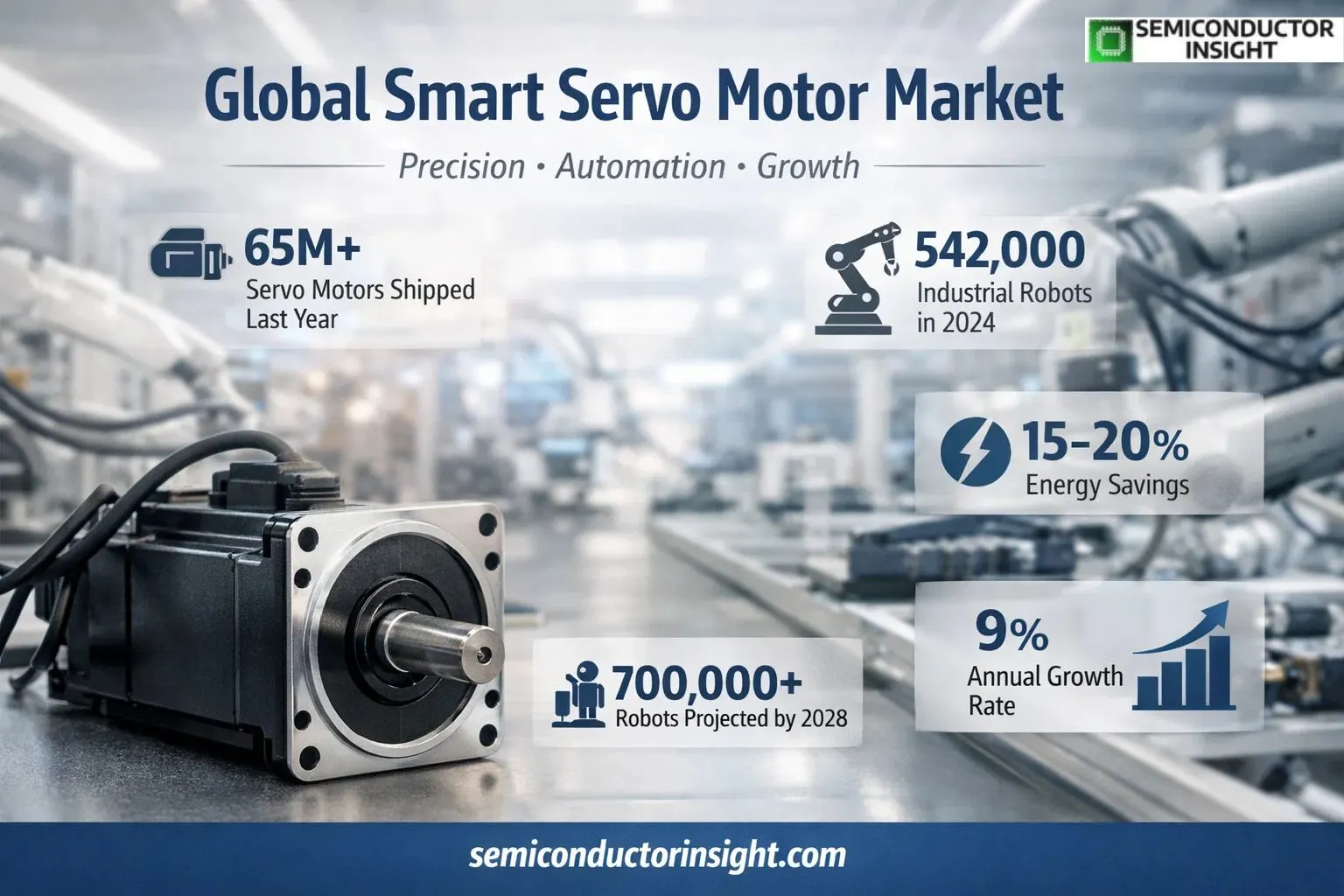
One of the most compelling aspects of this market is its scale and measurable growth in real-world deployments. Globally, over 65 million servo motors were shipped across industrial applications in the past year, with smart-enabled variants accounting for nearly 38% of total installations.
In semiconductor fabrication facilities alone, a single advanced fab can deploy over 10,000 servo-driven axes, highlighting the critical role of precision motion in chip production. The transition from conventional motors to smart servo systems is not gradual it is accelerating rapidly as industries demand tighter tolerances and faster cycle times.
For More Detailed Insights You Can Surf Our Latest Report Here: https://semiconductorinsight.com/report/global-smart-servo-motor-market/
Precision Meets Intelligence in Semiconductor Manufacturing
Semiconductor fabrication is among the most demanding environments for motion control. Processes such as wafer handling, lithography alignment, and chip packaging require positioning accuracy within ±1 micron, something only advanced servo systems can reliably achieve. Smart servo motors, equipped with high-resolution encoders exceeding 24-bit feedback systems, allow machines to perform millions of cycles with minimal deviation.
A recent example comes from advanced chip manufacturing lines where smart servo motors have reduced alignment errors by nearly 45%, directly improving yield rates. With semiconductor nodes shrinking below 5 nanometers, even microscopic inconsistencies can lead to defects, making intelligent motion systems essential rather than optional.
Embedded Intelligence Driving Real-Time Decision Making
- Smart servo systems use inbuilt processors that continuously assess performance, in contrast to conventional motors.
- Thousands of data points can be processed by these systems every second, allowing for operational predictive modifications. For example, a motor can rapidly recalibrate without stopping the operation if it detects tiny variations in torque.
- This level of intelligence has reduced unplanned downtime by up to 30% in automated production lines.
- In industries where a single hour of downtime can cost tens of thousands of dollars, such improvements translate directly into operational savings. Additionally, smart servo motors can communicate via industrial protocols like EtherCAT and PROFINET, enabling seamless integration into connected factory ecosystems.
Energy Efficiency Becoming a Competitive Advantage
Energy consumption is another major factor driving the adoption of smart servo motors. These systems are designed to optimize power usage through regenerative braking and adaptive load control. On average, smart servo motors consume 15-20% less energy compared to traditional motor systems in similar applications.
In large-scale industrial environments, this translates into substantial savings. For example, a manufacturing plant operating 500 servo-driven machines can reduce annual energy consumption by several million kilowatt-hours. Beyond cost savings, this also aligns with global sustainability goals, making smart servo systems an environmentally responsible choice.
Robotics as the Primary Demand Engine
- The International Federation of Robotics (IFR) tracks the installation statistics for industrial robots every year. This is the most dependable demand signal for servo motors.
- The IFR’s World Robotics 2025 research said that there were 542,000 industrial robots placed around the world in 2024. This is more than twice as many as there were ten years before.
- For the fourth year in a row, more than 500,000 units were installed each year. In 2024, there were 4,664,000 industrial robots in use in the world. This was a 9% increase from the year before.
- It is expected that there will be more than 700,000 industrial robots installed around the world by 2028, which is a compound annual growth rate (CAGR) of about 7% from 2025 to 2028.
- Each robot uses a lot of servo motors. According to engineering literature benchmarks, each industrial robot has 10 to 15 kg of NdFeB rare-earth magnets. Most of these magnets are in servo motors and torque motors that are built into robotic joints and actuators.
- According to estimates by the U.S. Department of Energy, the demand for NdFeB magnets for industrial servo motors might jump from 36,000 tonnes in 2020 to over 53,000 tonnes by 2030. This is a good way to see how much the number of servo motor units is growing.
- In 2024, electronics manufacturing made up about 24% of robot installations, automotive made up 23%, and metal/machinery made up 16%. All three fields rely significantly on servos.
Rising Enterprise Adoption of Robotics and Intelligent Automation
The robotics industry has been one of the fastest adopters of smart servo technology. Industrial robots now rely on servo systems for precise joint movement, with each robot typically using 6 to 12 servo motors depending on its complexity. Globally, over 4 million industrial robots are currently in operation, creating a massive demand for intelligent motion systems.
Collaborative robots (cobots), in particular, benefit from smart servo motors due to their need for safe and adaptive movement. These robots use torque-sensing servo systems to detect human interaction, ensuring safe operation in shared workspaces. This has expanded their adoption across small and medium enterprises, not just large factories.

Comments (0)