
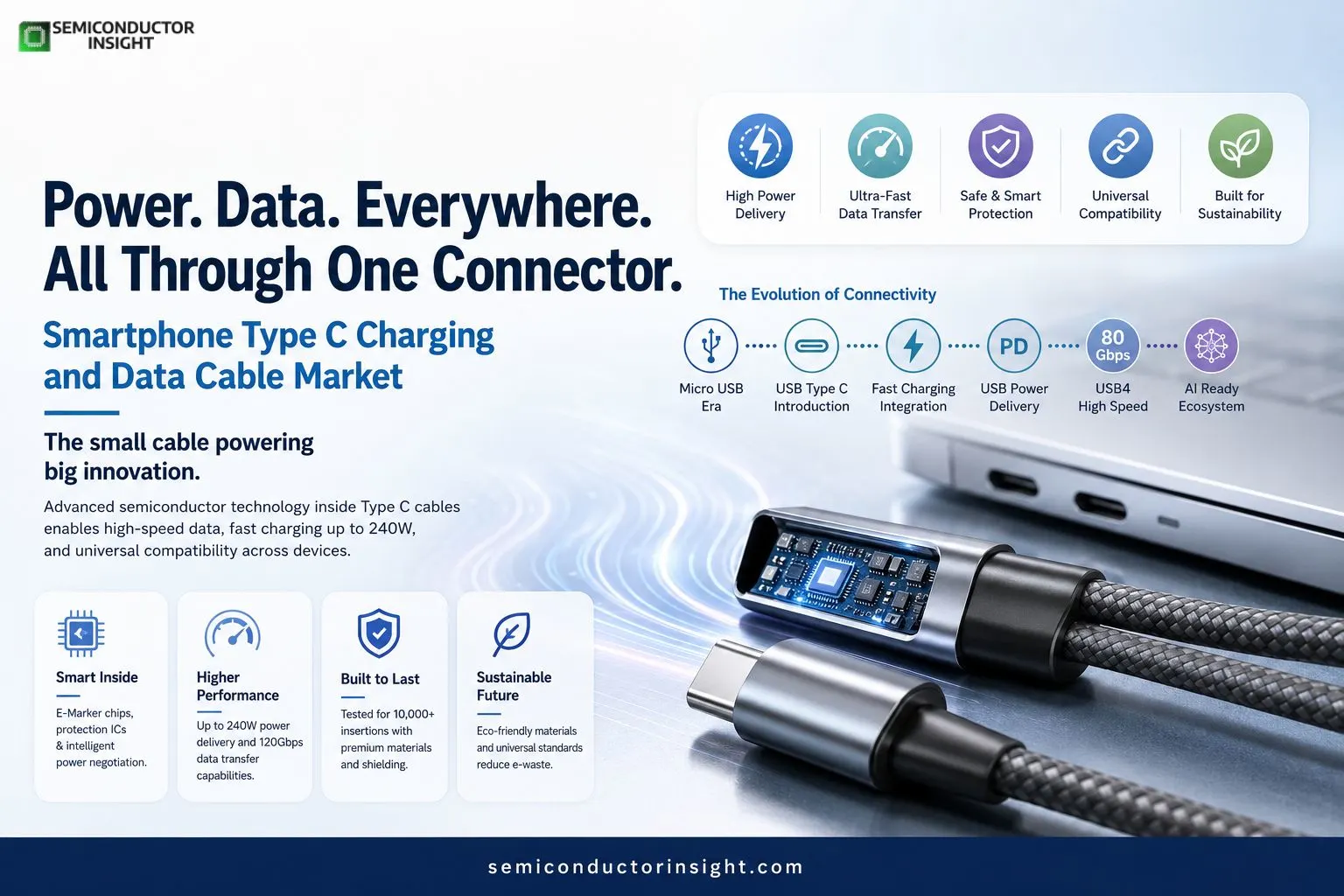
EU Common Charger Rules and USB C Adoption Strengthen the Smartphone Type C Charging and Data Cable Market in 2026
A charging cable is no longer just an accessory. It has become an essential component of the semiconductor ecosystem, enabling power delivery, high-speed data transfer, display connectivity, and device interoperability. The rapid transition to USB Type C has transformed how smartphones, tablets, laptops, wearables, gaming devices, and accessories communicate with one another. Behind this simple connector lies an ecosystem of advanced controller chips, power management ICs, signal integrity solutions, and high-performance semiconductor materials that make modern digital connectivity possible.
The momentum has accelerated as governments, technology companies, and consumers increasingly favour universal charging standards. With USB Type C becoming the preferred interface across multiple device categories, cable manufacturers are focusing on higher power delivery, faster data transmission, improved durability, and smarter electronic authentication.
From Charging Accessory to High Performance Electronic Component
- Today’s Type C cables contain far more technology than previous USB generations.
- Premium cables integrate electronic marker (E-Marker) chips that allow connected devices to negotiate charging voltage, current limits, and supported data speeds.
- These embedded semiconductor components ensure safe operation while enabling high-performance charging and communication.
- The USB Implementers Forum (USB-IF) states that USB4 Version 2.0 allows theoretical transfer speeds of up to 80 Gbps in normal mode and 120 Gbps in asymmetric configurations, while the most recent USB Power Delivery specification supports up to 240 watts using Extended Power Range (EPR).
- Because of these features, Type C is now the most adaptable wired interface on the market.
Why Semiconductor Innovation Matters Inside Every Cable?
Although consumers mainly see the external connector, semiconductor innovation determines cable performance. Advanced Type C assemblies include E-Marker ICs, signal conditioning chips, overcurrent protection circuits, electrostatic discharge protection, and intelligent power negotiation controllers.
As smartphone processors continue supporting AI workloads and ultra-high-resolution video, cable electronics must maintain signal integrity across increasingly demanding data rates. Manufacturers are therefore investing in improved shielding materials, lower-loss conductors, and precision connector engineering to minimise transmission errors.
Technology Evolution
Micro USB Era
↓
USB Type C Introduction
↓
Fast Charging Integration
↓
USB Power Delivery
↓
USB4 High Speed Connectivity
↓
AI Ready Universal Device Ecosystem
Numbers That Illustrate the Scale of the Transition
- The global shift towards USB Type C is supported by several measurable technology indicators published by industry organisations.
- According to IDC, worldwide smartphone shipments exceeded 1.24 billion units during 2025, while the USB Implementers Forum reports support for charging up to 240 W under USB PD 3.1 Extended Power Range.
- USB4 Version 2.0 supports transfer rates reaching 80 Gbps, with asymmetric operation delivering 120 Gbps for display-intensive applications.
- The European Union Common Charger Regulation requires many portable electronic devices sold in the EU to adopt USB Type C charging interfaces, covering categories including smartphones, tablets, cameras, headphones, e-readers, portable speakers, and handheld gaming devices.
- Many premium smartphones now support wired charging between 45 W and 120 W, while flagship USB Type C cables commonly undergo durability testing exceeding 10,000 insertion and removal cycles, according to manufacturer qualification standards.
- These engineering benchmarks demonstrate that cable technology has become an increasingly sophisticated semiconductor-enabled product rather than a passive accessory.
Universal Charging Is Changing Product Design Strategies
One of the biggest shifts in consumer electronics is the move towards a common charging ecosystem. Smartphone manufacturers are redesigning internal architectures around USB Type C controllers capable of supporting charging, data transfer, DisplayPort Alt Mode, and accessory communication through a single connector.
The implementation of the European Union’s Common Charger legislation has accelerated product redesign across the global electronics industry. Several manufacturers have expanded USB Type C compatibility beyond smartphones to include wireless earbuds, tablets, portable gaming systems, cameras, and accessories, simplifying charging for consumers while reducing electronic waste.
AI Smartphones Demand Better Connectivity
The latest generation of AI-enabled smartphones processes larger image files, records 8K video, and transfers high-capacity datasets between devices. These workloads require cables capable of maintaining stable high-speed communication without excessive signal degradation.
Manufacturers are responding by introducing premium Type C cables certified for USB4, Thunderbolt compatibility, and enhanced power delivery. Some designs now include braided fibre jackets, reinforced connector shells, and advanced shielding layers that improve durability in professional and industrial environments.
Recent flagship smartphone launches from leading Android manufacturers increasingly feature USB Type C interfaces supporting desktop modes, external storage, and high-resolution display output, extending the role of the cable far beyond battery charging.
Lastly, for more in-depth information, don’t forget to read our most recent exclusive report: https://semiconductorinsight.com/report/smartphone-type-c-charging-and-data-cable-market/
Sustainability Is Becoming Part of Cable Engineering
Environmental considerations are also influencing product development. Electronics manufacturers are increasing the use of recyclable aluminium connector housings, halogen-free insulation materials, and reduced plastic packaging. Universal charging standards are expected to reduce the production of redundant chargers and incompatible cables, supporting broader efforts to minimise electronic waste.
At the same time, semiconductor suppliers continue improving power efficiency within cable authentication chips and charging controllers, enabling safer energy delivery while reducing unnecessary power losses during charging cycles.
As smartphones become more powerful and connected devices continue to multiply, the Smartphone Type C Charging and Data Cable Market is evolving into a technology segment where semiconductor innovation, international standards, sustainability, and user convenience converge to define the future of wired connectivity.

Comments (0)