

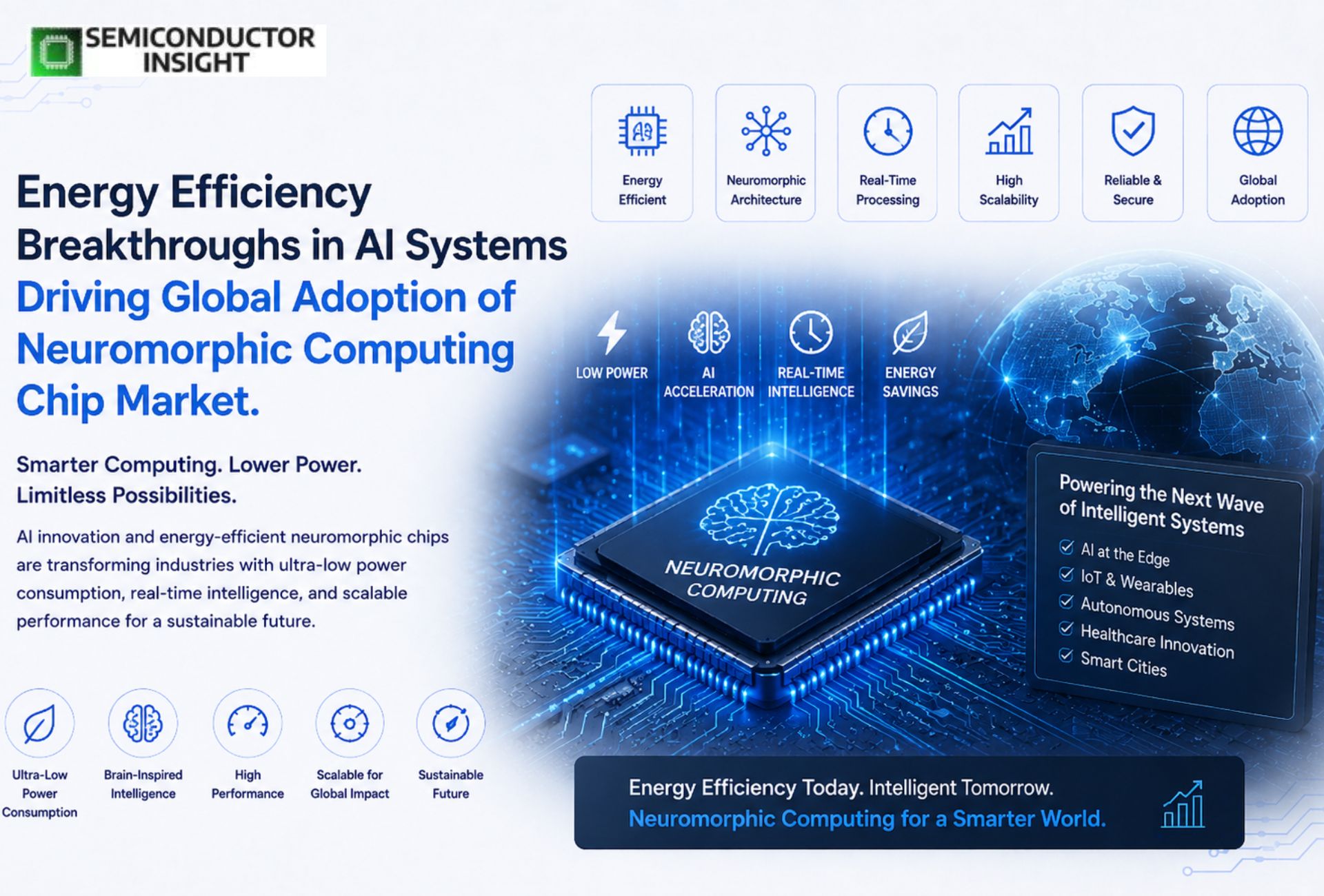
Energy Efficiency Breakthroughs in AI Systems Driving Global Adoption of Neuromorphic Computing Chip Market
Neuromorphic computing chips replicate the structure and function of the human brain using neural networks and spiking signals instead of traditional von Neumann architecture. These chips process information through asynchronous, event-driven spiking neural networks where neurons fire only when needed, dramatically reducing energy consumption compared to conventional processors.
- For instance, Intel’s Loihi 2 neuromorphic processor demonstrates up to 10x faster processing capability than its predecessor and comes with Lava, an open-source software framework for developing neuro-inspired applications.
The technology addresses the growing energy crisis in AI, with data centres and large language models consuming exponential amounts of power that traditional GPUs cannot sustain economically.
Energy Efficiency Breakthroughs Enable 100 to 1000x Power Reduction Compared to Conventional Processors
- Current estimates suggest that neuromorphic architectures can achieve energy efficiency improvements of 100-1000x compared to conventional computing systems. Intel’s Loihi-2 chip showed remarkable energy efficiency in sensor fusion applications, being over 100 times more efficient than a CPU and nearly 30 times more efficient than a GPU.
- TDK is working towards actualising neuromorphic devices capable of reducing the power consumption of today’s AI systems to less than 1/100 of current levels. For always-on workloads, neuromorphic computing delivers 10-100x lower power consumption while GPUs suffer from high idle draw.
- This energy reduction is critical as the Netherlands action plan notes that neuromorphic computing can break the explosive rise in energy consumption from data centers.
Real-Time Sensor Fusion Applications in Autonomous Vehicles and Robotics Systems
Research utilising Intel’s Loihi-2 neuromorphic chip demonstrated significantly enhanced sensor fusion in robotics and autonomous systems using datasets such as AIODrive, Oxford Radar RobotCar, and nuScenes. The Loihi-2 implementation achieved faster processing speeds on various datasets, marking a substantial advancement over existing state-of-the-art implementations.
Simulated and real-world case studies demonstrate significant improvements in energy efficiency up to 60% and reduced decision latency up to 40% for edge-AI accelerated neuromorphic VLSI architectures. National University of Singapore researchers developed a novel robotic system comprising an artificial brain that mimics biological neural networks, integrated with artificial skin and vision sensors to enable robots that feel. Neuromorphic chips enable microsecond reflexes since they operate without batching, while GPUs introduce latency due to batch processing.
To find out more, feel free to browse our latest updated report: https://semiconductorinsight.com/report/neuromorphic-computing-chip-market/
Medical Implant and Brain Computer Interface Applications Transforming Healthcare Technology
Neuromorphic devices provide a new way for biomedical data processing due to their low energy consumption and high dynamic information processing capabilities. Brain-machine interfaces face critical issues such as accuracy and stability, but neuromorphic computing models present a promising approach for developing high-performance neuroprosthesis. The biologically plausible property of neuromorphic models enables homogeneous information representation in the form of discrete spikes between the brain and machine, promoting deep brain-machine fusion.
Neuromorphic intelligence is transforming healthcare robotics through brain-inspired computing that enables medical robots, prosthetics, and diagnostic devices to operate autonomously with ultra-low power and high precision. Traditional BCIs suffer from low energy efficiency of the von Neumann architecture, while neuromorphic devices provide substantial computation power with extremely high energy efficiency.
Government Funding Initiatives and National Technology Strategies Supporting Chip Development
- The Government of India’s Ministry of Electronics and Information Technology is supporting R&D projects in neuromorphic computing as a brain-inspired approach to designing hardware systems.
The Netherlands announced a neuromorphic computing action plan with an additional investment volume of approximately €50 million over five years to strengthen its position in this field.
- This action plan includes three concrete steps: ecosystem development through the NC NL alliance, a market-driven application lab for testing hardware and software, and a prototyping facility for new materials and architectures.
- DARPA’s Systems of Neuromorphic Adaptive Plastic Scalable Electronics (SyNAPSE) program vision was to develop low-power electronic neuromorphic computers, establishing the foundation for current commercial developments.
- Neuromorphic computing is one of the seven digital key technologies of the Topsector ICT and links to 5 of 10 priority key technologies from the Dutch government’s National Technology Strategy.
Patent Surge and Commercial Transition from Academic Prototype to Market-Ready Products
Neuromorphic computing has crossed from academic prototype to commercial product, with 596 patents filed through early 2026 and a 401% surge in neuromorphic computing chip patents in 2025.
The TrueNorth ecosystem is in use at over 30 universities, government, and corporate labs worldwide, serving as a substrate for applications from mobile and embedded computing to cloud and supercomputers. Intel Labs has established the Intel Neuromorphic Research Community, bringing together academic groups, government labs, and companies to overcome challenges in the field.

Comments (0)