Asynchronous Boost Converter Market Insights
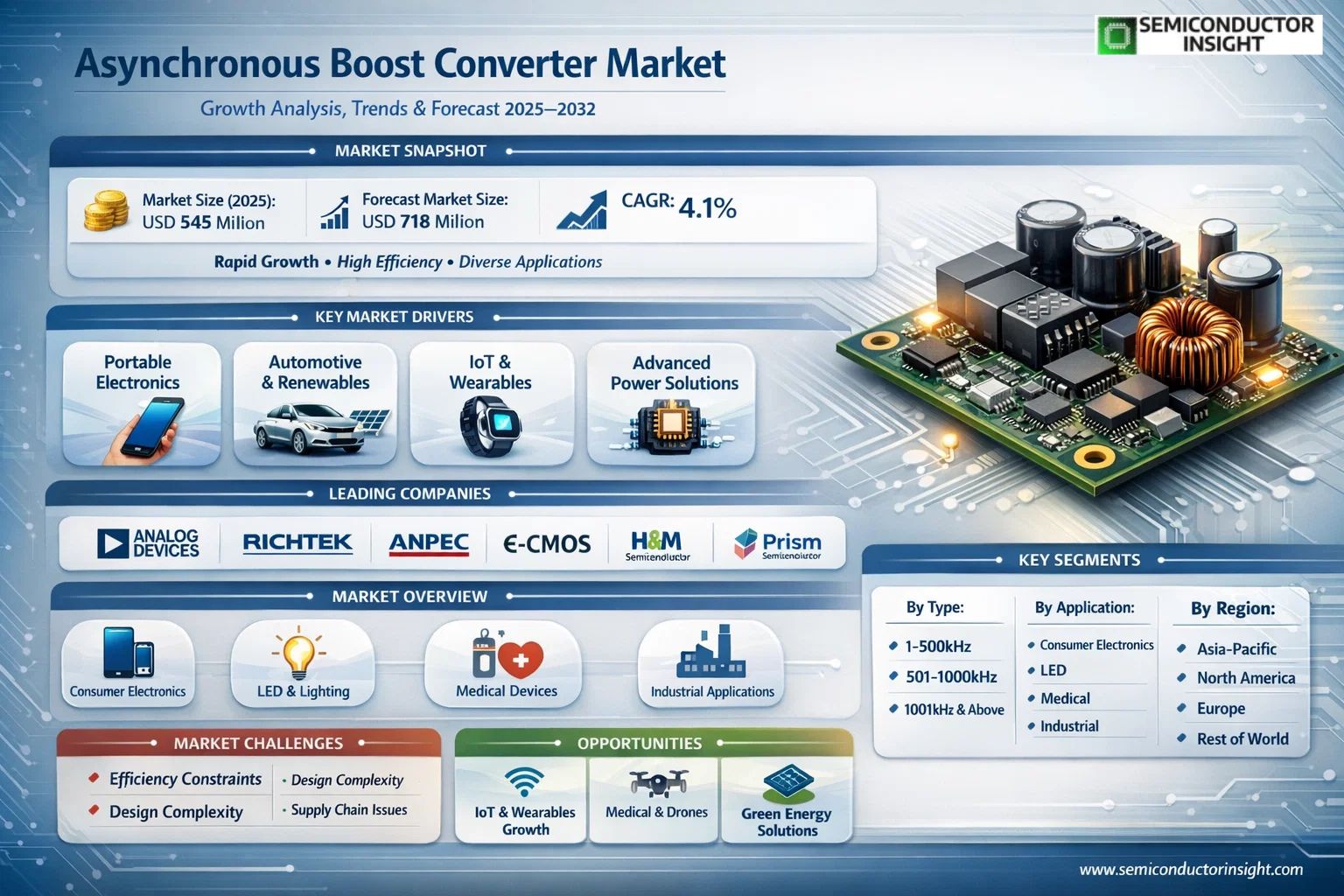
Global Asynchronous Boost Converter market size was valued at USD 545 million in 2025. The market is projected to reach USD 718 million by 2032, exhibiting a CAGR of 4.1% during the forecast period.
Asynchronous boost converters are power conversion devices that step up lower input voltages to higher output voltages without an external clock or synchronization signal. They utilize pulse width modulation (PWM) technology to boost voltage through rapid switching of internal elements. These converters find extensive use in devices needing voltage elevation, including portable electronics, wireless communications, and renewable energy systems. Their high efficiency in energy conversion and flexibility with varying inputs position them as ideal choices across diverse power management applications.
The market sees steady growth from surging demand in consumer electronics, LED systems, medical equipment, industrial uses, and more. Advancements in compact, efficient power solutions, alongside the push for renewables, further accelerate expansion. However, competition intensifies as key players innovate. Leading manufacturers like Analog Devices, Richtek Technology, ANPEC Electronics, E-CMOS, H&M Semiconductor, Prism Semiconductor (Nanjing), Shanghai Natlinear Electronics, Suzhou Xysemi, Shenzhen Yongfukang Technology, and Shenzhen Senliwell Electronics dominate with broad portfolios, driving the competitive landscape.
MARKET DRIVERS
Rising Demand in Portable Electronics
Asynchronous Boost Converter Market benefits from the surge in portable devices like smartphones and wearables, where efficient voltage stepping is essential for battery-powered applications. These converters provide reliable performance in low-power scenarios, supporting the integration of multiple power rails without complex synchronization.
Expansion in Automotive and Renewables
Growth in electric vehicles and renewable energy systems drives adoption, as asynchronous designs offer cost-effective solutions for boosting low-voltage sources such as solar panels or battery packs. Market projections indicate a CAGR of approximately 6.5% through 2028, fueled by these sectors’ need for compact power management.
➤ Key innovations in efficiency enhancements position asynchronous boost converters as vital for IoT deployments, where simplicity meets scalability.
Additionally, advancements in semiconductor materials reduce switching losses, further propelling Asynchronous Boost Converter Market in industrial automation and consumer gadgets.
MARKET CHALLENGES
Efficiency Limitations
Asynchronous Boost Converter Market faces hurdles from lower efficiency compared to synchronous counterparts, particularly at higher currents, leading to increased heat dissipation and reduced battery life in demanding applications.
Other Challenges
Design Complexity in High-Voltage Apps
Balancing inductor selection and diode losses requires precise engineering, complicating miniaturization efforts amid shrinking device footprints.
Supply chain disruptions for passive components exacerbate production delays, impacting scalability in the competitive electronics landscape.
Regulatory pressures for energy efficiency standards add compliance burdens, challenging manufacturers to innovate without inflating costs.
MARKET RESTRAINTS
Competition from Synchronous Alternatives
Dominant synchronous boost converters offer superior efficiency, restraining Asynchronous Boost Converter Market share in premium segments like high-end laptops and EVs, where power density is paramount.
High initial development costs for custom asynchronous ICs deter smaller players, limiting market penetration in emerging economies.
Technological maturity gaps result in reliability concerns under extreme temperatures, curbing adoption in aerospace and automotive exteriors.
MARKET OPPORTUNITIES
Emerging IoT and Wearables Growth
Asynchronous Boost Converter Market holds promise in the proliferating IoT ecosystem, where low-cost, low-quiescent current designs enable ultra-long battery life in sensors and smart home devices.
Expansion into medical wearables and drones leverages their simplicity for quick market entry, with potential revenue growth exceeding 8% annually.
Sustainable energy harvesting applications, such as in remote monitoring, open avenues for customized asynchronous solutions amid global green initiatives.
Asynchronous Boost Converter Market Trends
Growing Adoption in Consumer Electronics
Asynchronous boost converters, essential for stepping up lower input voltages in power-hungry portable devices, are seeing heightened integration within Asynchronous Boost Converter Market. Their pulse width modulation technology enables efficient voltage boosting without external synchronization, making them ideal for smartphones, tablets, and wearables that demand compact, reliable power management solutions. This trend is driven by the surge in consumer electronics requiring adaptable power conversion amid varying battery voltages, enhancing device runtime and performance.
Other Trends
Expansion in LED and Industrial Applications
Asynchronous Boost Converter Market is witnessing robust demand from LED lighting systems and industrial equipment, where stable high-voltage output is critical for driving high-brightness LEDs and powering motors. These converters excel in handling input fluctuations, supporting energy-efficient designs in smart lighting and automation sectors. Manufacturers are optimizing devices for higher efficiency, aligning with global pushes for sustainable power solutions.
Shift Toward Higher Frequency Segments
In Asynchronous Boost Converter Market, segments like 501-1000kHz and above 1001kHz are gaining traction due to their compact size and reduced component requirements, suiting space-constrained applications in medical devices and wireless communications. Key players such as Analog Devices and Richtek Technology are advancing asynchronous designs for faster switching, improving thermal performance and integration in renewable energy systems. Regional dynamics show Asia, particularly China and Japan, leading with innovation in these high-frequency variants, fueled by strong manufacturing bases and demand from consumer and industrial end-users. This evolution supports broader market penetration into emerging sectors like electric vehicles auxiliaries and IoT devices, where precision power boosting is paramount.
COMPETITIVE LANDSCAPE
Key Industry Players
Leading Manufacturers in Asynchronous Boost Converter Market
Asynchronous Boost Converter Market exhibits a moderately concentrated structure, dominated by a handful of established semiconductor firms and specialized Asian manufacturers. Analog Devices leads as a key player, leveraging its advanced PWM technology and broad portfolio in power management ICs to capture significant market share. In 2025, the global top five players collectively hold a substantial revenue share, driving innovation in efficient voltage boosting for portable electronics and renewable energy applications. The market, valued at US$545 million in 2025 and projected to reach US$718 million by 2032 at a 4.1% CAGR, reflects steady growth amid rising demand for compact, high-efficiency converters.
Beyond the leaders, niche players contribute through cost-effective solutions and regional specialization, particularly in Asia-Pacific. Companies like Richtek Technology and ANPEC Electronics focus on high-frequency segments such as 1-500kHz, serving consumer electronics and LED applications. Emerging Chinese firms including H&M Semiconductor and Suzhou Xysemi emphasize scalability and customization for industrial and medical uses, fostering a competitive environment that balances global giants with agile innovators adapting to input voltage variability and energy efficiency needs.
List of Key Asynchronous Boost Converter Companies Profiled
- Analog Devices
- Richtek Technology
- ANPEC Electronics
- E-CMOS
- H&M Semiconductor
- Texas Instruments
- Prism Semiconductor (Nanjing)
- Shanghai Natlinear Electronics
- Suzhou Xysemi
- Shenzhen Yongfukang Technology
- Shenzhen Senliwell Electronics
- Monolithic Power Systems
- STMicroelectronics
- NXP Semiconductors
Segment Analysis:
| Segment Category | Sub-Segments | Key Insights |
| By Type |
|
1-500kHz
|
| By Application |
|
Consumer Electronics
|
| By End User |
|
Consumers
|
| By Power Rating |
|
Low Power
|
| By Input Voltage |
|
Below 5V
|
Regional Analysis: Asynchronous Boost Converter Market
Asia-Pacific
The region excels in high-volume production of asynchronous boost converters, benefiting from clustered electronics supply chains in East Asia. Cost advantages and proximity to raw materials enable swift prototyping and mass deployment, catering to global OEMs in consumer gadgets and EVs.
Asynchronous boost converters thrive in EVs for battery management, solar inverters for renewables, and smartphones for efficient power boosting. The diverse application landscape underscores the market’s versatility in powering compact, energy-hungry devices across industrial and consumer domains.
R&D investments focus on higher efficiency and miniaturization, with advancements in wide input voltage ranges suiting variable renewable sources. Collaborative ecosystems between academia and industry drive next-gen topologies, enhancing reliability for harsh environments.
Rapid urbanization, EV adoption policies, and renewable energy mandates propel demand. Export-oriented strategies bolster global reach, while domestic consumption in burgeoning middle-class markets ensures balanced expansion in the Asynchronous Boost Converter sector.
North America
North America exhibits strong momentum in Asynchronous Boost Converter Market, propelled by technological innovation and premium applications in aerospace, automotive, and data centers. The United States and Canada prioritize high-performance power solutions, where asynchronous boost converters support advanced battery systems in electric vehicles and reliable backups for telecommunications. A mature ecosystem of design houses and semiconductor firms fosters cutting-edge developments, emphasizing compactness and thermal efficiency. Regulatory pushes for energy conservation and grid modernization encourage integration into smart home devices and industrial automation. While higher production costs pose challenges, strategic partnerships with Asian suppliers mitigate risks, enabling focus on value-added engineering. The region’s market dynamics highlight premium pricing power and rapid prototyping, positioning North America as a key influencer in setting global standards for Asynchronous Boost Converter technologies through evolving business strategies.
Europe
Europe’s Asynchronous Boost Converter Market is shaped by stringent environmental regulations and a commitment to sustainable power electronics. Germany, France, and the UK lead with applications in industrial machinery, EVs, and wind energy systems, where converters ensure optimal voltage boosting amid fluctuating inputs. Emphasis on RoHS compliance and energy efficiency drives demand for robust, low-EMI designs. Collaborative EU-funded projects accelerate advancements in modular power architectures, enhancing interoperability across sectors. Challenges like supply chain dependencies are countered by reshoring initiatives and diversified sourcing. The market benefits from a skilled engineering base, fostering innovations in wide-bandgap integration for superior performance. Overall, Europe’s dynamics revolve around quality-driven growth, regulatory alignment, and cross-border synergies, solidifying its competitive edge in the Asynchronous Boost Converter landscape.
South America
South America represents an emerging frontier in Asynchronous Boost Converter Market, with Brazil and Argentina at the forefront amid expanding consumer electronics and renewable projects. Asynchronous boost converters find traction in off-grid solar setups and affordable EVs, addressing unreliable grid conditions. Local manufacturing ramps up to serve agribusiness automation and telecom infrastructure, supported by import substitution policies. Economic volatility tempers pace, yet rising urbanization and energy access initiatives create opportunities for cost-sensitive solutions. Partnerships with global players introduce technology transfers, boosting local capabilities in design and assembly. The region’s market evolves through adaptive strategies, focusing on durability for tropical climates and scalability for infrastructure upgrades, gradually enhancing its role in Asynchronous Boost Converter Market trends.
Middle East & Africa
The Middle East & Africa Asynchronous Boost Converter Market gains traction from oil-to-renewables transitions and telecom expansions. In the UAE, Saudi Arabia, and South Africa, converters power solar microgrids, desalination plants, and 5G base stations, leveraging their efficiency in harsh conditions. Government visions for diversification spur investments in localized production, reducing import reliance. Challenges like skill gaps are addressed via training programs and joint ventures. The diverse geography demands rugged designs tolerant to dust and temperature extremes. Market dynamics emphasize strategic infrastructure builds and energy independence, with asynchronous boost converters enabling reliable power in remote oilfields transitioning to sustainable sources, carving a niche in regional growth narratives.
Report Scope
This market research report provides a comprehensive analysis of Asynchronous Boost Converter Market, covering the forecast period 2025–2032. It offers detailed insights into market dynamics, technological advancements, competitive landscape, and key trends shaping the industry.
Key focus areas of the report include:
- Market Overview: The report begins with an overview outlining its current market scenario, key growth indicators, and industry transformation drivers. It discusses macroeconomic factors, demand–supply balance, regulatory landscape, and the strategic role of semiconductors in powering advancements across industries such as automotive, telecommunications, consumer electronics, and industrial automation.
- Market Size & Forecast: Historical data and future projections for revenue, unit shipments, and market value across major regions and segments.
- Segmentation Analysis: Detailed breakdown by product type, technology, application, and end-user industry to identify high-growth segments and investment opportunities.
- Regional Insights: Insights into market performance across North America, Europe, Asia-Pacific, Latin America, and the Middle East & Africa, including country-level analysis where relevant.
- Competitive Landscape: Profiles of leading market participants, including their product offerings, R&D focus, manufacturing capacity, pricing strategies, and recent developments such as mergers, acquisitions, and partnerships.
- Technology Trends & Innovation: Assessment of emerging technologies, integration of AI/IoT, semiconductor design trends, fabrication techniques, and evolving industry standards.
- Market Drivers & Restraints: Evaluation of factors driving market growth along with challenges, supply chain constraints, regulatory issues, and market-entry barriers.
- Stakeholder Insights: Insights for component suppliers, OEMs, system integrators, investors, and policymakers regarding the evolving ecosystem and strategic opportunities.
Primary and secondary research methods are employed, including interviews with industry experts, data from verified sources, and real-time market intelligence to ensure the accuracy and reliability of the insights presented.
FREQUENTLY ASKED QUESTIONS:
What is the current market size of Asynchronous Boost Converter Market?
-> Asynchronous Boost Converter Market was valued at USD 545 million in 2025 and is expected to reach USD 718 million by 2032, at a CAGR of 4.1% during the forecast period.
Which key companies operate in Asynchronous Boost Converter Market?
-> Key players include Analog Devices, Richtek Technology, ANPEC Electronics, E-CMOS, H&M Semiconductor, Prism Semiconductor(Nanjing), Shanghai Natlinear Electronics, Suzhou Xysemi, Shenzhen Yongfukang Technology, Shenzhen Senliwell Electronics, among others.
What are the key growth drivers?
-> Key growth drivers include demand for voltage boost in portable electronics, wireless communications, renewable energy systems, and efficient power management solutions.
Which region dominates the market?
-> Asia is the fastest-growing region, while North America remains a key market.
What are the emerging trends?
-> Emerging trends include PWM technology advancements, higher frequency segments like 1-500kHz, and expanding applications in consumer electronics, LED, medical, and industrial sectors.

Get Sample Report PDF for Exclusive Insights
Report Sample Includes
- Table of Contents
- List of Tables & Figures
- Charts, Research Methodology, and more...
 Download Sample Report PDF