

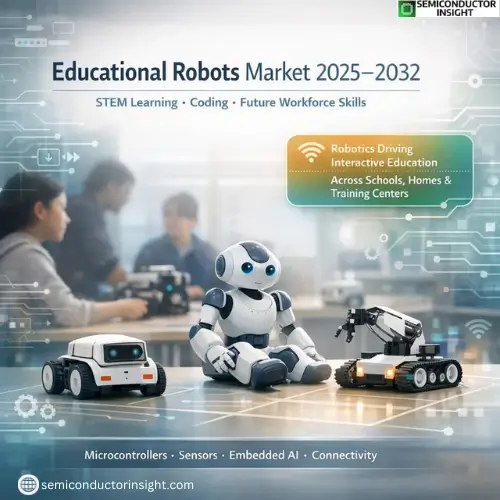
Educational Robots Market Dynamics Boosts as Semiconductor Innovation Enters Classrooms Worldwide
Walk into a modern classroom today and you may find something that would have seemed futuristic just a few years ago: small programmable robots helping children learn mathematics, coding, problem-solving, and even teamwork. Educational robots are no longer limited to elite institutions or research labs. They are becoming practical learning tools in schools, training centres, and homes across the world.
This shift is not just an education story it is also a semiconductor story. Every educational robot is powered by a combination of microcontrollers, sensors, processors, connectivity chips, and embedded systems. As education becomes more digital and interactive, robotics is emerging as one of the most exciting growth segments connecting technology manufacturing with human development.
Educational Robots Market is expanding because robotics is being recognized as a direct pathway to future-ready skills.
For instance, in June 2025,
- The School of Business and Public Administration (SBPA) developed the AIR concentration, which combines robotics, AI, STEM, and business to show how technology is changing the modern workforce.
- Giving students the skills they need to adapt, work together across disciplines, and prosper in a world that is becoming more and more digital is the aim.
- A summer course called Artificial Intelligence and Robotics in Business is being offered by SBPA.
- This course provides an early look at the new focus and is open to undergraduate and graduate students from all areas of the institution, including business, engineering, community college, and post-baccalaureate programs.
What Educational Robots Represent Today?
Educational robots are programmable robotic devices designed to support learning through interaction, simulation, and hands-on experimentation. They are widely used to teach coding, engineering fundamentals, logic-building, and collaborative STEM activities.
Educational robots, in contrast to industrial robots made for companies, are intended for:
- Safe classroom use
- Interactive learning experiences
- Modular programming and creativity
- Age-specific curriculum integration
Behind their friendly design, however, these robots rely heavily on advanced semiconductor components that enable motion control, sensing, connectivity, and intelligent feedback.
Why Demand Is Rising Across Global Education Systems?
The growth of this market is being driven by a fundamental change in how education is being approached. Schools and governments increasingly view robotics as essential for preparing students for technology-driven economies.
STEM education has become a strategic priority, and robots offer something textbooks cannot: real-world engagement. When students can program a robot to move, detect objects, or respond to commands, learning becomes active rather than passive.
In addition, the rise of digital learning platforms and post-pandemic education reform has increased investments in classroom technology. Educational robots are now part of broader smart education ecosystems.
Robotics is becoming a learning tool as common as tablets once were.
Semiconductor Backbone of Educational Robotics
Educational robots may look simple, but they are built on complex semiconductor-enabled architectures. The core value of robotics comes from embedded electronics that allow robots to sense, compute, and respond.
Key semiconductor elements inside educational robots include:
- Microcontrollers for processing and programming execution
- Motion control ICs for precise motor function
- Sensor chips for touch, vision, distance, and sound detection
- Wireless connectivity modules (Wi-Fi, Bluetooth)
- Power management chips to optimize battery performance
As semiconductor innovation improves energy efficiency and integration, educational robots are becoming more affordable, compact, and capable.
Key Buyers and Adoption Channels
The market is expanding across multiple end-user segments. Schools remain the primary buyers, but growth is also strong in after-school STEM programs, coding academies, and home-learning environments.
Demand is particularly high in:
- Primary and secondary schools integrating robotics into STEM
- Technical institutions teaching automation fundamentals
- EdTech companies offering robotics-based subscription learning
- Parents investing in skill-building toys and kits
This wide adoption base is creating a stable demand pipeline for robotics manufacturers and semiconductor suppliers alike.
To Know More about the Report, You Can Freely Browse Our Latest Updated Report:
https://semiconductorinsight.com/report/educational-robots-market/
Market Difficulties That Influence Product Development
- Despite growth, the market faces barriers that influence adoption.
- Cost remains a key issue for public school systems with limited budgets. Teacher training is another challenge robots are only effective if educators can integrate them confidently.
- Hardware durability is also important. Classroom robots must withstand repeated use, drops, and heavy handling, which increases the need for robust semiconductor packaging and component reliability.
- Data privacy is becoming relevant as robots become more connected and AI-enabled, requiring compliance with child safety and digital education regulations.
The next phase of the market will likely be shaped by deeper AI integration, lower-cost semiconductor designs, and broader curriculum standardization.
Emerging opportunities include:
- Robotics platforms for special education and therapy support
- AI-powered adaptive learning companions
- Cloud-based robotics classrooms for remote education
- Greater integration with national STEM certification programs
Educational robots are moving beyond novelty and becoming part of long-term education infrastructure.
This market represents one of the most human-centred growth pathways for semiconductor-enabled technology.

Comments (0)