
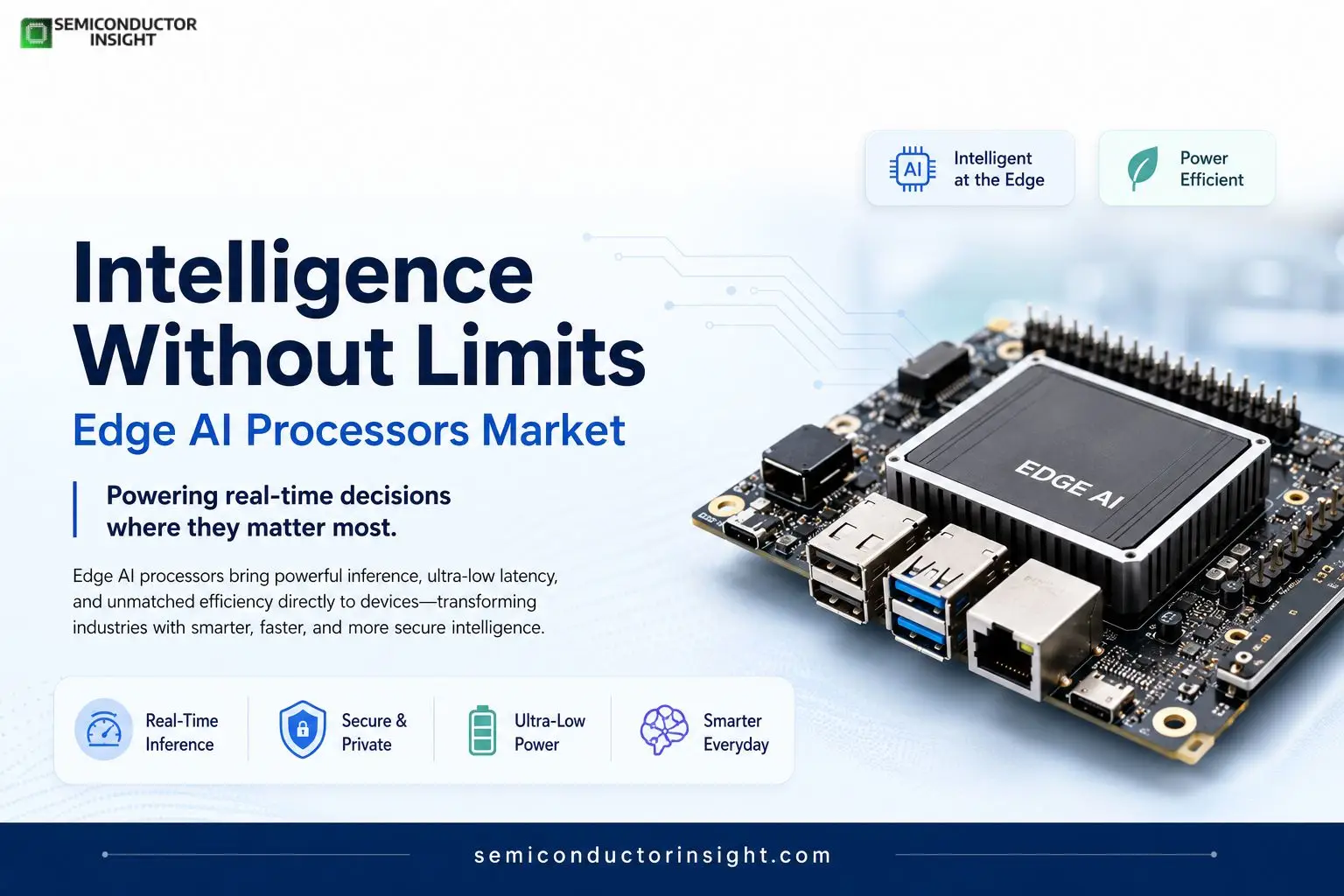
Edge AI Processors vs. Cloud AI Accelerators Which Architecture Delivers Faster Intelligence in 2026
Artificial intelligence is no longer confined to hyperscale data centers. Today’s intelligent cameras, autonomous mobile robots, industrial inspection systems, medical imaging equipment, retail kiosks, wearable devices, and connected vehicles increasingly process AI workloads locally through specialized edge AI processors. Instead of sending every image, sensor reading, or voice command to the cloud, these processors perform inference directly on the device, enabling decisions within milliseconds while improving privacy and reducing network dependence.
This architectural shift is reshaping semiconductor design priorities. Rather than focusing solely on raw computing performance, chip developers are balancing neural processing capability, energy efficiency, memory bandwidth, thermal management, and software optimization to meet the growing demand for real-time intelligence across diverse industries.
Real-World Deployments Are Defining the Next Generation of AI Hardware
- Edge AI processors are rapidly becoming standard components across multiple industries where immediate decision-making is essential.
- Manufacturing facilities are deploying AI-powered vision systems that inspect thousands of components every hour while detecting microscopic defects before products leave production lines.
- Hospitals increasingly integrate edge AI into portable ultrasound systems and patient monitoring equipment, allowing clinicians to receive rapid analytical support without relying on cloud connectivity.
- In transportation, advanced driver assistance systems (ADAS) continuously process camera, radar, and LiDAR data locally, enabling safer navigation even in areas with limited network coverage.
- Retail has also emerged as a significant adopter. Smart checkout systems, inventory-monitoring cameras, and automated warehouses increasingly perform image recognition directly at the edge, reducing response times while minimizing bandwidth requirements.
- According to the International Data Corporation (IDC), billions of intelligent endpoint devices are expected to perform AI inference locally during the coming years, reflecting a broader shift toward distributed computing architectures.
- Meanwhile, the Linux Foundation’s LF Edge initiative continues expanding collaborative software frameworks that support secure deployment across heterogeneous edge hardware.
Semiconductor Innovation Is Now Measured in Intelligence per Watt
Modern edge AI development is increasingly evaluated by computational efficiency rather than peak processing speed alone.
Neural Processing Units (NPUs), Tensor Processing Units (TPUs), AI accelerators, and dedicated inference engines now execute trillions of operations per second (TOPS) while consuming only a few watts in many embedded applications. This balance enables battery-powered devices to perform sophisticated computer vision, speech recognition, anomaly detection, and predictive analytics without sacrificing operational lifetime.
The semiconductor industry is also benefiting from advanced manufacturing nodes. Leading-edge process technologies below 5 nanometers integrate tens of billions of transistors on a single chip, improving performance while lowering energy consumption. At the same time, chiplet-based architectures, advanced packaging, and high-bandwidth memory integration are enabling increasingly compact AI platforms suitable for edge deployment.
To Stay Tuned with More meaningful and In-Depth Insights, Do Visit here: https://semiconductorinsight.com/report/edge-ai-processors-market/
What Are the Most Power-Efficient AI Processors for Edge Devices?
Power efficiency has become one of the defining metrics in edge AI design because many intelligent devices operate continuously under strict thermal and battery constraints.
- Several processor families have demonstrated significant progress in balancing AI performance with energy consumption.
- Arm-based NPUs integrated into mobile and embedded platforms enable efficient on-device inference for smartphones, cameras, and IoT systems.
- Qualcomm’s latest edge AI platforms combine dedicated AI engines with CPU and GPU resources to support multi-modal inference while maintaining low power requirements.
- NVIDIA Jetson modules continue powering robotics, autonomous machines, and industrial inspection systems through compact embedded GPU architectures optimized for edge deployment.
- Specialized processors from companies such as Hailo, Ambiq, Synaptics, and NXP are also advancing ultra-low-power AI computing. Some embedded inference accelerators operate within power envelopes measured in single-digit watts, while microcontroller-class AI processors designed for always-on sensing can function within milliwatt or even microwatt ranges for selected workloads.
Performance benchmarking by MLCommons increasingly evaluates both inference throughput and energy efficiency, reflecting industry demand for standardized comparisons across AI hardware platforms. These benchmarks are helping developers identify processors capable of delivering higher TOPS per watt rather than focusing solely on maximum computational output.
AI Models Are Becoming Smaller but Significantly Smarter
Another defining trend is the optimization of AI models specifically for edge deployment. Instead of relying on extremely large cloud-based neural networks, developers increasingly apply quantization, pruning, knowledge distillation, and sparsity optimization to reduce memory requirements while preserving inference accuracy.
Frameworks such as TensorFlow Lite, ONNX Runtime, OpenVINO, and ExecuTorch allow optimized AI models to execute efficiently across heterogeneous processors, enabling broader deployment in industrial automation, agriculture, healthcare, logistics, and consumer electronics.
This software evolution is making edge AI processors more practical for real-world applications where latency, privacy, bandwidth, and continuous availability matter more than access to unlimited cloud computing resources.

Comments (0)