

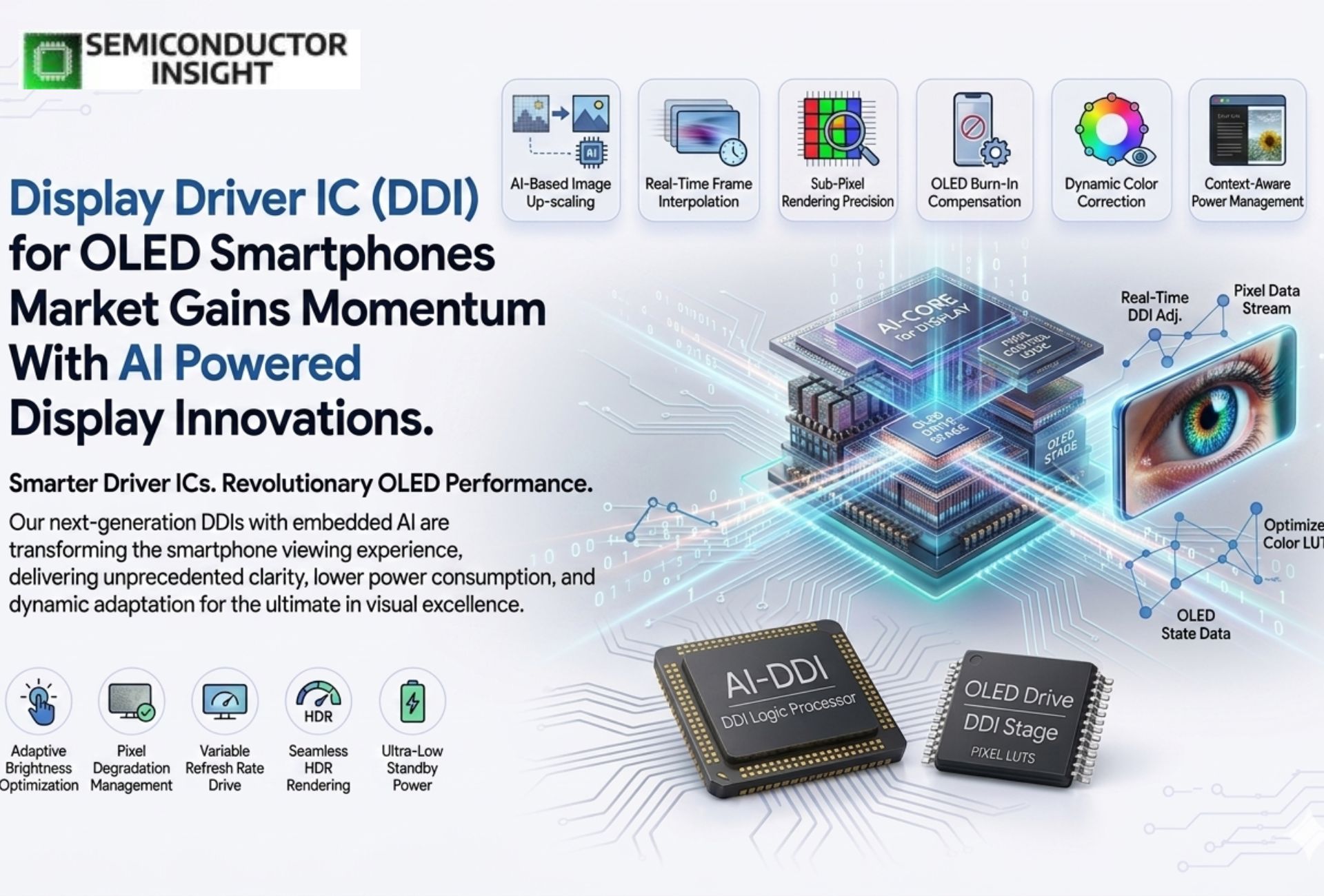
Display Driver IC (DDI) for OLED Smartphones Market Gains Momentum With AI Powered Display Innovations
OLED smartphones are no longer limited to flagship devices. Mid-range phones, gaming smartphones, foldables, and premium camera centric models are all rapidly shifting toward OLED displays, and this transition is pushing demand for advanced Display Driver ICs at an unprecedented scale. Display Driver ICs, commonly called DDIs, are the semiconductor components responsible for controlling brightness, refresh rate, pixel accuracy, power consumption, and color rendering on smartphone screens.
As smartphone displays become thinner, brighter, and more power efficient, the DDI has evolved from a supporting chip into one of the most technically critical components inside a mobile device.
According to shipment data published by the OLED industry supply chain and smartphone manufacturers, global OLED smartphone panel shipments crossed 820 million units during 2024, with China accounting for a major portion of panel manufacturing expansion. Flexible OLED production capacity also increased significantly across South Korea and China as companies invested in advanced Gen 6 OLED fabrication lines.
Ultra High Refresh Screens Are Rewriting DDI Architecture
The jump from 60Hz displays to 120Hz and even 144Hz smartphone panels has dramatically changed DDI engineering priorities. A higher refresh rate demands faster signal processing, lower latency, and tighter synchronization between GPU output and display response.
Modern OLED DDIs are now being designed with integrated timing controllers and advanced compensation technologies to reduce motion blur and screen flickering. Gaming smartphones from brands such as ASUS, Xiaomi, and Samsung Electronics are pushing refresh rate standards higher, forcing semiconductor suppliers to deliver DDIs capable of maintaining image quality while controlling thermal output.
Some premium OLED smartphones now support touch sampling rates above 200Hz, creating additional demand for faster driver communication between the display and application processor.
Foldable Smartphones Are Creating a New DDI Design Category
- Foldable smartphones have introduced one of the most complex engineering environments for DDIs. Unlike conventional flat displays, foldable OLED panels experience constant bending stress, uneven power distribution, and variable brightness conditions across flexible layers.
- To address these issues, DDI manufacturers are developing chips with dynamic voltage correction and adaptive pixel compensation. Foldable smartphone shipments exceeded 17 million units globally in 2024 according to multiple electronics industry reports, with strong adoption seen in China and South Korea.
- Companies including BOE Technology and LG Display continue expanding flexible OLED production for foldable devices, creating long term opportunities for advanced DDI suppliers.
- The complexity of foldable displays has also increased the semiconductor value per smartphone unit, giving DDI makers stronger revenue potential compared to traditional LCD driver technologies.
Power Efficiency Is Becoming More Important Than Brightness
Consumers expect brighter smartphone displays, but battery performance remains equally important. This balance has pushed DDI developers toward low power display management systems.
Recent OLED DDIs support adaptive refresh rate switching, allowing devices to automatically shift between 1Hz and 120Hz depending on user activity. This technology significantly reduces power consumption during video playback, reading, and standby modes.
Apple’s LTPO based OLED displays and Samsung’s adaptive AMOLED panels rely heavily on intelligent DDIs that can coordinate power distribution in real time. Some smartphone manufacturers report battery savings of several hours through adaptive display optimization technologies integrated with advanced driver ICs.
The rising popularity of always on displays is also increasing pressure on DDI manufacturers to reduce energy leakage while maintaining screen responsiveness.
China Is Rapidly Expanding Its Semiconductor Display Ecosystem
- China’s smartphone and display ecosystem has become one of the strongest growth engines for OLED DDIs. Chinese panel manufacturers are scaling OLED production aggressively to reduce dependence on imported technologies.
- Government backed semiconductor initiatives and display manufacturing investments have accelerated local DDI development. Several Chinese semiconductor firms are now entering OLED driver IC production for domestic smartphone brands.
- At the same time, smartphone makers including Honor, OPPO, and Vivo are increasing adoption of curved OLED and ultra narrow bezel displays, further expanding the need for high performance DDIs.
- Industry reports from electronics supply chain publications indicate that Chinese OLED capacity utilization remained above 80% during several quarters of 2025 due to sustained smartphone demand and export activity.
To Know More about the Report, You Can Freely Browse Our Latest Updated Report: https://semiconductorinsight.com/report/display-driver-ic-ddi-for-oled-smartphones-market/
AI Enhanced Smartphones Are Influencing Display Processing Technologies
The rise of on device AI is beginning to affect display technologies as well. Smartphone brands are integrating AI based brightness adjustment, color optimization, eye comfort modes, and content aware refresh systems.
This trend is increasing communication requirements between the application processor and the DDI. Future OLED DDIs are expected to include more embedded processing functions to support real time visual optimization.
- Advanced OLED displays now deliver peak brightness levels exceeding 3000 nits in some flagship models, compared to less than 1000 nits in many premium devices just a few years ago. Managing such brightness without overheating or rapid battery drain requires increasingly sophisticated DDI semiconductor architectures.
As OLED smartphones continue moving toward thinner form factors, foldable designs, and AI assisted interfaces, the Display Driver IC is becoming one of the silent technologies shaping the next generation of mobile hardware innovation.

Comments (0)