

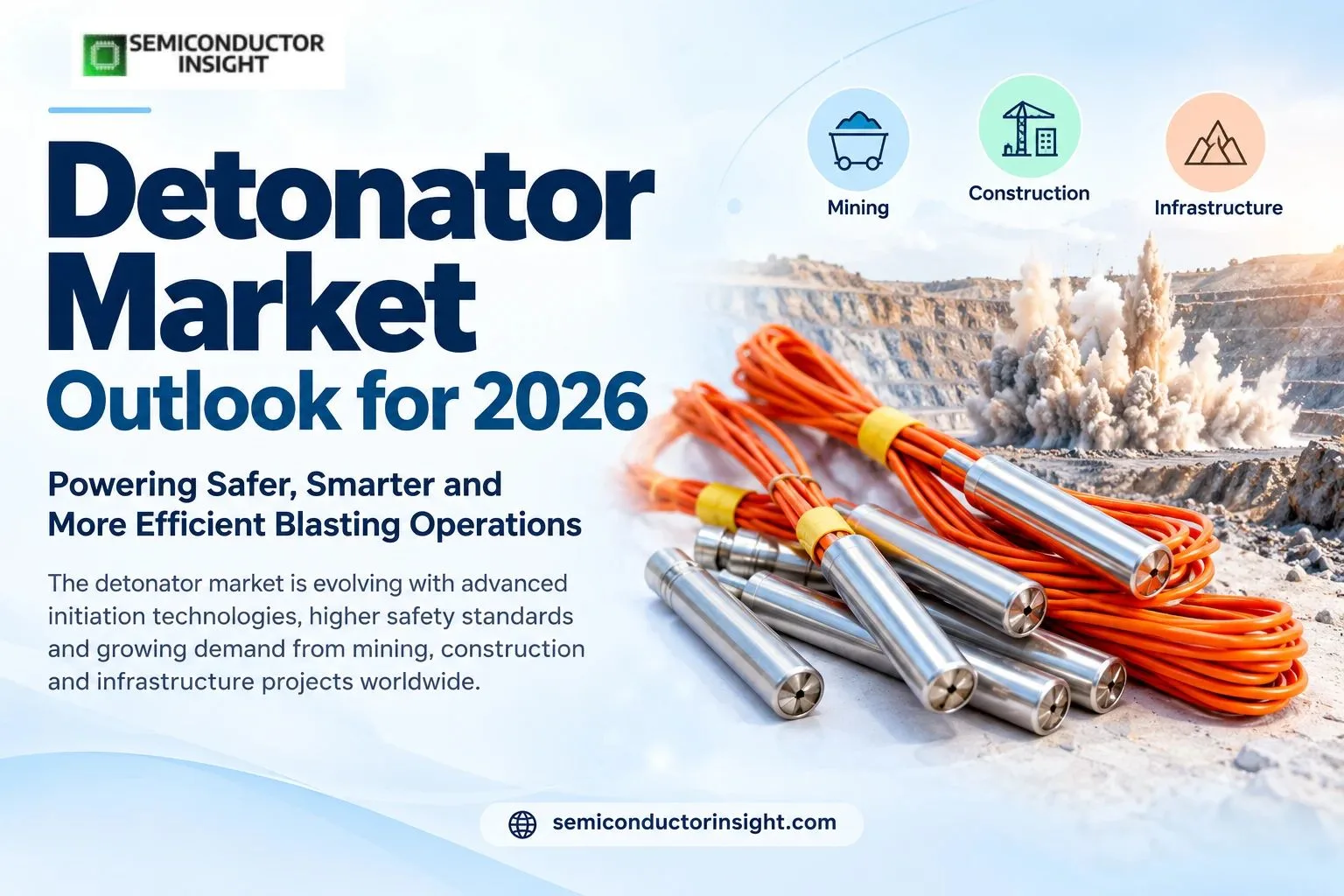
Detonator Market Outlook for 2026 as Mining Operations and Infrastructure Projects Demand Greater Blasting Control
Detonators play a critical role in authorised industrial blasting by initiating an explosive charge under controlled operating conditions. Their relevance extends across mineral extraction, quarrying, tunnel construction and selected civil engineering projects, where blasting outcomes affect fragmentation, equipment productivity and site safety.
The industry is evolving beyond the purchase of an individual component. Mining operators increasingly evaluate initiation products as part of a broader system involving blast planning, qualified personnel, regulatory compliance and post-blast assessment. This makes product traceability and compatibility with approved blasting procedures important considerations for suppliers and industrial buyers.
India’s 2025 Regulatory Shift Has Created a Distinct Industry Story
- A significant development occurred on 1 July 2025, when India’s Ministry of Commerce and Industry published a Gazette notification reiterating the prohibition on the manufacture, possession and import of electric detonators, subject to specified exemptions and transitional provisions.
- The notification initially provided an exemption period for certain permitted delay detonators used in coal mines and suitable detonators for oil-well logging and seismic survey operations through 30 September 2025.
- The Petroleum and Explosives Safety Organisation (PESO) subsequently listed related notices on phasing out electric detonators and curbing illegal use. These developments make regulatory status, authorised product categories and compliance documentation especially important for Indian industrial procurement.
- The important distinction is that India’s regulatory position should not be treated as a worldwide ban.
- Requirements differ by jurisdiction, product classification and intended application.
Digital Blasting Is Changing What Operators Expect From Initiation Technology
Electronic initiation systems have attracted attention because digitally controlled timing can help authorised blasting professionals coordinate complex blasting plans. Their practical value depends on the entire operation, including geological conditions, blast design, equipment compatibility and compliance with applicable safety procedures.
The US Occupational Safety and Health Administration distinguishes electronic detonators from conventional electric detonators in its technical discussion of explosives regulation. Its rules also address storage, handling, worker competency and precautions against unintended initiation.
For Detonator Market, this creates an important commercial distinction: technology adoption cannot be assessed only by the sophistication of the initiation device. Operators must also consider training requirements, approved systems, documentation and the suitability of the product for the authorised application.
What Mining Buyers Should Check Beyond the Product Specification?
Procurement teams need to assess whether a proposed product can be legally acquired, stored, transported and used within the intended jurisdiction. Certification and traceability are particularly important where regulations restrict certain detonator categories.
Supplier assessments should consider product approvals, documentation, storage and transport compliance, training support, and compatibility with the operator’s authorised blasting system. These checks help distinguish legitimate industrial procurement from decisions based solely on price or technical claims.
For More Detailed Insights, You Can Surf Our Latest Report Here: https://semiconductorinsight.com/report/detonator-market/
Does Tesla Use Silicon Carbide?
- Tesla is relevant to semiconductor technology, but silicon carbide (SiC) belongs to a different industry segment from explosive detonators. Tesla adopted SiC power semiconductor technology in the traction inverter of the Model 3 introduced in 2017, according to IEEE Spectrum’s technical coverage.
- A traction inverter converts battery power into the electrical form required to drive an electric motor. SiC devices can support efficient power conversion because of their electrical and thermal properties. STMicroelectronics, a supplier of automotive power semiconductors, describes SiC MOSFETs as one of the technologies available for improving the efficiency and size of EV traction inverters.
- This example is useful when discussing semiconductor innovation, but it should not be presented as a trend within Detonator Market. The two subjects have different applications, supply chains and regulatory frameworks.
Why Compliance and Technology Must Be Discussed Together?
Detonator Market is shaped by the requirements of mining and infrastructure operators, the evolution of authorised initiation technologies, and the regulations governing explosive materials. India’s 2025 restrictions provide a concrete example of how government policy can directly influence product availability and purchasing decisions.
For a commercially useful industry blog, the strongest angle is the connection between regulatory developments, industrial safety, traceability and the changing expectations of mining operators. This provides readers with practical context without relying on unsupported market forecasts or confusing explosives technology with semiconductor engineering.

Comments (0)