
Demand for Displays and Smart Infrastructure Boosts the Growth of the High Brightness LED Market
High brightness light-emitting diodes (HB-LEDs) have become one of the most transformative innovations in the semiconductor and optoelectronics ecosystem. Built on compound semiconductor materials such as gallium nitride (GaN) and indium gallium nitride (InGaN), these LEDs deliver extremely high luminous intensity while consuming far less electrical power than legacy lighting technologies.
Today, HB-LEDs power everything from automotive headlamps and stadium lighting to digital displays and industrial inspection systems, positioning them as a critical component of the global semiconductor lighting transition.
Semiconductor Materials Driving High Brightness LED Performance
The efficiency and brightness of HB-LEDs are fundamentally tied to semiconductor material innovation. Gallium nitride-based LEDs, first commercialized in the 1990s, and allowed manufacturers to produce high-intensity blue and white light sources with significantly higher brightness than traditional LEDs.
Over the past decade, semiconductor process improvements have dramatically increased luminous efficacy. Many commercial LED modules now exceed 150-210 lumens per watt, with laboratory research programs targeting efficiencies near 250 lumens per watt for next-generation devices.
Thermal management has also become a defining engineering challenge in high brightness LEDs. Manufacturers increasingly rely on advanced ceramic substrates and metal-core printed circuit boards to dissipate heat and maintain optical stability under high electrical currents. As a result, modern HB-LEDs can operate continuously for 50,000 hours or more, compared with around 1,000 hours for incandescent lamps.
These performance improvements illustrate how semiconductor materials science continues to push the boundaries of solid-state lighting.
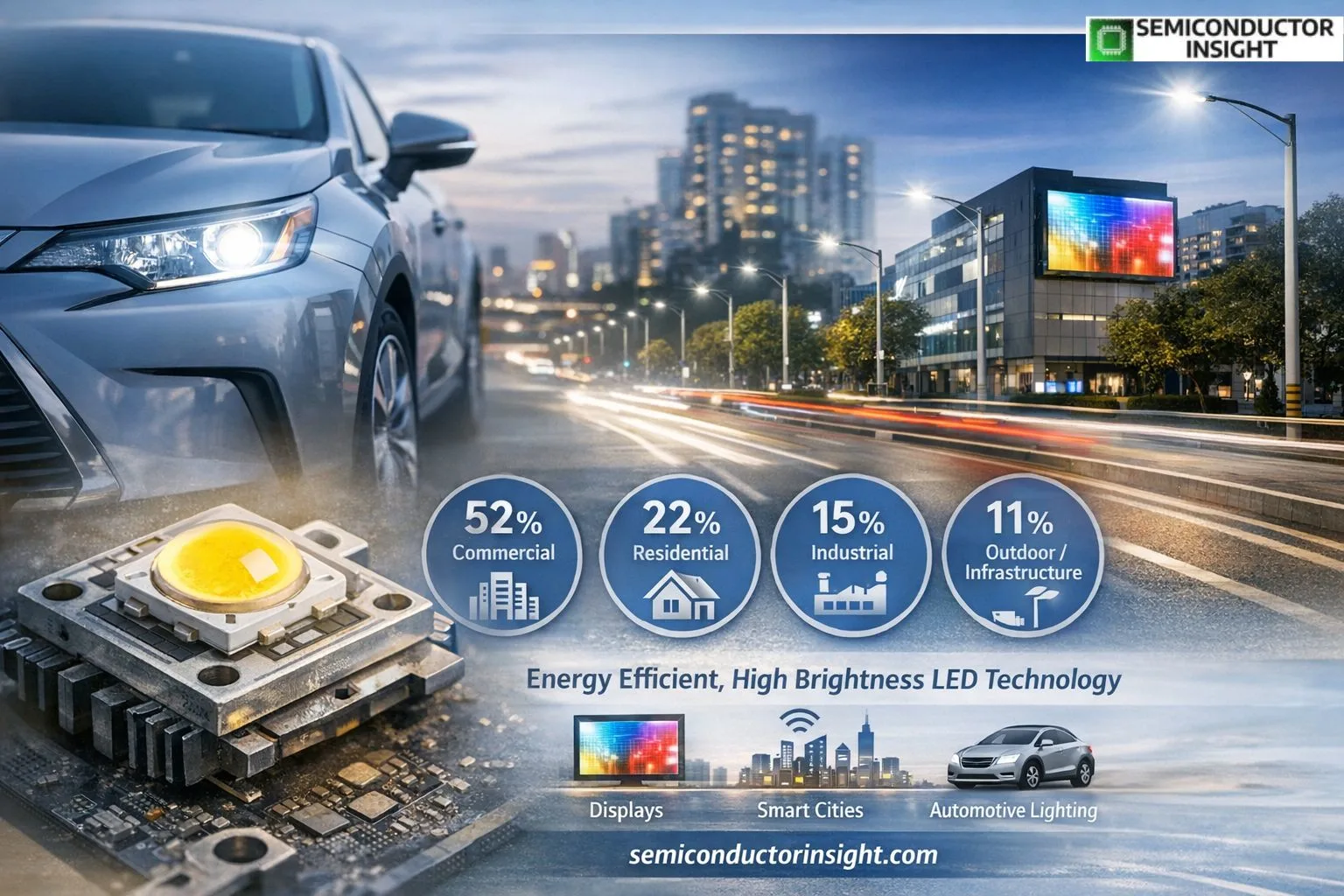
Application Segment Revenue Split
- Commercial Segment Share: ~51.9% of total LED revenue
- Includes offices, retail, warehouses dominant category
- Residential Segment Share: ~21.8% of total LED revenue
- A-type bulbs, strip lighting, down lights
- Industrial Segment Share: ~15.3% of total LED revenue
- High bay, factory floor, manufacturing
- Outdoor / Infrastructure Share: ~11.0% of total LED revenue
- Street lighting, signage, public spaces
Don’t Forget to Surf Our Updated Report for More Detailed Analysis: https://semiconductorinsight.com/report/high-brightness-led-market/
Urban Infrastructure and Smart City Illumination
One of the largest deployment environments for high brightness LEDs is urban infrastructure. Municipalities worldwide are rapidly replacing traditional street lighting with LED-based systems due to their efficiency and long operational lifetimes.
Recent global lighting studies indicate that LED technology now powers roughly 60% of street lighting installations, and outdoor parking areas in developed economies have achieved nearly 80% LED conversion.
The energy impact of this transition is substantial. Lighting currently consumes between 2,500 and 3,500 terawatt-hours of electricity annually, making efficiency improvements in illumination systems a major contributor to global energy savings.
High brightness LEDs are particularly suited for these applications because they deliver concentrated illumination with high lumen output while maintaining relatively low power consumption. In addition, digital drivers and sensors allow LED systems to integrate with intelligent city infrastructure for adaptive brightness control, traffic monitoring, and environmental sensing.
Automotive Lighting and Advanced Displays
- Another major application segment for HB-LEDs is automotive lighting. Vehicle manufacturers increasingly rely on LED-based headlamps, daytime running lights, and interior illumination systems due to their brightness, durability, and compact semiconductor packaging.
- Modern LED headlamp modules can generate thousands of lumens while consuming only tens of watts of electrical power. This performance advantage enables precise beam shaping, adaptive lighting systems, and improved night-time visibility for drivers.
- Display technology also represents a rapidly expanding application area. High brightness LEDs form the backbone of digital signage, stadium screens, and premium televisions. Mini-LED and micro-LED display technologies rely on extremely small LED chips arranged in dense arrays to deliver high brightness and improved contrast ratios in modern display panels.
- The semiconductor manufacturing ecosystem supporting these displays has expanded rapidly. Global LED chip production capacity reached approximately 5 billion units annually, with East Asian semiconductor clusters accounting for the majority of manufacturing output.
Energy Efficiency and Environmental Impact
- Beyond performance advantages, high brightness LEDs are widely recognized for their environmental benefits. Compared with traditional lighting sources, LEDs convert 80-90% of electrical energy into visible light, significantly reducing wasted heat.
- This efficiency translates directly into global energy savings. Studies estimate that LED adoption could reduce electricity consumption for lighting by nearly 40% by 2030, while preventing over 1 billion metric tons of carbon emissions annually through lower energy demand.
- Governments have actively supported the transition through efficiency standards and national lighting programs. For example, large-scale public initiatives have distributed hundreds of millions of LED bulbs to households in developing economies, accelerating the replacement of inefficient lighting technologies.
Further, as semiconductor innovation continues to improve optical efficiency, thermal stability, and device lifetime, high brightness LEDs are expected to remain a central technology in the evolution of global lighting, advanced displays, and intelligent infrastructure. Their combination of energy efficiency, durability, and semiconductor scalability positions them as one of the most influential optoelectronic components in modern electronic systems.

Comments (0)