
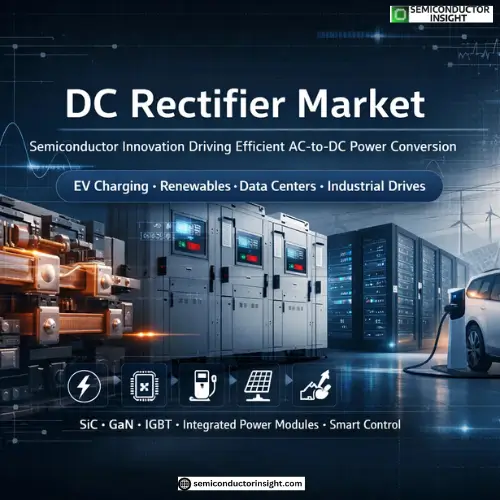
DC Rectifier Market Trends Spur Innovation in Power Electronics and System Reliability
Electric power systems fundamentally rely on the controlled conversion of alternating current (AC) to direct current (DC) to power modern electronics, data centres, industrial drives, and transportation systems. DC rectifier’s semiconductor-based systems that perform this conversion are therefore critical infrastructure components in power electronics. As demand for electrification intensifies across industries, the DC rectifier market is gaining strategic relevance not just as a discrete power conversion technology, but as an enabling platform for advanced semiconductor implementations.
Unlike traditional transformer-centric approaches, modern rectifiers leverage advanced semiconductor devices including silicon controlled rectifiers (SCRs), insulated gate bipolar transistors (IGBTs), and wide-band gap materials such as silicon carbide (SiC) to deliver higher efficiency, lower losses, and enhanced reliability.
Market Definition and Semiconductor Integration
At its core, a DC rectifier is a power electronic subsystem that converts AC input into controlled DC output. Historically used in battery charging, electroplating, and telecom power supplies, rectifiers have expanded into electric vehicle (EV) charging stations, renewable energy systems, rail traction, aerospace power electronics, and data centre UPS systems.
Their performance depends heavily on semiconductor elements that regulate, switch, and shape current flows. Modern rectifier solutions are often designed as integrated power modules with embedded control logic not just discrete diode bridges.
Semiconductor advancements are driving key performance criteria:
- Switching speed and thermal tolerance
- High voltage handling with low conduction loss
- Harmonic suppression and waveform fidelity
This evolution enhances system efficiency and reduces operational costs for end users.
Semiconductor Technologies Driving Innovation
Recent advances in semiconductor materials and device architectures are reshaping the DC rectifier landscape:
- Wide Bandgap Devices:
Silicon carbide (SiC) and gallium nitride (GaN) are increasingly preferred for high-performance rectifiers due to their superior voltage breakdown strength, low on-resistance, and high thermal conductivity. These properties allow rectifiers to operate efficiently at elevated temperatures and high switching frequencies.
- Integrated Power Modules:
Rectifier solutions are migrating toward system-in-package (SiP) designs that combine power devices, drivers, and protective circuitry. These integrated modules reduce parasitic losses and improve overall reliability.
- Digital Control Integration:
Microcontrollers and digital signal processors (DSPs) embedded in rectifier systems enable real-time waveform optimization, adaptive response to load changes, and predictive fault diagnostics all of which enhance uptime and serviceability.
Application Expansion across Key Industries
- Renewable Energy Integration: Solar PV systems and wind farms use rectifiers to convert generated AC into DC for storage, grid interfacing, and inverter feed circuits. Advanced rectifier designs help mitigate power quality issues and support grid compliance.
- Electric Vehicle Infrastructure: Fast EV charging stations require robust DC rectification to supply high-current DC power to batteries. SiC-based rectifiers are becoming standard in ultra-fast chargers due to their efficiency and thermal performance.
- Industrial Automation and Drives: Variable frequency drives (VFDs), robotics, and industrial actuators depend on stable DC rails. Modern rectifiers with active power factor correction (PFC) ensure compliance with industrial power quality standards and reduce peak grid loads.
- Telecom and Data Centers: Uninterruptible Power Supplies (UPS) and DC power plants in telecom and data centers use rectifiers to ensure continuous DC feed for critical loads. Semiconductor-enhanced rectifiers minimize downtime and enhance energy efficiency.
Quantifying Market Dynamics
While global rectifier unit shipment data fluctuates annually due to industry cycles, recent trends indicate measurable growth associated with megatrends:
- Urban electrification projects and EV charger deployment increased rectifier installations by an estimated 14-18% in 2024 in major markets including North America, Europe, and Asia-Pacific.
- SiC device adoption in power modules rose from under 8% of total high-power semiconductors in 2021 to over 17% in 2025 projections, signaling accelerated conversion to high-efficiency rectifier designs.
These figures suggest that semiconductor-driven rectifier demand is moving beyond incremental growth into structural momentum.
Regulatory and Efficiency Standards Impacting Adoption
Global energy efficiency and power quality regulations are influencing rectifier design and deployment. Standards such as IEEE 519 for harmonic control, IEC 61000 for electromagnetic compatibility (EMC), and emerging green building codes require rectifiers to deliver high power factor, low total harmonic distortion (THD), and reduced losses.
Semiconductor innovation plays a pivotal role in meeting these standards. Advanced rectifiers embedded with adaptive control algorithms and optimized switching profiles help systems:
- Comply with regional grid codes
- Minimize wasted energy
- Extend equipment lifecycles
Compliance is no longer optional it is a driver of product specification and procurement decisions.
For More Detailed Insights You Can Surf Our Latest Report Here:
https://semiconductorinsight.com/report/dc-rectifier-market/
Supply Chain and Manufacturing Considerations
The semiconductor supply chain plays a decisive role in rectifier availability and performance outcomes. High-reliability power devices, precision packaging, and quality control processes directly shape market competitiveness.
Manufacturers must balance:
- Silicon vs. wide band gap semiconductor sourcing
- Domestic vs. international supply resilience
- Inventory control for long lifecycle products (often 7-10 years)
Companies that secure stable semiconductor supply, invest in testing infrastructure, and align production with evolving rectifier specifications gain a strategic edge in long-term contracts.
DC rectifier market is a dynamic segment at the intersection of power conversion, semiconductor innovation, and electrification demand. Rising adoption in renewable energy, EV charging, industrial automation, and digital infrastructure underscores its strategic relevance. Semiconductor companies that lead with advanced materials, smart control integration, and resilient supply strategies are best positioned to capture growth as the world transitions toward efficient, reliable DC power regimes.

Comments (0)