

Cutting-Edge Semiconductor Miniaturization Trends Elevating Smart Ring PPG Sensor Modules
Smart ring PPG sensor modules with stress tracking represent a fusion of semiconductor miniaturization and optical sensing technology. Photoplethysmography (PPG) uses light-emitting diodes typically green, red, and infrared to detect blood volume changes in finger arteries through the skin. Wikipedia and technical literature explain that the finger’s thin tissue and rich vascular supply yield clearer signals than wrist-based alternatives, especially for heart rate variability (HRV) metrics central to stress assessment.
These modules pack resistance wires or micro-LEDs, photodiodes, and signal processing chips into a compact ring form. Algorithms analyze HRV patterns alongside movement data from integrated accelerometers to estimate stress levels in real time. Penn State research prototypes highlight how PPG combined with inertial sensors captures mood and stress indicators, recommending interventions like breathing exercises.
Sensor Signal Pathway in Daily Operation
- Light emission from LEDs penetrates the skin → Blood pulsations modulate reflected light → Photodiodes capture variations → On-board semiconductor processors filter noise and compute metrics → App delivers stress insights.
- This sequence operates continuously with low power draw, often under 1 mA average in optimized designs, enabling multi-day battery life.
- In 2025-2026 global scenarios, users in high-stress professions such as healthcare and tech employed these rings for continuous monitoring.
- One university-led study featured adjustable smart rings validating pulse rate and oxygen saturation under motion, supporting clinical-grade accuracy in dynamic conditions.
- European and Asian wellness programs integrated them into employee health initiatives, tracking recovery during remote work shifts.
From Raw Signal to Actionable Insight
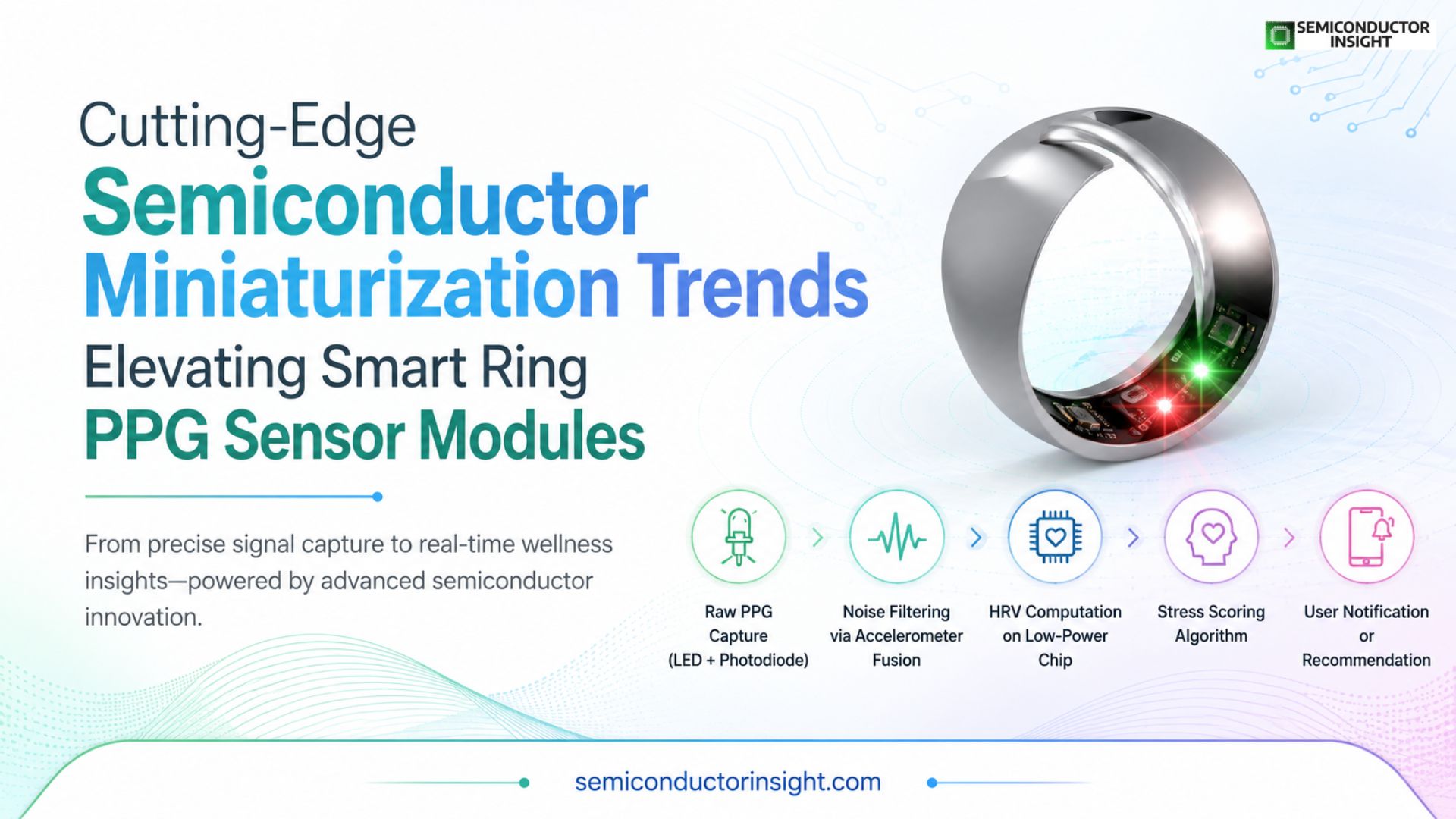
Raw PPG Capture (LED + Photodiode) → Noise Filtering via Accelerometer Fusion → HRV Computation on Low-Power Chip → Stress Scoring Algorithm → User Notification or Recommendation.
Recent instances include deployments in clinical feasibility studies where ring-type PPG sensors monitored ventricular rhythms or cognitive load in extended reality settings. Government-affiliated health tech explorations, such as those from academic labs, demonstrate potential for early detection of physiological strain in daily environments.
To Stay Tuned with More meaningful and In-Depth Insights, Do Visit here: https://semiconductorinsight.com/report/smart-ring-ppg-sensor-module-with-stress-tracking-market/
Bullet Points on Global Application Patterns
- Workplace wellness: Tracking autonomic nervous system balance during meetings or commutes.
- Athletic recovery: Monitoring overnight HRV to guide training intensity.
- Sleep optimization: Linking daytime stress data to night-time restoration metrics.
- Chronic condition support: Observing trends in vascular responses for lifestyle adjustments.
These patterns emerge from peer-reviewed articles and prototype case summaries.
Semiconductor Integration Excellence: Which Partners Enhance Smart Ring Ecosystem Compatibility?
Leading semiconductor fabricators specializing in low-power analog and mixed-signal chips pair effectively with health platforms. Their components enable seamless Bluetooth connectivity to smartphone ecosystems and cloud analytics for longitudinal stress profiling. Technical papers note that flexible PCBs and temperature-adaptive algorithms from collaborative university-industry efforts improve accuracy under varying conditions, such as cold environments or physical activity.
Flow Map Visualization of Data Ecosystem
- Imagine streams flowing from the ring’s PPG module outward: Personal device sync → Aggregated anonymized insights → Health platform dashboards → Personalized coaching loops. This map highlights closed feedback benefiting both individual users and broader research datasets.
- Ongoing examples from 2025 showcase open-source platforms like multimodal sensor rings fusing PPG with other signals for robust blood pressure estimation, adaptable to stress contexts. Academic publications detail rotation-robust designs that maintain signal quality regardless of finger orientation, a key advancement for all-day wear.
These modules continue advancing through innovations in photon transmission modeling and multi-channel fusion. Their role in personal health underscores how semiconductor ingenuity delivers discreet, powerful monitoring tools. From enhancing daily resilience to supporting specialized health protocols, smart ring PPG sensor modules with stress tracking quietly empower users worldwide with deeper physiological awareness.

Comments (0)