
Crystal RTC vs. Temperature Compensated RTC across the Real Time Clock Market
A real-time clock rarely receives the attention given to processors, memory or power semiconductors, yet it performs one of the most persistent jobs inside an electronic system. Even when the main processor is sleeping or disconnected from its primary power source, the RTC can continue tracking seconds, minutes, dates and scheduled events.
That basic requirement is now being engineered for battery-powered sensors, automotive electronics, industrial controllers, connected appliances and embedded computing platforms.
The 32.768 kHz Frequency Still Sits at the Centre
- The architecture of many conventional RTC devices remains remarkably consistent. A 32.768 kHz quartz reference is divided electronically to produce a 1 Hz time base, allowing the device to maintain calendar information while consuming extremely little power.
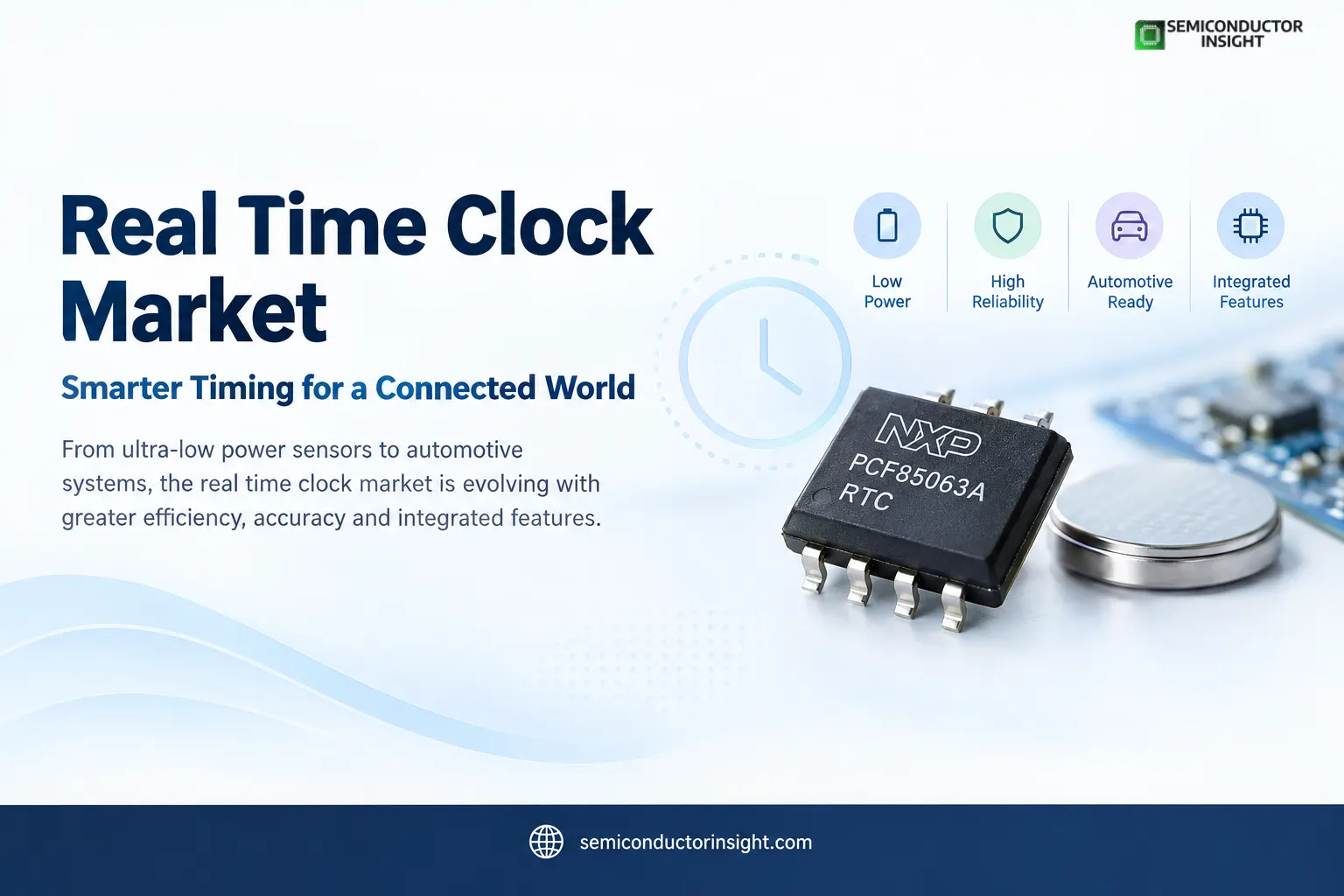
- NXP’s PCF85063A, for example, operates from 0.9 V to 5.5 V and specifies a typical current of just 0.27 μA at 3.0 V and 25°C. It also supports a 400 kHz I²C interface and programmable outputs ranging from 32.768 kHz down to 1 Hz.
- That combination illustrates where modern RTC design is heading: the timing function remains simple, but the surrounding semiconductor architecture is becoming substantially more efficient and configurable.
Trend One Is Turning Microamps into Nanoamps
Power consumption has become one of the most visible specifications in RTC selection because the device may remain active while the rest of a system spends most of its time asleep. In battery-backed applications, even a small continuous current can accumulate over months or years.
NXP’s PCF8563 specifies a typical backup current of 0.25 μA at 3.0 V and 25°C. Its operating range extends from 1.0 V to 5.5 V.
This matters for remote sensors, utility equipment, asset trackers and other products where replacing a battery frequently is impractical. The RTC is therefore becoming part of the system’s energy budget rather than simply a timekeeping accessory.
Trend Two Is Moving RTCs into Automotive Electronics
Vehicle electronics demand timing components that can tolerate substantially harsher operating environments than ordinary consumer products. Temperature variation, long product lifetimes, power-state transitions and functional-safety requirements all influence RTC selection.
NXP’s PCA85073A is an automotive RTC with AEC-Q100 Grade 2 compliance, a 32.768 kHz quartz reference and a 400 kbit/s I²C interface. Its automotive portfolio also includes the PCA85074ADP, designed for operation up to 125°C.
In modern vehicles, precise timekeeping can support event logging, scheduling, low-power wake-up functions and electronic control architectures that increasingly divide computing workloads across numerous controllers.
Trend Three Is Making the RTC More Than a Clock
- Today’s RTC devices increasingly combine timing with alarms, countdown functions, timestamp inputs, memory and power-switching features. This reduces the number of separate components needed around the processor.
- NXP’s PCF85363A combines an RTC with 64 bytes of battery-backed RAM, two alarms, two interrupt outputs, time-log registers and automatic switching to battery operation when the main supply is lost. It can also operate as an elapsed-time counter.
- The shift is important for embedded designers because a single timing IC can handle several low-power housekeeping functions that would otherwise require additional circuitry.
Trend Four Is Giving Engineers More Control Over the Clock Signal
An RTC does not necessarily have to provide only calendar information. Clock outputs can also become useful references for other low-frequency functions.
The PCF85063A supports programmable outputs at 32.768 kHz, 16.384 kHz, 8.192 kHz, 4.096 kHz, 2.048 kHz, 1.024 kHz and 1 Hz.
This range allows designers to select a clock frequency appropriate to the connected subsystem while retaining a common timing reference. It also demonstrates why the RTC market increasingly overlaps with the wider timing-component ecosystem.
Trend Five Is Bringing Accuracy into the Spotlight
Low current alone is no longer sufficient for applications where timestamp precision matters. Temperature, crystal characteristics, ageing and environmental conditions can all influence oscillator accuracy.
The growing technical focus is visible in NXP’s 2026 publication of an application note specifically dedicated to RTC timekeeping accuracy. The company has also introduced the PCA2131, described as a nano-power highly accurate RTC with an integrated quartz crystal for automotive applications. Its latest datasheet was revised in June 2026.
This reflects an important design transition: engineers are increasingly evaluating power consumption and timing stability together rather than treating them as independent specifications.
For additional report info, feel free to view our most recent edition: https://semiconductorinsight.com/report/real-time-clock-market/
Trend Six Is Keeping I²C at the Heart of Board-Level Integration
Despite the emergence of newer processor and connectivity architectures, I²C remains a practical interface for RTC devices because it requires only two signal lines and supports straightforward communication between the controller and peripheral.
NXP’s I²C documentation describes the protocol’s two-wire architecture and highlights its suitability for low-current and battery-backed systems. RTC products such as the PCF85063A and PCA85073A support communication at up to 400 kbit/s.
For compact embedded designs, this keeps the RTC electrically simple while allowing firmware to read calendar registers, configure alarms and adjust clock parameters.
The Design Numbers That Matter
Several specifications provide a useful snapshot of contemporary RTC engineering. Common devices operate from supplies below 1 V through several volts, use a 32.768 kHz reference, communicate through interfaces reaching 400 kHz and can consume fractions of a microamp under specified backup conditions. Some automotive devices extend operation to 125°C, while multifunction RTCs can incorporate dozens of bytes of battery-backed memory.
These figures explain why the Real Time Clock Market remains relevant inside increasingly sophisticated semiconductor systems. The technology is not competing to perform the most computationally demanding task on a circuit board. Its value comes from performing one small function continuously, accurately and with exceptionally little energy.

Comments (0)