Key Statistics
Key Takeaways
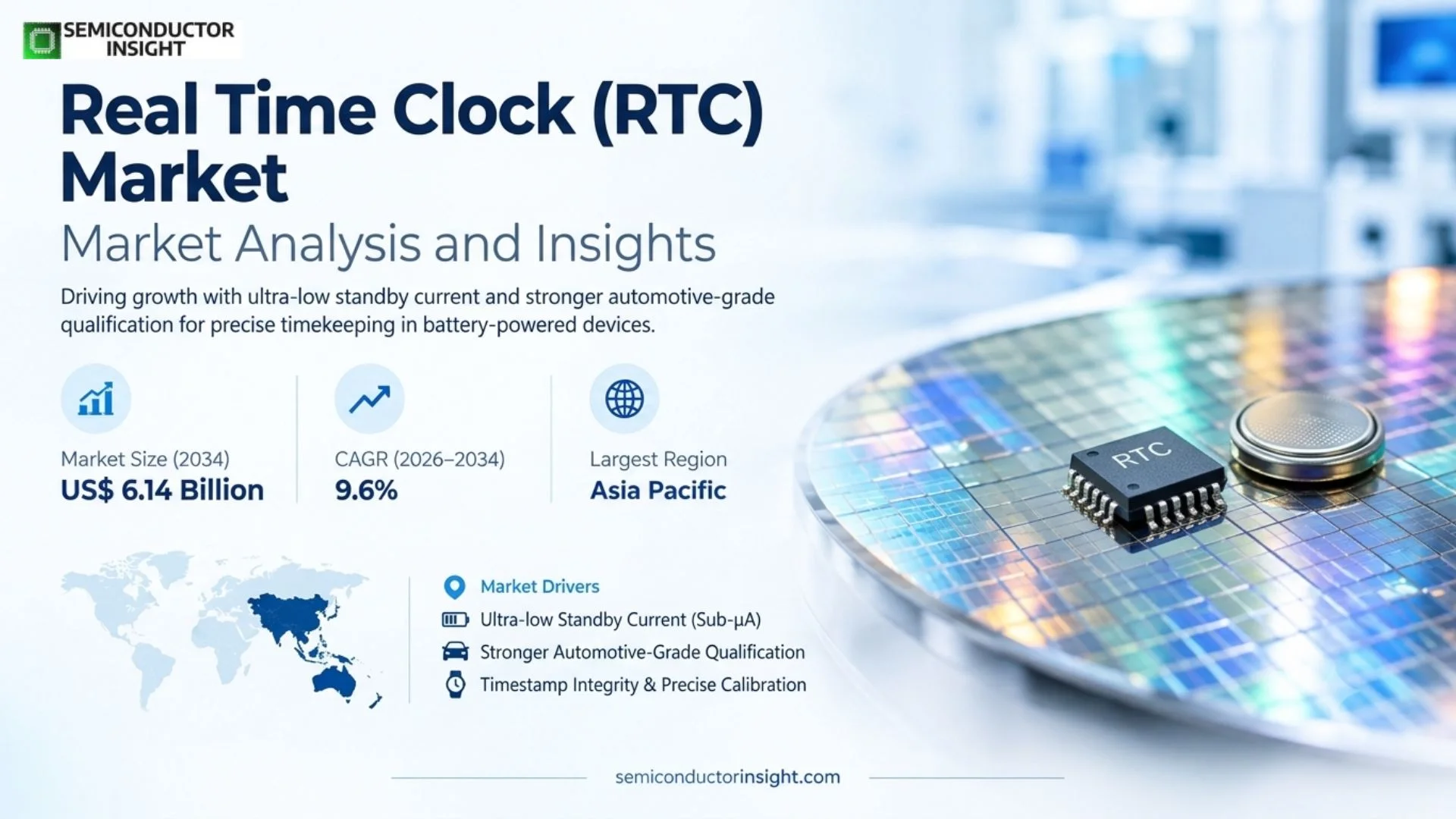
- Asia Pacific is the largest regional market with a 66% share on the report page, reflecting the region’s concentration of consumer-electronics, automotive and communications-equipment manufacturing.
- I2C RTCs lead by type with a 52% share on the report page because the two-wire interface is widely supported by microcontrollers and minimizes pin count in compact electronic designs.
- Consumer electronics remains the largest application because clocks, cameras, appliances, wearables and connected devices need low-cost calendar retention and wake scheduling across power cycles.
- Automotive and industrial systems support premium products where qualification, wide temperature range, event logging and time retention through key-off or power interruption are more important than the lowest component price.
- Integration is the main structural restraint: microcontrollers and systems-on-chip often include basic RTC blocks, so dedicated devices must justify themselves through lower backup current, better accuracy, independent power domains or richer timestamp functions.
Real Time Clock Market Overview
Real Time Clock Market was valued at USD 2.7 billion in 2025 and is projected to reach USD 6.14 billion by 2034, expanding at a 9.6% CAGR during 2026–2034. Asia Pacific is the largest market, accounting for 66% of demand on the report page, while the category is shifting toward lower standby current, smaller packages, tighter clock correction and stronger automotive-grade qualification. The commercial value of a dedicated RTC remains highest where time must survive main-power loss, where timestamp integrity matters, or where a host processor cannot depend on network synchronization.
A real-time clock is a low-power timing IC that maintains calendar and time information independently from the main processor. A typical device combines a 32.768 kHz crystal oscillator interface or integrated resonator, clock and calendar registers, alarm and timer functions, and a low-current backup domain. The category spans simple I2C and SPI devices through temperature-compensated and automotive-qualified products. The purchasing decision is therefore less about basic time display and more about holdover accuracy, backup current, package footprint, interface compatibility, temperature range, event timestamping and long-term supply continuity.
Demand is distributed across consumer electronics, vehicles, industrial controls, communications equipment and IoT nodes. These systems increasingly spend long periods in sleep or standby states while still needing a reliable notion of time for wake scheduling, logging, metering, maintenance intervals, security events or network recovery. Dedicated RTCs are especially defensible when the MCU is fully powered down, when backup energy is tightly constrained, or when software-only time synchronization is unavailable during outages. This creates a stable design-in market even as many microcontrollers incorporate basic RTC peripherals.
Technical competition is centered on microampere and sub-microampere current, calibration capability, wide supply range, timestamp features and package size. NXP lists a typical current of 0.27 microampere for the PCF85063A at 3.0 V, while ABLIC markets RTCs at 0.25 microampere with 1 ppm correction resolution. These specifications show why the category continues to matter in battery-backed systems: the clock domain can remain active for years from a small cell or supercapacitor while the higher-power application processor is switched off.
Segment Analysis: By Type
The market is segmented into I2C RTC, SPI RTC, Parallel Interface RTC, Autonomous RTC and Others. I2C devices lead with 52% share on the report page because they combine low pin count, broad MCU support and adequate bus speed for clock and calendar access. SPI parts remain important where designers value a faster or electrically simpler serial interface, while autonomous and high-function devices serve systems requiring independent scheduling, timestamping or power-domain control.
| Type | Technical / functional role | Market position and purchasing logic |
|---|---|---|
| I2C RTC | Uses a two-wire serial interface for clock, calendar, alarm, timer and status registers. The interface reduces pin count and is supported by a very broad range of microcontrollers, making it attractive in space-constrained and low-power systems where RTC data rates are modest. | Largest type, 52% share on the report page. Design wins depend on backup current, package size, clock correction, oscillator implementation and software familiarity. Active products such as NXP PCF85063A demonstrate the segment’s focus on low current and compact packages rather than high data throughput. |
| SPI RTC | Uses a synchronous serial interface with separate clock and data lines. SPI can provide higher transfer speed and deterministic signaling, and it can fit industrial controllers or embedded systems that already have an SPI peripheral available and want to avoid sharing an I2C bus. | A substantial secondary segment. It is selected where the system architecture favors SPI, where bus isolation is useful, or where designers prefer dedicated chip-select control. Suppliers compete on the same core timing metrics as I2C devices, but interface compatibility and firmware reuse strongly influence vendor selection. |
| Parallel Interface RTC | Exposes time and control information through a wider bus or memory-mapped interface. These devices historically fit processors and boards designed around parallel buses, offering straightforward access but consuming more pins and board area than serial alternatives. | A mature, replacement-oriented segment. New designs generally favor serial interfaces because they reduce routing and package size, but parallel RTCs retain value in long-life industrial platforms and legacy systems where a board redesign would cost more than maintaining the incumbent device. |
| Autonomous RTC | Extends basic timekeeping with independent alarms, wake control, timestamping, power switching or event counters so the RTC can coordinate low-power behavior while the main processor remains asleep. | A higher-value functional segment aligned with battery devices, remote sensors and fault logging. The commercial proposition is system-level energy savings and resilience: an autonomous timing domain can wake the processor only when required and can preserve event history across interruptions. |
| Others | Includes specialized RTC implementations such as temperature-compensated, highly integrated, module-based or application-specific devices that do not fit the primary interface categories. | A diverse niche where value is determined by accuracy, environmental robustness, integration and certification. Automotive, telecom, metering and precision equipment can support higher unit prices when the RTC removes external components or simplifies system qualification. |
Why low-current I2C devices anchor volume while compensated RTCs capture premium value
I2C dominates volume because a two-wire bus is already present in many embedded systems, but the strongest differentiation is moving beyond the interface. NXP’s PCF85063A specifies low-current operation and a programmable offset register, while ABLIC highlights 0.25 microampere current and 1 ppm correction resolution. Those features matter when a design must preserve time for years on backup energy. Temperature compensation, automotive qualification and event timestamping create additional value because they reduce calibration effort and improve reliability across real operating conditions.
Segment Analysis: By Application
By application, the market covers Consumer Electronics, Automotive, IT and Communication, Industrial Applications, IoT Devices and Other uses. Consumer electronics leads through sheer device volume, while automotive and industrial designs generally carry higher qualification requirements and longer product lifecycles. IoT creates a broad opportunity because many nodes sleep for most of their operating life and depend on an independent low-power time base to wake, log or synchronize without keeping the main processor active.
| Application | Demand characteristics |
|---|---|
| Consumer Electronics | The largest application. Cameras, appliances, portable devices, wearables and smart-home products use RTCs to retain calendar time, manage alarms and schedule operation when the application processor is off. Price and package area matter, but battery life can make backup current equally important. The category rewards suppliers that provide compact packages, broad voltage support and reference software that shortens integration time across high-volume product families. |
| Automotive | Vehicle RTCs support telematics, event logging, infotainment, domain controllers and other systems that must maintain time through key-off and battery-management states. OICA reported 96.4 million vehicles produced globally in 2025, including 59.2 million in Asia-Oceania. Automotive parts face wider temperature requirements, AEC-Q100 qualification, PPAP expectations and long availability commitments, creating higher barriers than consumer designs. |
| IT and Communication | Networking equipment, gateways, servers, routers and communications nodes use RTCs for logs, management functions and recovery after power interruption. Precision timing for radio synchronization usually relies on higher-performance oscillators and network timing, but a local RTC remains useful as a low-power calendar and holdover reference for system management, especially during boot and fault recovery. |
| Industrial Applications | Industrial controllers, meters, factory equipment and infrastructure systems use RTCs for maintenance schedules, timestamped alarms, data logging and scheduled operation. Equipment lifetimes can exceed a decade, so component longevity, wide temperature range and supply continuity can be more important than small differences in unit price. Rugged systems also value independent timekeeping when communications or main power are intermittent. |
| IoT Devices | Battery-powered sensors and remote endpoints are a natural fit for low-current RTCs because the node may sleep for minutes, hours or days between measurements. The RTC can maintain time and trigger wake events while the MCU remains off, reducing average power. As IoT deployments scale, system designers increasingly compare the RTC’s backup current, alarm flexibility and package footprint against an MCU-only solution. |
| Other | Medical electronics, instrumentation, security systems and specialized embedded platforms form a fragmented but attractive residual segment. These applications often value timestamp integrity, battery backup, calibration and long-term reliability more than consumer-style price optimization, giving established analog suppliers room to differentiate through documentation, qualification and lifecycle support. |
Additional segmentation dimensions
| Axis | Source-defined segments | Commercial interpretation |
|---|---|---|
| By Technology | Standard RTC; Low-Power RTC; Temperature-Compensated RTC; High-Precision RTC | Technology segmentation tracks the trade-off between cost, power and accuracy. Standard parts address routine calendar retention, while low-power and compensated devices gain value in battery-backed, automotive, metering and industrial designs where drift or current directly affects system performance. |
| By Power Source | Battery-Backed RTC; Main-Powered RTC; Energy-Harvesting RTC | Backup architecture affects both component selection and board design. Coin cells remain common, supercapacitors support maintenance-free systems, and energy-harvesting concepts fit remote nodes where replacing a backup cell is difficult or expensive. |
Regional Analysis
Asia Pacific leads with 66% market share on the report page, followed by North America at 17% and Europe at 12%. The regional pattern closely follows electronics manufacturing, automotive production and embedded-system design activity. SIA reported 2025 semiconductor sales growth of 45.0% in Asia Pacific/All Others, 30.5% in the Americas and 6.3% in Europe, while OICA recorded 59.2 million vehicles produced in Asia-Oceania compared with 18.7 million in the Americas and 17.2 million in Europe.
How do electronics production, automotive scale and embedded-system design shape RTC demand by region?
RTC demand is not simply proportional to end-market consumption because many clocks are purchased where electronics are designed and assembled. Asia Pacific therefore captures a larger share than its final-device consumption alone would imply. North America and Europe remain important for high-value industrial, automotive, medical and communications designs, while South America and the Middle East & Africa are more dependent on imported electronics and regional assembly. The mix determines whether suppliers compete primarily on price and package density or on qualification, precision and long-life support.
| Region | Position | Growth outlook | Demand profile | Evidence-led market logic |
|---|---|---|---|---|
| Asia Pacific | Largest, 66% | High | High-volume electronics manufacturing | China, Japan and South Korea combine semiconductor, consumer-electronics and automotive production. SIA reported 45.0% annual semiconductor sales growth for Asia Pacific/All Others in 2025, reinforcing the region’s role as the largest design-in and manufacturing base for RTC-enabled systems. |
| North America | Second, 17% | Moderate-high | Design-intensive, industrial and automotive | The United States anchors semiconductor design, data infrastructure, industrial electronics and medical devices. SIA recorded 30.5% annual semiconductor sales growth in the Americas in 2025, while OICA counted 15.6 million vehicles produced across NAFTA, supporting both embedded and automotive timing demand. |
| Europe | Third, 12% | Moderate | Automotive and industrial quality led | Europe combines automotive electronics, industrial automation and energy systems. OICA recorded 17.2 million vehicles produced in Europe in 2025. RTC opportunities are weighted toward qualified, wide-temperature and long-lifecycle products rather than only high-volume consumer designs. |
| South America | Smaller | Selective | Import and automotive assembly led | Regional demand is tied to imported electronics, smart metering and local automotive production. OICA recorded 3.17 million vehicles produced in South America in 2025, including 2.64 million in Brazil, giving automotive and industrial distributors a measurable installed base for embedded timing components. |
| Middle East & Africa | Emerging | Selective-high from low base | Infrastructure, telecom and industrial projects | Demand is project-led across telecommunications, energy, industrial monitoring and vehicle assembly. OICA recorded 1.23 million vehicles produced in Africa in 2025. Suppliers typically compete through distributors and design support because local semiconductor manufacturing remains limited. |
Competitive Landscape
Competition is semi-consolidated around established timing and analog-semiconductor suppliers. The report page states that five major companies collectively hold more than 54% of the market and identifies EPSON as the largest individual supplier at 18%. Scale matters, but the key competitive variables are oscillator expertise, backup current, package options, automotive qualification, calibration features, software familiarity and the ability to keep a device available for many years after it enters a customer platform.
EPSON, NXP, STMicroelectronics, Renesas Electronics and Analog Devices benefit from broad semiconductor portfolios and established customer relationships. RTCs are low-cost parts in many systems, so design engineers strongly prefer suppliers that can provide reliable documentation, evaluation boards, firmware examples and long-term supply. Once the device is qualified, switching often requires board, firmware and validation work that exceeds the component cost difference, creating sticky design wins.
Power consumption is a visible technical battleground. NXP lists typical current near a quarter microampere for the PCF85063A family, and ABLIC markets 0.25 microampere RTCs with fine clock correction. These numbers demonstrate the practical ceiling for differentiation in backup domains: when current falls into the sub-microampere range, accuracy, oscillator behavior, package, temperature range and system features become the next basis of comparison.
Automotive and industrial markets create a second competitive layer because qualification and lifecycle are as important as electrical performance. Suppliers able to offer AEC-Q100 parts, PPAP support, wide temperature operation and stable manufacturing processes can defend higher value. Consumer and IoT segments are more price-sensitive, but miniaturization and low power still create opportunities for specialized products in wearables and battery devices.
| Competitive tier | Representative companies | How they compete |
|---|---|---|
| Global timing leaders | EPSON; NXP Semiconductors; STMicroelectronics; Renesas Electronics; Analog Devices | Broad RTC portfolios, large distribution networks, oscillator or analog expertise, strong documentation and access to automotive, industrial and consumer customers. These suppliers can support long design cycles and multi-region production. |
| Specialist / diversified analog suppliers | Microchip Technology; Texas Instruments; ABLIC; Diodes Incorporated | Compete through low power, automotive or industrial qualification, integration and channel support. They are often strongest where RTC functionality complements a broader power-management or embedded-control portfolio. |
| Legacy / integrated portfolios | Maxim Integrated and other acquired or legacy product families | Installed designs can remain commercially relevant for many years. Acquisitions consolidate portfolios, but customers continue to require compatible replacements, documentation and lifecycle management for qualified equipment. |
Key Participants
Production Capacity Analysis
RTC manufacturing uses mature mixed-signal CMOS processes, crystal or resonator technology, wafer fabrication, packaging and final electrical/timekeeping test. Capacity is therefore not constrained only by leading-edge wafer availability. The more important risks are continuity of mature-node foundry capacity, availability of quartz or integrated oscillator components, automotive qualification, assembly/test allocation and the supplier’s willingness to maintain older products for long equipment lifecycles.
Wafer fabrication can be internal or outsourced, depending on the supplier. RTC die sizes are small and many designs use mature process nodes, so a single wafer can yield large unit volumes. That reduces the likelihood that RTCs themselves dominate fab-capacity decisions, but it increases exposure to mature-node allocation cycles because RTC suppliers compete with many analog, power and interface products for the same capacity.
Packaging is a major source of differentiation because wearables and IoT devices reward very small footprints while industrial and automotive customers may prefer gull-wing packages that are easy to assemble and inspect. Suppliers often maintain several package families for one RTC core. Qualification cost means those package choices remain in production for years once adopted by large OEM programs.
Crystal integration and calibration determine accuracy, cost and board-area trade-offs. Some RTCs use an external 32.768 kHz crystal, while others integrate a crystal or temperature-compensation function. The integrated option simplifies the customer design and can improve control over oscillator behavior, but it raises component value and places more manufacturing know-how inside the supplier’s package.
Market Dynamics
Market growth reflects a balance between more electronic systems needing persistent timestamps and the steady integration of basic RTC functions into microcontrollers. IoT, automotive electronics and industrial logging expand the number of potential sockets, while low-power system design increases the value of an independent backup domain. Against that, connected devices can recover time from networks and cost-sensitive products can use an MCU’s internal RTC. Dedicated suppliers therefore win by solving the hard cases: very low current, better accuracy, independent power, event logging, harsh environments and long lifecycle.
Market Drivers
Growth drivers and directional market impact
| Driver | Directional impact* | Why it matters |
|---|---|---|
| Expansion of battery-powered IoT and edge devices | High | Remote sensors, wearables and connected endpoints often sleep for most of their operating life. A dedicated RTC can maintain time and wake the system while the MCU is fully off, lowering average power and preserving event timing through communications outages. As device fleets scale, small reductions in backup current and component area become meaningful at the system level. |
| Automotive electronics and event logging | High | Vehicles increasingly contain telematics, infotainment, domain controllers and electronic control systems that must preserve time across key-off and low-power modes. OICA recorded 96.4 million vehicles produced globally in 2025. Automotive qualification, temperature range and lifecycle requirements raise the value of reliable RTCs relative to consumer-grade alternatives. |
| Need for precise, low-current holdover | Medium-high | Products may lose network access or main power yet still require a trustworthy timestamp. Sub-microampere RTCs extend backup life from coin cells and supercapacitors, while calibration or temperature-compensation features reduce drift. This is especially valuable in metering, security logs, industrial maintenance records and communications equipment. |
| Long-lived industrial and infrastructure electronics | Medium | Industrial controllers, energy systems and infrastructure equipment often remain deployed for a decade or more. These designs value component continuity, wide operating range and deterministic behavior. A qualified RTC can remain in the bill of materials for multiple product generations, creating recurring replacement and production demand even when unit growth is modest. |
Expansion of battery-powered IoT and edge devices
Remote sensors, wearables and connected endpoints often sleep for most of their operating life. A dedicated RTC can maintain time and wake the system while the MCU is fully off, lowering average power and preserving event timing through communications outages. As device fleets scale, small reductions in backup current and component area become meaningful at the system level.
Automotive electronics and event logging
Vehicles increasingly contain telematics, infotainment, domain controllers and electronic control systems that must preserve time across key-off and low-power modes. OICA recorded 96.4 million vehicles produced globally in 2025. Automotive qualification, temperature range and lifecycle requirements raise the value of reliable RTCs relative to consumer-grade alternatives.
Need for precise, low-current holdover
Products may lose network access or main power yet still require a trustworthy timestamp. Sub-microampere RTCs extend backup life from coin cells and supercapacitors, while calibration or temperature-compensation features reduce drift. This is especially valuable in metering, security logs, industrial maintenance records and communications equipment.
Long-lived industrial and infrastructure electronics
Industrial controllers, energy systems and infrastructure equipment often remain deployed for a decade or more. These designs value component continuity, wide operating range and deterministic behavior. A qualified RTC can remain in the bill of materials for multiple product generations, creating recurring replacement and production demand even when unit growth is modest.
Market Restraints
Constraints and directional market impact
| Restraint | Directional impact* | Commercial effect |
|---|---|---|
| RTC integration inside microcontrollers and SoCs | High | Many microcontrollers include a basic RTC peripheral, eliminating the cost of a discrete device when accuracy and backup behavior are sufficient. This is the largest structural restraint on standalone units. Suppliers must justify a separate part through lower current, independent power domains, calibration, timestamping, wider temperature range or simpler certification. |
| Network-based time synchronization | Medium | Connected products can recover time from NTP, GNSS or network infrastructure after boot. This reduces the need for a high-accuracy local RTC in systems that tolerate downtime and have reliable connectivity. Dedicated RTCs remain useful as a local calendar and fault-recovery reference, but the value proposition is weaker in always-connected, mains-powered devices. |
| Commodity pricing in basic consumer designs | Medium | Simple I2C RTCs are mature products with many compatible alternatives. High-volume buyers can exert price pressure and dual-source designs are common. Suppliers defend margins by moving toward smaller packages, integrated crystals, automotive qualification, timestamp functions and lower backup current instead of competing only on basic clock/calendar features. |
| Qualification and redesign friction | Medium | The same stickiness that protects an incumbent can slow adoption of new products. Customers may avoid changing a qualified RTC unless the existing part becomes unavailable or the new device produces a clear system benefit. New entrants therefore face long design cycles and must prove oscillator stability, software compatibility and long-term manufacturing quality. |
RTC integration inside microcontrollers and SoCs
Many microcontrollers include a basic RTC peripheral, eliminating the cost of a discrete device when accuracy and backup behavior are sufficient. This is the largest structural restraint on standalone units. Suppliers must justify a separate part through lower current, independent power domains, calibration, timestamping, wider temperature range or simpler certification.
Network-based time synchronization
Connected products can recover time from NTP, GNSS or network infrastructure after boot. This reduces the need for a high-accuracy local RTC in systems that tolerate downtime and have reliable connectivity. Dedicated RTCs remain useful as a local calendar and fault-recovery reference, but the value proposition is weaker in always-connected, mains-powered devices.
Commodity pricing in basic consumer designs
Simple I2C RTCs are mature products with many compatible alternatives. High-volume buyers can exert price pressure and dual-source designs are common. Suppliers defend margins by moving toward smaller packages, integrated crystals, automotive qualification, timestamp functions and lower backup current instead of competing only on basic clock/calendar features.
Qualification and redesign friction
The same stickiness that protects an incumbent can slow adoption of new products. Customers may avoid changing a qualified RTC unless the existing part becomes unavailable or the new device produces a clear system benefit. New entrants therefore face long design cycles and must prove oscillator stability, software compatibility and long-term manufacturing quality.
Market Opportunities
Automotive domain controllers and telematics
As vehicle electronic architectures consolidate, time retention and event logging become important across more centralized controllers. Suppliers with automotive-qualified RTCs, timestamp capability and very low key-off current can target telematics, gateways and domain controllers where battery draw and traceable event history are design requirements.
Energy-harvesting and maintenance-free IoT
Remote devices that harvest solar, vibration or thermal energy cannot assume continuous main power. An ultra-low-current RTC paired with a supercapacitor or small storage element can maintain schedules through energy gaps. This supports monitoring, agriculture, infrastructure and asset-tracking systems where replacing a backup battery is costly.
Integrated crystal and compensated timing modules
Combining the oscillator, RTC and compensation inside one package reduces board area and customer calibration effort. Higher integration also creates more defensible pricing because the buyer is purchasing a timing subsystem rather than a commodity calendar IC. Industrial and precision applications are likely to value this trade-off most.
Migration support for long-life equipment
Large installed bases of industrial, medical and infrastructure products eventually face component discontinuations. Suppliers that offer pin-compatible or firmware-compatible migration paths, long lifecycle commitments and application engineering can capture replacement designs without competing for entirely new system architectures.
Supply Chain Analysis
1. Quartz / semiconductor inputs
2. RTC wafer fabrication
3. Assembly, crystal integration & test
4. Distribution & OEM design-in
Quartz / semiconductor inputs
RTC supply begins with mixed-signal CMOS wafers and, for crystal-based products, a stable 32.768 kHz resonator. Material cost is a small part of system value, but oscillator quality and mature-node availability influence yield, accuracy and supply continuity.
RTC wafer fabrication
The RTC core, counters, interface logic and power-management circuits are fabricated on mature processes that prioritize low leakage and stable analog performance. Capacity competition with other analog products can create allocation risk even when leading-edge nodes are unaffected.
Assembly, crystal integration & test
Assembly determines footprint and whether the crystal is external or integrated. Final test checks current consumption, oscillator behavior, register functions and alarms. Automotive parts add qualification and process-control requirements that increase cost but support longer customer programs.
Distribution & OEM design-in
RTC vendors reach customers through catalog distribution, direct automotive or industrial accounts and reference designs. Design-in support is crucial because firmware, oscillator layout and backup-power decisions are fixed early, and a successful qualification can generate revenue for many years.
Recent Developments
NXP updated the PCF85063A data sheet
NXP’s active PCF85063A portfolio lists low-current I2C timekeeping, multiple package options and clock-correction capability. The July 2026 documentation update illustrates continued lifecycle support for mature RTC families, an important purchasing factor in industrial and embedded systems that remain in production for long periods. NXP product page
OICA reported global vehicle production of 96.4 million units in 2025
OICA’s 2025 production release showed vehicle output returning to growth and shifting further toward Asia. More vehicle production expands the addressable base for qualified RTCs used in telematics, event logging, infotainment and low-power electronic control systems. OICA release
ABLIC refreshed its RTC portfolio information around ultra-low-current products
ABLIC’s current RTC portfolio highlights 0.25 microampere current, 1 ppm clock-correction resolution and very small packages. The specifications reinforce the industry’s shift from basic calendar functionality toward energy efficiency, accuracy and integration as the basis for design wins. ABLIC RTC portfolio
SIA reported record 2025 semiconductor sales of USD 791.7 billion
The Semiconductor Industry Association reported 25.6% growth in global semiconductor sales during 2025, with particularly strong regional growth in Asia Pacific/All Others and the Americas. The broader electronics expansion supports new embedded-system designs in which RTCs compete for persistent-timekeeping sockets. SIA release
Report Scope & Segmentation
| Attribute | Scope |
|---|---|
| Market | Real Time Clock |
| Base Year | 2025 |
| Estimated Year | 2026 |
| Forecast Period | 2026–2034 |
| 2025 Market Size | USD 2.7 billion |
| 2034 Market Size | USD 6.14 billion |
| CAGR | 9.6% (2026–2034) |
| Largest Market | Asia Pacific (66% share) |
| By Type | I2C RTC; SPI RTC; Parallel Interface RTC; Autonomous RTC; Others |
| By Application | Consumer Electronics; Automotive; IT and Communication; Industrial Applications; IoT Devices; Other |
| By Technology | Standard RTC; Low-Power RTC; Temperature-Compensated RTC; High-Precision RTC |
| By Power Source | Battery-Backed RTC; Main-Powered RTC; Energy-Harvesting RTC |
| Regions | North America; Europe; Asia Pacific; South America; Middle East & Africa |
| Key Companies | EPSON, NXP Semiconductors, STMicroelectronics, Renesas Electronics, Analog Devices, Microchip Technology, Maxim Integrated, Texas Instruments, ABLIC Inc., Diodes Incorporated |
Frequently Asked Questions
What is the Real Time Clock market size in 2025?
The global Real Time Clock market is valued at USD 2,698.7 million in 2025. This figure is derived consistently from the report page’s published USD 2,463 million value for 2024 and USD 5,117 million endpoint for 2032. The category covers dedicated RTC integrated circuits used across consumer electronics, vehicles, communications equipment, industrial systems and IoT devices where time must be retained independently from the main processor.
What will the Real Time Clock market reach by 2034?
The market is projected to reach USD 6,143.3 million by 2034. The same growth curve implies USD 2,957.0 million for 2026 and a 9.6% CAGR across 2026–2034. Growth is supported by battery-powered connected devices, automotive electronics, industrial logging and the need for accurate low-current holdover, while integrated MCU clocks and network synchronization constrain the standalone opportunity.
Which region leads the Real Time Clock market?
Asia Pacific is the largest region and accounts for 66% of the market on the report page. The region combines large-scale semiconductor, consumer-electronics and automotive manufacturing. SIA reported 45.0% annual semiconductor sales growth for Asia Pacific/All Others in 2025, and OICA recorded 59.2 million vehicles produced in Asia-Oceania, giving RTC suppliers a broad base of design and production programs.
Which RTC type has the largest share?
I2C RTCs lead with 52% share on the report page. The two-wire interface is widely supported by microcontrollers and minimizes pin count, which makes it well suited to consumer electronics, IoT and industrial boards. Supplier differentiation increasingly comes from backup current, package size, calibration, oscillator implementation and timestamp features rather than the interface alone.
Why do designers still use a dedicated RTC when MCUs include clock functions?
A dedicated RTC is used when the system needs timekeeping during complete MCU power-down, lower backup current, better oscillator accuracy, an independent power domain or richer event and alarm functions. Network time may not be available during outages, and an MCU’s internal RTC can consume more standby power or drift more than a specialized device. The discrete component is therefore justified in designs where persistent time is a system requirement rather than a convenience.
What applications are driving RTC demand?
Consumer electronics provides the largest volume, while automotive, industrial and IoT applications create higher-value opportunities. Vehicle electronics need time retention across key-off states, industrial equipment uses timestamps for alarms and maintenance logs, and IoT nodes use an RTC to wake from deep sleep. These applications reward low-current devices, wide operating ranges, long lifecycle support and reliable backup-power behavior.
How low can RTC current consumption be?
Current products can operate in the sub-microampere range. ABLIC lists 0.25 microampere current for selected RTCs, and NXP lists a typical 0.27 microampere at 3.0 V for the PCF85063A. Such values allow years of calendar retention from a small backup cell or supercapacitor, making current consumption a critical specification for wearables, metering and remote sensors.
What are the main restraints on RTC market growth?
The principal restraint is integration of basic RTC functions inside microcontrollers and systems-on-chip. Connected products can also recover time from network services, reducing the need for a precise local device. Commodity price pressure affects simple serial RTCs as well. Suppliers respond by adding lower current, temperature compensation, integrated crystals, timestamping, automotive qualification and long-lifecycle support.
Who are the key Real Time Clock companies?
The report profiles EPSON, NXP Semiconductors, STMicroelectronics, Renesas Electronics, Analog Devices, Microchip Technology, Maxim Integrated, Texas Instruments, ABLIC Inc. and Diodes Incorporated. The competitive structure favors established timing and analog suppliers because customers value documented quality, oscillator expertise, global distribution and the ability to keep qualified parts available for long product lifecycles.
Where are the strongest opportunities through 2034?
The strongest opportunities are automotive telematics and domain controllers, battery-powered IoT, energy-harvesting devices, integrated-crystal or compensated RTCs and migration support for long-life industrial products. These niches reduce direct competition with free MCU peripherals because customers are paying for independent power, accuracy, environmental robustness, compact integration or lifecycle assurance rather than basic calendar registers alone.
Research Sources & Evidence Base
View research sources used for this overview
- Semiconductor Industry Association. Global Annual Semiconductor Sales Increase 25.6% to $791.7 Billion in 2025, global and regional semiconductor sales evidence, 6 February 2026.
- International Organization of Motor Vehicle Manufacturers. Auto industry growth shifted east in 2025 amid global repositioning, 2025 global vehicle production and regional growth evidence, 23 April 2026.
- International Organization of Motor Vehicle Manufacturers. World Motor Vehicle Production 2025, country and regional vehicle production statistics for 2025.
- ABLIC Inc.. Real-Time Clock (RTC), 0.25 microampere current, 1 ppm correction and package evidence, updated 19 March 2026.
- ABLIC Inc.. Automotive Real-time Clocks (RTCs), automotive voltage range, qualification and temperature capability evidence.
- NXP Semiconductors. PCF85063A Tiny Real-Time Clock/Calendar, I2C RTC current, voltage, package and feature evidence.
Get Sample Report PDF for Exclusive Insights
Report Sample Includes
- Table of Contents
- List of Tables & Figures
- Charts, Research Methodology, and more...