
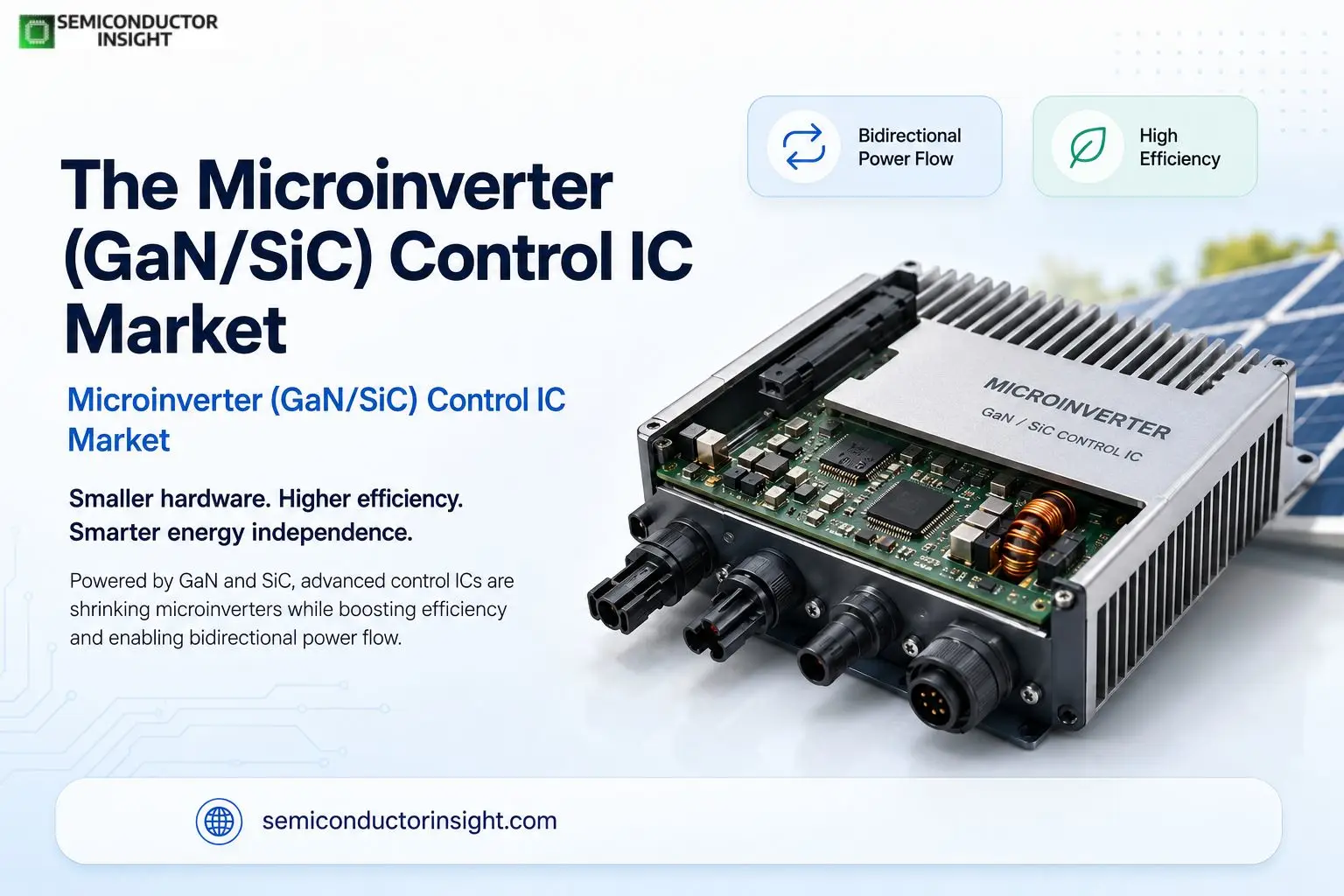
China vs. the West: The Patent Battle Over the Microinverter (GaN/SiC) Control IC Market
The Semiconductor Engineering based Microinverter (GaN/SiC) Control IC Market refers to the global industry focused on the development, manufacturing, and commercialization of specialized control integrated circuits used in microinverters powered by wide-bandgap semiconductor materials such as Gallium Nitride (GaN) and Silicon Carbide (SiC).
If you open the latest generation of solar microinverters like the recently released Enphase IQ9 series you will notice something missing: the sheer volume of bulky magnetic components and complex cooling fans that defined previous decades. What you are actually looking at is the physical manifestation of the Wide Bandgap (WBG) revolution.
- The traditional silicon-based inverter relied on brute force; the modern Microinverter (GaN/SiC) Control IC relies on physics that operate at a higher frequency and lower resistance.
- The shift is tangible. Instead of heavy copper windings, engineers are now staring at a single, dense board where the control IC acts as the conductor of an ultra-efficient orchestra.
- Texas Instruments recently demonstrated a 1.6kW bidirectional reference design (TIDA-010933) that compresses what used to be a suitcase-sized unit into a device smaller than a tablet.
- This is achieved by pushing switching frequencies into the megahertz range, a territory unreachable by standard silicon.
For the installer handling a residential rooftop in California or Germany, this weight reduction translates directly to lower labor costs and faster installations. For the homeowner, it means a system that runs cooler, quieter, and without the degradation risks associated with high thermal stress. The hardware hasn’t just evolved; it has effectively dissolved into the background, leaving only the intelligence of the III-V compound semiconductors to do the heavy lifting.
The Bi-Directional Handshake | Where Power Flows Both Ways
- The most profound shift introduced by the advanced Microinverter (GaN/SiC) Control IC is the normalization of bidirectional power flow. In the old model, electricity moved strictly from the solar panel to the home to the grid.
- Today, courtesy of innovations like Infineon’s CoolGaN BDS (Bi-directional Switch), the microinverter is becoming a transactional hub.
- This specific silicon carbide and gallium nitride integration allows a single device to handle DC from solar panels and AC from the grid while simultaneously managing the charge/discharge cycles of an electric vehicle battery.
- It turns the home into an independent energy node rather than just a consumption endpoint.
- Consider the scenario during a grid outage in Texas or a blackout in South Africa. A standard grid-tied system shuts down for safety. However, a system powered by these next-gen control ICs can island itself disconnecting from the failed grid and powering the house directly from the rooftop or an EV battery pack.
- This requires the control IC to manage logic that was previously split across three separate boards. Navitas has been pushing this envelope with their GaNFast technology, integrating the gate drivers directly onto the same die as the power switches.
- This handshake happens in nanoseconds, allowing the system to react to load changes faster than the human eye can perceive. It is an always-on, intelligent switch that redefines energy independence.
Before Proceeding, Feel Free to Overlook Our Updated Report: https://semiconductorinsight.com/report/microinverter-gan-sic-control-ic-market/
Efficiency Math | The 97.8% Benchmark and the Data Centre Crossover
We are currently witnessing a statistical plateau in power conversion, where fractions of a percentage point separate market leaders from laggards. The new baseline, set by joint labs like the Digital Power Joint Lab established by GigaDevice and Navitas, is hovering around 97.8% peak efficiency for server and microinverter applications.
To put this in volume perspective, consider that a 0.5% increase in efficiency across a 12kW AI server rack reduces cooling requirements by roughly 15%. Scaling this to a hyperscale data center in Virginia or Singapore, the energy savings can power a small town for a year.
This crossover between data center technology and residential solar is one of 2026’s silent trends. The GaN and SiC control ICs being deployed in Google’s servers are the exact same architectures now being embedded into balcony solar kits in Berlin. The efficiency math is brutal and unforgiving. For every watt lost as heat in a microinverter, the internal temperature rises, degrading the electrolytic capacitors that have historically dictated the 10-year replacement cycle.
By hitting the 97.8% mark verified in real-world shading tests rather than lab conditions these new ICs effectively eliminate derating. The result is a solar system that actually delivers its nameplate power during the suboptimal conditions of winter mornings or dusty afternoons, a reality check that the industry has been avoiding for years.
The Patent Playground | Who Owns the Air Gap
Just beneath the surface of the commercial announcements lies a legal war over intellectual property. Because GaN and SiC involve growing crystals on mismatched substrates (GaN-on-Si specifically), the air gap or transition layer is often the location of patented gold. The industry is currently watching the showdown between legacy giants like Infineon (who acquired GaN Systems) and aggressive Chinese manufacturers like Innoscience, who have successfully driven down the cost of 150V and 650V GaN transistors.
The US International Trade Commission (ITC) has been actively involved, investigating potential patent infringements regarding the manufacturing processes of these power transistors.
The outcome of these IP battles determines which Microinverter (GaN/SiC) Control ICs can legally land on US shores. For original equipment manufacturers (OEMs) building solar products, this has created a dual-sourcing nightmare. They cannot simply design a board for one chip; they must create hardware that is agnostic enough to accept a Texas Instruments driver or an Infineon switch, depending on customs clearance and legal rulings.
This complexity is driving a trend toward digital power where the control loops are software-defined, allowing the hardware to adapt to whatever silicon is available. The true winner in this litigation might not be the company with the best physics, but the company with the most cross-licensed legal portfolio, ensuring their specific air-gap structure is the only one legally sellable in the next fiscal year.

Comments (0)