Microinverter (GaN/SiC) Control IC Market Insights
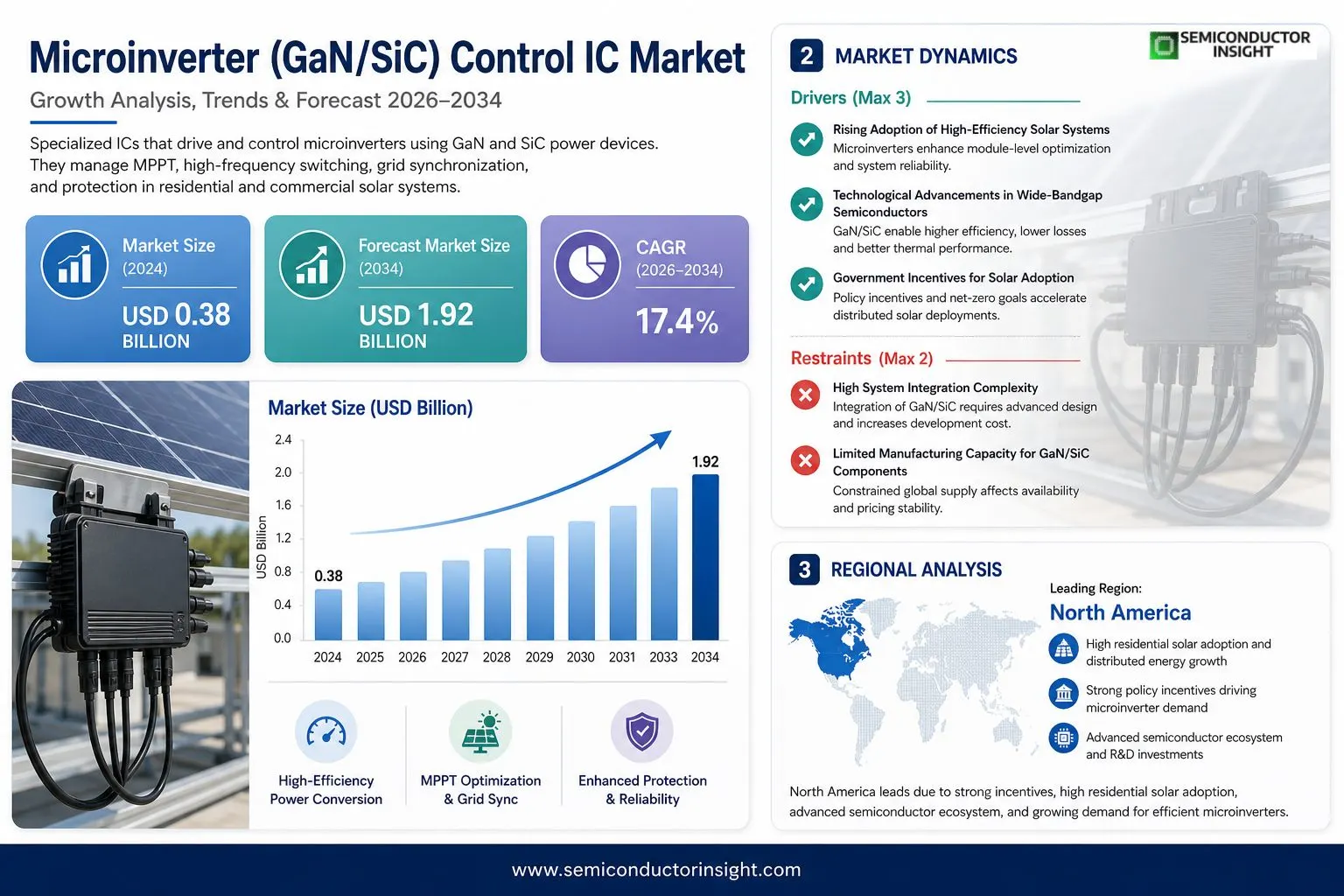
Global Microinverter (GaN/SiC) Control IC market size was valued at USD 0.38 billion in 2024. The market is projected to grow from USD 0.45 billion in 2025 to USD 1.92 billion by 2034, exhibiting a CAGR of 17.4% during the forecast period.
Microinverter (GaN/SiC) Control ICs are specialized integrated circuits engineered to drive and control microinverters leveraging Gallium Nitride (GaN) and Silicon Carbide (SiC) power devices. These ICs oversee critical functions like maximum power point tracking (MPPT), high-frequency switching, grid synchronization, and fault protection, delivering enhanced efficiency, compactness, and thermal performance in residential and commercial solar systems.
The market is surging due to booming solar PV installations worldwide, driven by net-zero goals and falling module costs. While traditional silicon lags in high-efficiency needs, GaN/SiC enables lighter, higher-power-density designs. Furthermore, policy incentives like the U.S. Inflation Reduction Act boost adoption. Key initiatives include Texas Instruments’ June 2024 launch of the UCC31C45 GaN driver for microinverters. Leading players such as Texas Instruments, Infineon Technologies, STMicroelectronics, Renesas Electronics, and Monolithic Power Systems dominate with innovative portfolios.
MARKET DRIVERS
Rising Adoption of High‑Efficiency Solar Systems
Microinverter (GaN/SiC) Control IC Market is being propelled by the increasing deployment of distributed solar architectures, where microinverters enhance module-level power optimization and reliability. The shift toward GaN and SiC technologies is driven by their ability to support higher switching frequencies, improved thermal performance, and greater power density. These characteristics enable more compact and efficient control ICs, aligning with industry requirements for advanced solar electronics integrated into residential and commercial installations.
Technological Advancements in Wide-Bandgap Semiconductors
Manufacturers are accelerating the integration of GaN and SiC devices into microinverter control ICs due to their superior efficiency, reduced conduction losses, and ability to operate at elevated temperatures. These performance advantages support next-generation inverter architectures designed to meet evolving solar energy standards and to optimize power conversion across variable environmental conditions.
➤ GaN/SiC-based control ICs reduce switching losses, enabling higher conversion efficiency in microinverter systems.
Growing government incentives for distributed renewable energy installations further stimulate demand for advanced microinverter platforms using GaN/SiC control ICs. As reliability requirements and efficiency standards strengthen globally, the market for high-performance control ICs is expected to expand in alignment with broader solar deployment trends.
MARKET CHALLENGES
High System Integration Complexity
Microinverter (GaN/SiC) Control IC Market faces technical challenges related to the integration of wide-bandgap materials within compact inverter architectures. Ensuring electrical compatibility, mitigating electromagnetic interference, and maintaining thermal stability require highly specialized control algorithms and precise IC design. These engineering complexities elevate design cycles and increase development expenses for manufacturers.
Other Challenges
Cost Sensitivity in Solar Inverter Deployment
Although GaN and SiC devices offer strong performance advantages, they come at a higher cost than traditional silicon components. This price differential can limit adoption in regions with cost-driven solar installation markets, where the upfront expense of microinverter systems remains a key purchasing factor.
MARKET RESTRAINTS
Limited Manufacturing Capacity for GaN/SiC Components
Microinverter (GaN/SiC) Control IC Market is constrained by the limited global fabrication capacity for wide-bandgap materials, which affects supply availability and pricing stability. GaN and SiC wafers require specialized processing techniques, and current production levels are concentrated among a small number of semiconductor manufacturers.
MARKET OPPORTUNITIES
Expansion of Distributed Energy and Smart Grid Infrastructure
Emerging opportunities in Microinverter (GaN/SiC) Control IC Market stem from the rapid development of distributed energy resources, smart grids, and energy storage ecosystems. As utilities adopt bidirectional power flow systems and real-time grid monitoring, microinverters equipped with advanced GaN/SiC control ICs are positioned to play a critical role in enhancing grid responsiveness and decentralized power management. These trends are expected to expand commercial applications and create demand for next-generation, high-efficiency control IC platforms.
Microinverter (GaN/SiC) Control IC Market Trends
Advancements in Wide-Bandgap Power Devices
Microinverter (GaN/SiC) Control IC Market is experiencing accelerated momentum as solar system manufacturers increasingly prioritize higher power density and improved conversion efficiency. The shift toward wide-bandgap materials such as gallium nitride and silicon carbide has strengthened demand for control ICs capable of supporting high-frequency switching, advanced MPPT capabilities, and precise grid-synchronization features. This trend reflects the industry’s focus on optimizing rooftop PV installations where compactness, thermal stability, and long operating lifespans are essential. Vendors integrating GaN and SiC technologies into control IC architectures are addressing performance gaps left by traditional silicon-based solutions, enabling improved thermal behavior and reduced overall system losses.
Market trends are further shaped by policy-driven growth in solar adoption. Incentives such as the U.S. Inflation Reduction Act have encouraged residential and commercial installations, increasing the need for microinverters equipped with efficient and reliable control ICs. Additionally, declining global solar module prices continue to push integrators toward microinverter-based architectures, reinforcing the importance of advanced control ICs that support stable real-time power management. The introduction of new products, including Texas Instruments’ GaN-focused driver solutions in 2024, underscores the ongoing shift toward integrated, high-performance microinverter control platforms adopted by leading manufacturers.
Other Trends
Increasing Integration of Protection and Monitoring Functions
Another notable trend in Microinverter (GaN/SiC) Control IC Market is the integration of enhanced protection, sensing, and monitoring features within control IC architecture. As microinverters operate in varied environmental conditions, demand has increased for ICs that support active protection against overvoltage, rapid temperature shifts, switching anomalies, and grid disturbances. Manufacturers are incorporating fault detection and isolation mechanisms directly into control ICs to reduce external component dependencies and to streamline system designs. This trend aligns with the push toward more compact microinverters that maintain high reliability across long operating periods, particularly in residential PV systems where maintenance access may be limited.
Shift Toward High-Efficiency Microinverter Designs
Microinverter developers are progressively prioritizing system-level optimization, prompting greater reliance on GaN/SiC-enabled control ICs that support faster switching frequencies and reduced conduction losses. This shift is driven by the need to maximize rooftop energy yields through superior MPPT performance and to meet evolving grid-interconnection standards that require more responsive control behavior. Companies such as Infineon, STMicroelectronics, Renesas, and Monolithic Power Systems are expanding their portfolios with ICs that enhance power density while maintaining robust thermal profiles. As global solar deployment intensifies, this transition toward efficiency-centric designs will remain a defining trend shaping Microinverter (GaN/SiC) Control IC Market.
COMPETITIVE LANDSCAPE
Key Industry Players
Competitive Analysis of Microinverter (GaN/SiC) Control IC Market
Microinverter (GaN/SiC) Control IC Market is shaped by a concentrated group of global semiconductor leaders, each expanding their portfolios to meet rising demand for high-efficiency solar power electronics. Companies such as Texas Instruments, Infineon Technologies, STMicroelectronics, Renesas Electronics, and Monolithic Power Systems hold significant influence due to their strong R&D capabilities and specialized power management architectures. Their offerings address high-frequency switching, MPPT optimization, grid-synchronization algorithms, and protection circuitry tailored for next-generation microinverters. With continuous investments in GaN and SiC technologies, these companies are accelerating system-level efficiency gains and reducing thermal loads, critical for residential and commercial PV deployments.
Beyond the market leaders, several niche and emerging manufacturers are gaining relevance by introducing GaN/SiC driver ICs, digital power controllers, and high-voltage interface solutions. Firms such as Power Integrations, Navitas Semiconductor, NXP Semiconductors, Onsemi, and ROHM Semiconductor are expanding collaboration with microinverter OEMs to optimize switching performance and improve reliability under varying load and grid conditions. Additional players, including Microchip Technology, Analog Devices, and Vicor Corporation, contribute specialized power conversion and control innovations that strengthen the competitive landscape. The market’s high growth trajectory continues to attract strategic partnerships, product launches, and technology upgrades focused on maximizing microinverter efficiency, miniaturization, and long-term durability.
List of Key Microinverter (GaN/SiC) Control IC Market Companies Profiled
- Texas Instruments
- Infineon Technologies
- STMicroelectronics
- Renesas Electronics
- Monolithic Power Systems (MPS)
- Power Integrations
- Navitas Semiconductor
- NXP Semiconductors
- Onsemi
- ROHM Semiconductor
- Analog Devices
- Microchip Technology
- Vicor Corporation
- GaN Systems
- EPC (Efficient Power Conversion)
Segment Analysis:
| Segment Category | Sub-Segments | Key Insights |
| By Type |
|
Leading Segment: GaN-Based Control ICs
|
| By Application |
|
Leading Segment: Residential Solar Systems
|
| By End User |
|
Leading Segment: Inverter Manufacturers
|
| By Power Rating |
|
Leading Segment: Medium-Power Microinverters
|
| By Functionality Level |
|
Leading Segment: Advanced MPPT ICs
|
Regional Analysis: Microinverter (GaN/SiC) Control IC Market
North America
The high rate of residential solar adoption across the United States has created a deep and recurring demand base for microinverter control ICs leveraging GaN and SiC technology. Homeowners increasingly prefer microinverter architectures over string inverters due to their panel-level optimization capabilities, directly amplifying the need for sophisticated, high-efficiency control ICs with low switching losses.
Federal and state-level incentive structures, including clean energy tax provisions and utility interconnection standards, have created a favorable policy backdrop for microinverter deployment. These measures reduce overall system cost and shorten payback periods, encouraging broader adoption of GaN and SiC control IC-integrated microinverter solutions across the residential and light commercial segments in North America.
North American semiconductor firms and research institutions are at the forefront of wide-bandgap material innovation, channeling significant resources into improving GaN and SiC device reliability and reducing die costs. This ongoing investment accelerates the commercial availability of next-generation Microinverter (GaN/SiC) Control ICs with enhanced thermal tolerance and higher power conversion efficiency.
The presence of leading microinverter OEMs and a well-developed power electronics supply chain within North America enables rapid product iteration and close collaboration between IC designers and system integrators. This tightly coupled ecosystem supports faster commercialization of GaN and SiC control IC platforms tailored to regional grid standards and application requirements.
Europe
Europe represents one of the most strategically significant regions for Microinverter (GaN/SiC) Control IC Market, underpinned by the European Union’s ambitious renewable energy targets and the accelerating shift toward distributed solar generation. Nations including Germany, the Netherlands, Spain, and Italy have demonstrated particularly strong uptake of rooftop photovoltaic systems, generating consistent downstream demand for advanced microinverter control ICs. The EU’s energy independence agenda, intensified following regional energy supply disruptions, has prioritized solar self-consumption models that inherently favor microinverter architectures. European regulators have also introduced stringent grid-compliance and electromagnetic compatibility standards, compelling microinverter manufacturers to adopt GaN and SiC control ICs for their superior high-frequency switching performance and compact form factors. Indigenous semiconductor initiatives under EU industrial policy are beginning to foster regional production capabilities for wide-bandgap devices, gradually reducing dependency on Asian supply chains and reinforcing Europe’s long-term position in the Microinverter (GaN/SiC) Control IC value chain.
Asia-Pacific
Asia-Pacific is emerging as a high-growth frontier for Microinverter (GaN/SiC) Control IC Market, propelled by rapid solar capacity additions across China, Japan, Australia, and India. China’s position as both the world’s largest solar market and a dominant manufacturer of power semiconductors gives the region a dual advantage in shaping the supply and demand dynamics of GaN and SiC control ICs. Japan’s preference for high-reliability residential solar systems and Australia’s exceptional rooftop solar penetration rate have cultivated mature demand environments for microinverter solutions incorporating advanced control IC technologies. India, backed by expanding government-led solar programs and falling system costs, is progressively transitioning toward distributed solar architectures. Regional semiconductor manufacturers in China, Japan, and South Korea are scaling their wide-bandgap IC production capabilities, which is expected to improve cost competitiveness and availability of Microinverter (GaN/SiC) Control ICs across the region throughout the 2026–2034 forecast horizon.
South America
South America presents a developing but increasingly promising landscape for Microinverter (GaN/SiC) Control IC Market, with Brazil and Chile emerging as the primary demand centers. Brazil’s distributed generation regulatory framework has undergone meaningful liberalization in recent years, enabling a broader base of residential and small commercial solar adopters to enter the market and driving incremental demand for microinverter systems. Chile’s exceptional solar irradiance, particularly in the Atacama region, continues to attract distributed solar investment that gradually filters into the microinverter segment. However, the region faces structural challenges including currency volatility, import dependency on semiconductor components, and uneven grid infrastructure that can slow the broader adoption of GaN and SiC control IC-enabled microinverters. As regional solar markets mature and local financing mechanisms improve, South America is expected to contribute more meaningfully to the global Microinverter (GaN/SiC) Control IC Market over the latter portion of the forecast period.
Middle East & Africa
The Middle East and Africa region occupies an early-stage but strategically noteworthy position in Microinverter (GaN/SiC) Control IC Market. Across the Gulf Cooperation Council nations, solar energy diversification programs tied to long-term economic development visions are stimulating investment in distributed photovoltaic infrastructure. The UAE and Saudi Arabia have emerged as focal points for high-profile solar initiatives that increasingly incorporate advanced inverter technologies. In Africa, off-grid and mini-grid solar deployments represent a compelling application domain for microinverters, where panel-level power optimization and system resilience are critical requirements in areas with limited grid access. The adoption of GaN and SiC control ICs in this context remains nascent due to cost sensitivity and limited local semiconductor manufacturing, but the long-term potential is reinforced by declining wide-bandgap device prices and growing international development financing directed toward clean energy access across sub-Saharan markets.
Report Scope
This market research report provides a comprehensive analysis of the Microinverter (GaN/SiC) Control IC Market , covering the forecast period 2026–2034. It offers detailed insights into market dynamics, technological advancements, competitive landscape, and key trends shaping the industry.
Key focus areas of the report include:
- Market Overview: The report begins with an overview outlining its current market scenario, key growth indicators, and industry transformation drivers. It discusses macroeconomic factors, demand–supply balance, regulatory landscape, and the strategic role of semiconductors in powering advancements across industries such as automotive, telecommunications, consumer electronics, and industrial automation.
- Market Size & Forecast: Historical data and future projections for revenue, unit shipments, and market value across major regions and segments.
- Segmentation Analysis: Detailed breakdown by product type, technology, application, and end-user industry to identify high-growth segments and investment opportunities.
- Regional Insights: Insights into market performance across North America, Europe, Asia-Pacific, Latin America, and the Middle East & Africa, including country-level analysis where relevant.
- Competitive Landscape: Profiles of leading market participants, including their product offerings, R&D focus, manufacturing capacity, pricing strategies, and recent developments such as mergers, acquisitions, and partnerships.
- Technology Trends & Innovation: Assessment of emerging technologies, integration of AI/IoT, semiconductor design trends, fabrication techniques, and evolving industry standards.
- Market Drivers & Restraints: Evaluation of factors driving market growth along with challenges, supply chain constraints, regulatory issues, and market-entry barriers.
- Stakeholder Insights: Insights for component suppliers, OEMs, system integrators, investors, and policymakers regarding the evolving ecosystem and strategic opportunities.
Primary and secondary research methods are employed, including interviews with industry experts, data from verified sources, and real-time market intelligence to ensure the accuracy and reliability of the insights presented.
FREQUENTLY ASKED QUESTIONS:
What is the current market size of Microinverter (GaN/SiC) Control IC Market?
-> Global Microinverter (GaN/SiC) Control IC market size was valued at USD 0.38 billion in 2024. The market is projected to grow from USD 0.45 billion in 2025 to USD 1.92 billion by 2034, exhibiting a CAGR of 17.4% during the forecast period.
Which key companies operate in Microinverter (GaN/SiC) Control IC Market?
-> Key players include Texas Instruments, Infineon Technologies, STMicroelectronics, Renesas Electronics, and Monolithic Power Systems, among others.
What are the key growth drivers?
-> Key growth drivers include booming solar PV installations worldwide driven by net-zero goals, falling module costs, policy incentives such as the U.S. Inflation Reduction Act, and the superior efficiency and power-density advantages of GaN/SiC technology over traditional silicon.
Which region dominates the market?
-> Asia-Pacific is the fastest-growing region, while North America remains a dominant market supported by strong policy incentives such as the U.S. Inflation Reduction Act driving solar PV adoption.
What are the emerging trends?
-> Emerging trends include high-frequency switching designs enabled by GaN/SiC devices, maximum power point tracking (MPPT) optimization, grid synchronization advancements, and next-generation GaN gate driver ICs such as Texas Instruments’ UCC31C45 launched in June 2024 for microinverter applications.

Get Sample Report PDF for Exclusive Insights
Report Sample Includes
- Table of Contents
- List of Tables & Figures
- Charts, Research Methodology, and more...
 Download Sample Report PDF