
Semiconductors in Process Control Market Insights
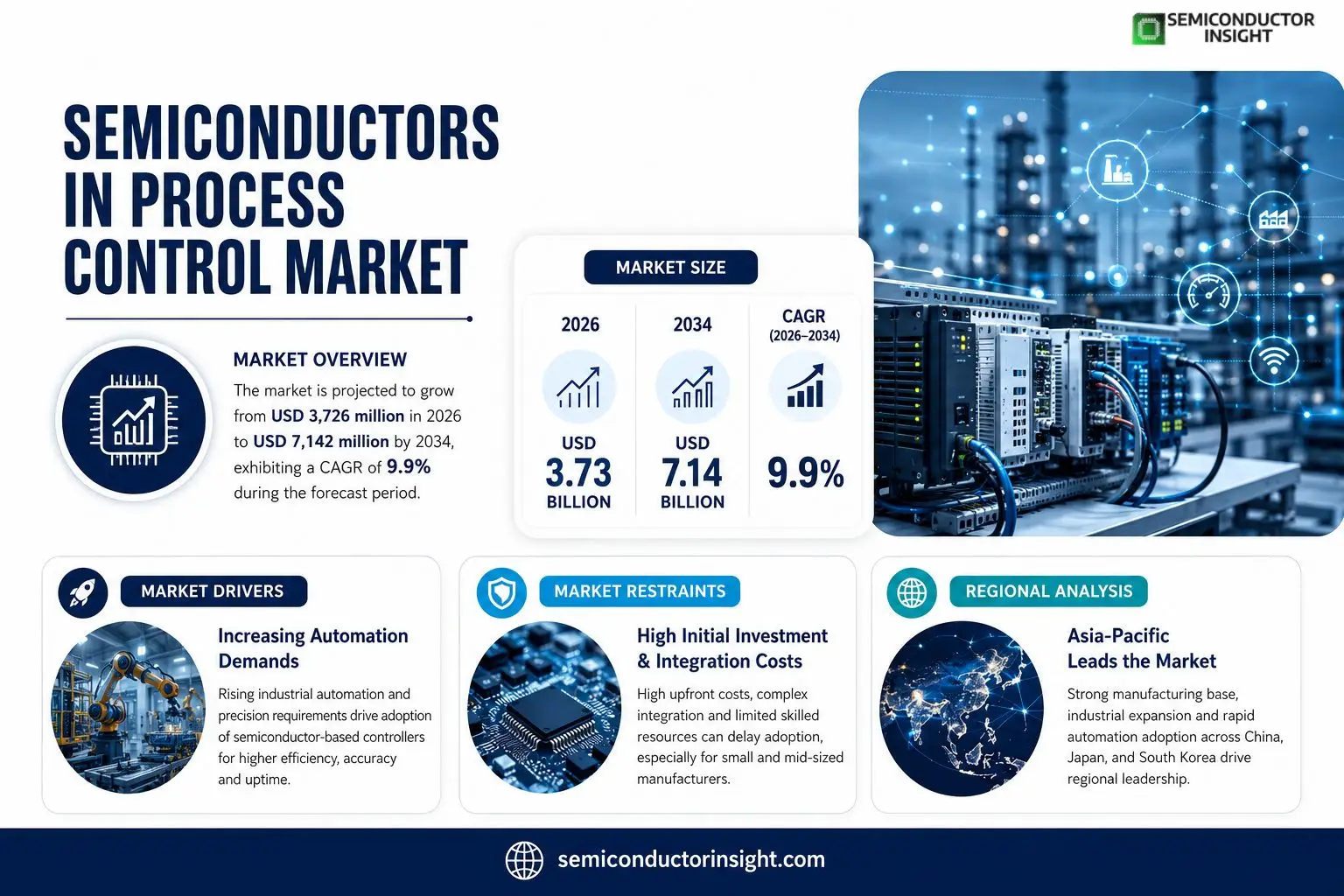
Semiconductors in Process Control market size was valued at USD 3,726 million in 2025 and will grow to USD 7,142 million by 2034, reflecting a CAGR of 9.9% during the forecast period.
Semiconductors in process control comprise integrated circuits, discrete devices and power modules that enable signal acquisition, data conversion, isolation, real‑time communication and power driving across PLCs, DCS, PACs, remote I/O and field sensors. The portfolio spans high‑precision ADCs/DACs, analog front ends, operational amplifiers, digital isolators, optocouplers, industrial Ethernet interfaces, MCUs, security chips and SiC/GaN power devices. Customers range from PLC/DCS manufacturers to actuator‑drive suppliers; their value lies in turning temperature, pressure or flow measurements into reliable digital information while tolerating harsh EMI and temperature extremes.The market expands because industrial automation equipment volumes rise and PLC/DCS designs become denser and more software‑configurable. Companies such as Analog Devices and Texas Instruments are releasing reference designs that combine multiple functions into single packages, reducing board area and calibration effort. At the same time, demand for functional‑safety‑qualified components and long‑life‑cycle supply drives adoption of system‑level semiconductor portfolios rather than isolated parts.
MARKET DRIVERS
Increasing Automation Demands
The shift toward higher throughput in chemical and petrochemical facilities pressures operators to replace legacy controllers with semiconductor‑based modules that deliver sub‑microsecond response times. Faster cycle times translate directly into higher plant utilization, making the upgrade economically compelling.
Regulatory Push for Precision
Stringent emissions limits and safety audits now require real‑time monitoring of temperature, pressure, and flow at a granularity previously unattainable. Semiconductor sensors, with their superior linearity and lower drift, meet these compliance thresholds while reducing calibration frequency.
➤ Plants that adopted semiconductor controllers in 2023 reported an average 12% reduction in energy consumption, underscoring the cost advantage of precision control.
Beyond compliance, the reliability of silicon‑based devices curtails unexpected shutdowns. Uptime gains of 2–3% per annum, while modest in absolute terms, have a pronounced impact on profit margins for high‑value process streams.
MARKET CHALLENGES
Complex Integration Costs
Retrofitting existing control loops with semiconductor modules often entails redesign of wiring harnesses, firmware upgrades, and staff training. The upfront capital outlay can deter operators with constrained CAPEX budgets, especially in regions where plant turnover is low.
Skill Shortage in Advanced Electronics
Manufacturing sites frequently lack engineers versed in mixed‑signal ASICs and digital signal processing, leading to longer commissioning timelines. This expertise gap forces reliance on external consultants, adding to project expense.
Other Challenges
Supply Chain Vulnerabilities
semiconductor shortages have intermittently delayed component deliveries, prompting plants to hold safety stocks that inflate inventory costs. The market’s sensitivity to wafer fab capacity underscores the need for diversified sourcing strategies.
MARKET RESTRAINTS
High Initial Investment
Although operating expenditures decline after implementation, the capital required for semiconductor‑based control hardware remains a barrier for small‑to‑mid‑size producers. The cost differential versus traditional analog controllers can exceed 30%, making the business case contingent on long‑term payback analyses.
MARKET OPPORTUNITIES
Edge‑Computing Integration
Embedding lightweight AI inference engines directly on semiconductor controllers opens pathways for predictive adjustments without reliance on central SCADA systems. Early adopters are positioning themselves to capture efficiency gains that rival traditional optimization projects.
Expansion into Renewable Energy Processing
The rising share of bio‑fuel and green‑hydrogen production introduces process variables that fluctuate more rapidly than conventional oil refining. Semiconductor controllers, with their high bandwidth, are uniquely suited to manage these dynamic set‑points, creating a niche growth segment.
Semiconductors in Process Control Market Trends
System‑Level Portfolio Sourcing Gains Traction
Equipment manufacturers are increasingly preferring a single semiconductor portfolio that can cover an entire I/O channel rather than sourcing discrete parts. This shift reflects the rising density of analog and communication functions within modern PLCs and DCS modules, where board space, calibration effort, and certification costs are at a premium. By integrating high‑precision ADCs, DACs, isolation stages and power drivers into a unified family, vendors can reduce layout complexity, shorten time‑to‑market, and improve signal integrity under harsh industrial conditions. The trend is reinforced by the growing adoption of remote I/O and IO‑Link, which demand compact, multifunctional devices capable of handling both data conversion and rugged communication. For Semiconductors in Process Control Market, the move toward portfolio‑level sourcing translates into higher per‑unit value and longer design cycles.
Other Trends
Technology Consolidation and Integration
Four technology tracks dominate the evolution of these portfolios: high‑precision analog front ends, digital isolation interfaces, industrial‑grade communications, and high‑efficiency power stages. Companies such as NXP have released AFEs that combine configurable analog inputs, voltage references and protective circuitry, illustrating a push toward tighter integration and greater configurability. Chinese firms are entering the niche with 24‑bit ADCs capable of 60 kSPS rates, while isolation specialists expand the bandwidth of digital isolators and isolated CAN transceivers to meet tighter latency budgets. On the power side, the migration from silicon MOSFETs to SiC and GaN devices reduces losses in motor‑drive and inverter applications, supporting tighter efficiency targets in smart factories. The convergence of these tracks creates a signal‑chain solution that can be offered as a drop‑in module for PLC and PAC designs.
Competitive Landscape and Regional Opportunities
Competitive dynamics are reshaping the supplier landscape. Established playersADI, Texas Instruments, Infineon, ST and NXPretain advantage through extensive reference designs, functional‑safety documentation and assured long‑term availability. Meanwhile, Chinese manufacturers are positioning themselves as low‑cost, locally supported alternatives for MCU, precision analog and isolation components, a positioning that gains importance as end‑users seek supply‑chain resilience amid geopolitical uncertainty. Regional growth is strongest in Asia, where new‑energy and water‑treatment projects drive demand for robust process‑control semiconductors. Semiconductors in Process Control Market therefore faces a bifurcated future: intensified competition on price and integration, and expanding opportunities for firms that can bundle a complete I/O and power solution while guaranteeing lifecycle support.
COMPETITIVE LANDSCAPEKey Industry Players
Semiconductors in Process Control: Competitive Overview
The market is anchored by a handful of multinational firms that dominate high‑end analog, mixed‑signal and power‑device segments. Texas Instruments leverages its extensive MCU and analog portfolio to supply integrated signal‑chain blocks for PLC and DCS modules, while Analog Devices commands premium pricing through precision ADCs, DACs and isolation solutions that meet functional‑safety standards. Infineon, NXP and STMicroelectronics complement the landscape with robust automotive‑origin power‑device lines that have been repurposed for industrial drives and inverter applications. These companies differentiate themselves through long‑term production guarantees, comprehensive reference designs and deep firmware ecosystems, which shrink time‑to‑market for equipment manufacturers seeking to consolidate bill‑of‑materials and reduce certification effort.Beyond the leaders, a growing cohort of regionally focused players is reshaping supply‑chain dynamics. Chinese firms such as GigaDevice, SG Micro and 3PEAK have introduced competitive MCUs, high‑resolution ADCs and silicon‑carbide power modules that address cost‑sensitive and locally sourced requirements. ChipAnalog and Vishay offer niche isolation and optocoupler families that cater to safety‑critical process environments, while onsemi and Wolfspeed supply SiC and GaN devices that improve efficiency in motor‑drive and renewable‑energy converters. The increasing emphasis on domestic substitution, accelerated by policy incentives in China and Europe, is prompting these challengers to expand lifecycle support and develop ecosystem‑level reference kits that rival the traditional giants.
List of Key Semiconductors Companies Profiled
- Texas Instruments Incorporated
- Analog Devices, Inc.
- Infineon Technologies AG
- STMicroelectronics N.V.
- NXP Semiconductors N.V.
- onsemi
- ROHM Co., Ltd.
- GigaDevice Semiconductor Inc.
- SG Micro Corp
- 3PEAK Incorporated
- Wolfspeed, Inc.
- Vishay Intertechnology, Inc.
Segment Analysis:
| Segment Category | Sub-Segments | Key Insights |
| By Type |
|
Integrated Signal‑Chain Solutions drive market dynamics – – Customers prioritize portfolios that combine high‑precision analog front ends with built‑in isolation, reducing board footprint and simplifying design verification. – The shift toward system‑level sourcing reflects a need for consistent lifecycle support and reduced engineering effort for safety certification. – High‑efficiency power devices are increasingly selected to meet energy‑saving objectives in servo and inverter applications. |
| By Application |
|
High‑Integration I/O Platforms dominate application trends – – Designers look for chips that embed multiple functions (ADC, DAC, reference, protection) to achieve higher channel density and lower calibration complexity. – Communication‑centric devices (IO‑Link, industrial Ethernet) are essential for the migration toward smart factories and real‑time data exchange. – Functional‑safety capable components are increasingly mandated where equipment must meet stringent safety integrity levels. |
| By End User |
|
OEM Emphasis on Portfolio Consistency shapes end‑user choices – – OEMs value long‑term supply assurance and consistent family‑wide documentation to streamline certification across product generations. – The ability to replace multiple discrete components with a single, highly integrated device reduces board area and improves reliability under harsh industrial conditions. – Local technical support and ecosystem reference designs are becoming decisive factors, especially for customers targeting domestic substitution strategies. |
| By Technology |
|
Emerging Wide‑Bandgap Power Devices are reshaping the technology landscape – – SiC and GaN devices enable higher switching frequencies, reducing filter size and improving overall system efficiency. – Precision analog solutions that integrate programmable gain and low‑noise architectures support tighter process‑control tolerances. – Isolation technologies evolving toward higher voltage ratings and lower propagation delay help meet increasing safety and real‑time communication requirements. |
| By Functional Role |
|
Holistic Signal‑Chain Architecture is the guiding principle – – Manufacturers favor components that seamlessly bridge sensing, isolation, power delivery, and communication within a single channel, cutting down integration risk. – Functional safety features embedded at the device level simplify system‑level safety analysis and reduce overall certification time. – The convergence of communication standards (IO‑Link, Ethernet) with power management functions accelerates the move toward modular, plug‑and‑play control nodes. |
Regional Analysis: Semiconductors in Process Control Market
North America
Heavy‑industry players prioritize semiconductor‑enabled control loops to tighten process windows, which translates into lower scrap rates and higher uptime. The convergence of digital twins with robust sensors is compelling mid‑size manufacturers to upgrade legacy controllers, creating a steady pipeline of retrofit projects across the United States and Canada.
Venture capital and corporate R&D funds are targeting silicon‑on‑sensor platforms that embed intelligence at the edge. This funding emphasis shortens time‑to‑market for next‑generation process controllers, especially in sectors where millisecond‑level response is critical.
Recent updates to safety standards require traceable, semiconductor‑based monitoring for high‑risk processes. Compliance pathways now intersect with performance metrics, prompting manufacturers to certify their control hardware against tighter criteria, which in turn fuels demand for higher‑grade chips.
Proximity to major fab sites in the United States gives North American system integrators a logistical edge, enabling quicker component replenishment and more flexible inventory strategies that mitigate disruption risks.
Europe
European factories are leveraging Semiconductors in Process Control Market to meet stringent environmental directives. The emphasis on energy efficiency drives adoption of semiconductor‑based monitoring that can dynamically balance load against production targets. Cross‑border collaborations between German automation giants and French chip designers have birthed specialized modules for batch processes, where precision directly influences carbon footprints. Meanwhile, the EU’s emphasis on data sovereignty encourages local sourcing of control chips, nudging vendors to establish regional fabs or assembly lines to satisfy policy requirements.
Asia‑Pacific
In Asia‑Pacific, rapid industrial scaling is juxtaposed with a growing appetite for smart factories. Countries such as China, Japan, and South Korea channel considerable engineering talent into integrating semiconductors into legacy process equipment, turning previously analog lines into digitally controllable assets. The region’s cost‑competitive manufacturing ecosystem allows system builders to experiment with heterogeneous integration, merging power‑efficient chips with high‑temperature sensors for petrochemical applications. Consumer‑driven expectations for product consistency are also nudging food‑processing plants to adopt tighter process‑control loops powered by semiconductor technology.
South America
South American process industries are at a pivot point where legacy infrastructure meets emerging digital initiatives. Brazil’s expanding petrochemical corridor has sparked interest in semiconductor‑enabled safety interlocks that can react autonomously to abnormal conditions, reducing incident response times. Argentina’s agribusiness sector is exploring precision fermentation, where semiconductor sensors monitor temperature and pH with granular accuracy, unlocking higher yields. Limited local chip production means many firms rely on imported components, creating a strategic focus on long‑term supply agreements.
Middle East & Africa
The Middle East & Africa region is witnessing a nascent but decisive shift toward semiconductor‑driven process control, primarily motivated by water‑intensive industries and oil‑refining hubs. In the Gulf, desalination plants install semiconductor‑based flow meters to fine‑tune membrane performance, delivering measurable water savings. South Africa’s mining operations employ ruggedized semiconductor controllers that survive harsh underground environments while delivering real‑time vibration analytics. The scarcity of local semiconductor fabs pushes regional OEMs to forge partnerships with Asian suppliers, fostering a hybrid supply model that blends cost efficiency with bespoke engineering support.
Report Scope
This market research report provides a comprehensive analysis of the Semiconductors in Process Control Market , covering the forecast period 2026–2034. It offers detailed insights into market dynamics, technological advancements, competitive landscape, and key trends shaping the industry.
Key focus areas of the report include:
- Market Overview: The report begins with an overview outlining its current market scenario, key growth indicators, and industry transformation drivers. It discusses macroeconomic factors, demand–supply balance, regulatory landscape, and the strategic role of semiconductors in powering advancements across industries such as automotive, telecommunications, consumer electronics, and industrial automation.
- Market Size & Forecast: Historical data and future projections for revenue, unit shipments, and market value across major regions and segments.
- Segmentation Analysis: Detailed breakdown by product type, technology, application, and end-user industry to identify high-growth segments and investment opportunities.
- Regional Insights: Insights into market performance across North America, Europe, Asia-Pacific, Latin America, and the Middle East & Africa, including country-level analysis where relevant.
- Competitive Landscape: Profiles of leading market participants, including their product offerings, R&D focus, manufacturing capacity, pricing strategies, and recent developments such as mergers, acquisitions, and partnerships.
- Technology Trends & Innovation: Assessment of emerging technologies, integration of AI/IoT, semiconductor design trends, fabrication techniques, and evolving industry standards.
- Market Drivers & Restraints: Evaluation of factors driving market growth along with challenges, supply chain constraints, regulatory issues, and market-entry barriers.
- Stakeholder Insights: Insights for component suppliers, OEMs, system integrators, investors, and policymakers regarding the evolving ecosystem and strategic opportunities.
Primary and secondary research methods are employed, including interviews with industry experts, data from verified sources, and real-time market intelligence to ensure the accuracy and reliability of the insights presented.
FREQUENTLY ASKED QUESTIONS:
What is the current market size of Semiconductors in Process Control Market?
-> Semiconductors in Process Control Market was valued at USD 3,726 million in 2025 and is expected to reach USD 7,142 million by 2034, growing at a CAGR of 9.9%.
Which key companies operate in Semiconductors in Process Control Market?
-> Key players include Texas Instruments Incorporated, Infineon Technologies AG, STMicroelectronics N.V., Analog Devices, Inc., NXP Semiconductors N.V., onsemi, Renesas Electronics Corporation, ROHM Co., Ltd.
What are the key growth drivers?
-> Key growth drivers include rising industrial automation equipment volumes, higher density and intelligence of PLC/DCS and remote I/O, expanding adoption of IO‑Link and industrial Ethernet, functional safety upgrades, and increasing demand for high‑precision analog front ends and efficient power semiconductor devices.
Which region dominates the market?
-> Asia dominates the market, propelled by strong manufacturing bases in China, Japan, and South Korea, along with rapid adoption of advanced process‑control solutions across the region.
What are the emerging trends?
-> Emerging trends include greater integration of analog front‑end modules, accelerated deployment of SiC and GaN power devices, wider use of IO‑Link and industrial Ethernet for real‑time communication, and a growing focus on functional safety and domestic substitution strategies.
Get Sample Report PDF for Exclusive Insights
Report Sample Includes
- Table of Contents
- List of Tables & Figures
- Charts, Research Methodology, and more...
