
How Worldwide Semiconductor Innovation Is Accelerating Catalytic CO2 Sensor Adoption?
Semiconductor metal oxide sensors (MOS) form the core of catalytic CO2 detection, relying on chemiresistive changes when CO2 molecules interact with the oxide surface. Materials like SnO2, ZnO, and CuO dominate because of their tunable band gaps, high surface area at nanoscale, and stability in real environments. Nanostructured versions, on the other hand, have more active sites for gas adsorption than bulk materials. This cuts down on power consumption and speeds up response times.
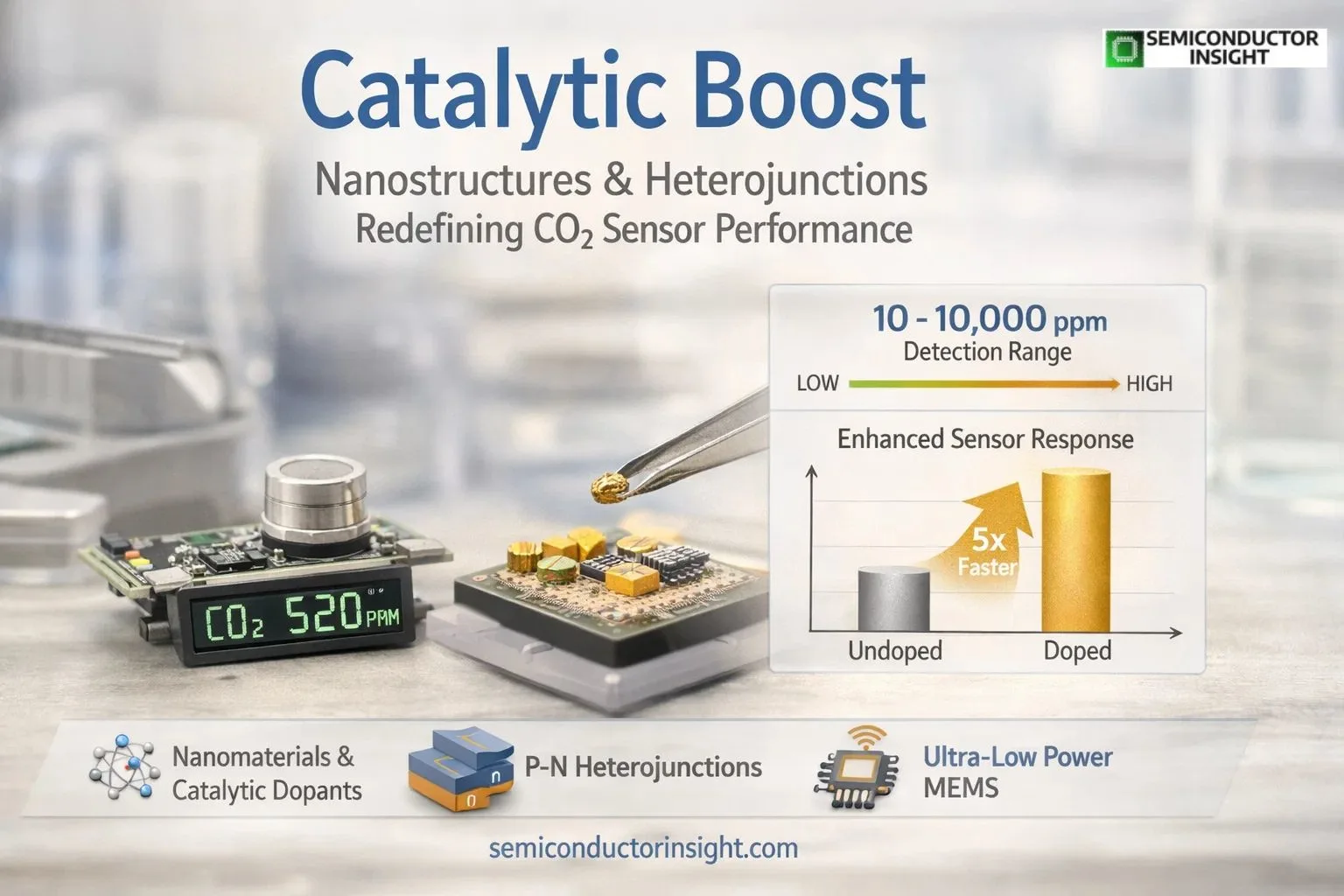
Catalytic dopants such as palladium (Pd), gold (Au), or lanthanum (La) act as accelerators. They enhance CO2 adsorption and electron transfer without needing extreme heat. For instance, Pd decoration on La2O3 films lifts response at 523 K for 500 ppm CO2. Au-sputtered La2O3/SnO2 nanofibers deliver a 10.1 response at just 100 ppm and 300°C, with 50% better overall performance than undoped versions.
Catalytic Boost: Nanostructures and Heterojunctions Redefine Sensor Performance
- P-n heterojunctions take things further by building built-in electric fields that speed charge separation.
- CuO/SnO2 with 0.5 wt% Ag hits 72% response at 300°C for 10,000 ppm CO2, while ZnO/CuO bilayers achieve 9.7% at room temperature for 1,000 ppm. CeO2/CdS heterostructures clock in at 3.62 response for 1,000 ppm with response/recovery times of 6.39 s and 4.82 s.
- These gains matter in tight spaces. Detection ranges span 10-10,000 ppm, covering everything from breath analysis to industrial exhaust.
- Operating temperatures drop from 450°C in early designs to room temperature in optimized nanostructures, cutting energy use to milliwatts in MEMS
- One BaTiO3-CuO MEMS microheater design runs at 4.8-5.8 mW while delivering 21% sensitivity at 400 ppm and 70% at 1,000 ppm.
Typical MOS Catalytic CO2 Sensors
| Material | Modification | Concentration | Response | Temp (°C) | Key Advantage |
| La2O3/SnO2 nanofibers | Au-decorated | 100 ppm | 10.1 | 300 | 50% faster detection |
| La2O3 film | Pd nanoparticles | 500 ppm | 28% (from 13%) | 523 | Enhanced selectivity |
| CuO/SnO2 | 0.5 wt% Ag | 10,000 ppm | 72% | 300 | Strong low-temp performance |
| ZnO/CuO bilayer | Heterojunction | 1,000 ppm | 9.7% | RT | Humidity-independent |
| Ni-SnO2 nanoparticles | Ni-doped | 100 ppm | 62-73 | 27 | Ultra-low power |
Real Deployments: From Smart Buildings to Industrial Safety
These sensors shine in enclosed environments where CO2 triggers discomfort or ventilation alerts. Semiconductor versions integrate seamlessly into IoT nodes for continuous monitoring in offices, greenhouses, and factories. MEMS platforms enable battery-powered units that fit inside HVAC systems or wearable air-quality badges. Heterostructure designs cut cross-sensitivity to humidity or interfering gases like CO and NO2, making them reliable in mixed atmospheres.
Research output tells the story: publications on nanostructured MOS CO2 sensors have grown exponentially over the past decade, signalling intense global R&D focus across Asia, Europe, and North America.
Market Pulse: Demand Trends Reshaping Semiconductor Gas Sensing Worldwide
- Demand for catalytic CO2 sensors tracks broader pushes for smarter air-quality networks. Semiconductor fabs worldwide are scaling production of these low-power MOS chips to meet IoT and edge-computing needs.
- Catalytic bead technologies already represent about 12.4% of commercial e-nose systems, and MOS variants are expanding fastest in environmental and building automation sectors.
- Growth stems from regulations on indoor air, food packaging freshness tracking, and emissions monitoring in energy and transport.
- Miniaturization via global semiconductor supply chains keeps costs low while raising volumes think millions of integrable sensor dies per wafer run.
- Heterostructures and catalytic dopants deliver the selectivity edge that older infrared methods can’t match at this scale and price point.
You Can Freely Surf Our Latest Updated Report Here: https://semiconductorinsight.com/report/catalytic-co2-sensor-market/
Innovation Spotlight: MEMS and Global Semiconductor Synergy
MEMS microheaters with suspended diaphragms now achieve uniform 300°C across 100 µm × 100 µm zones at under 6 mW. This opens doors for portable, wireless networks spanning factories or urban grids. Semiconductor leaders continue refining fabrication plasma-enhanced CVD for diaphragms, precise doping for catalytic layers to hit tighter tolerances and longer lifetimes.
Worldwide collaboration accelerates it all: shared IP in oxide nanomaterials and heterojunction design flows from research labs into high-volume production. The result? Catalytic CO2 sensors that are smaller, cheaper, and more responsive than ever, quietly embedding into the semiconductor-powered infrastructure monitoring our air.

Comments (0)