
Market Insights
Global MEMS Fiber Optic Acceleration Sensor Market size was valued at USD 342.7 million in 2025. The market is projected to grow from USD 378.5 million in 2026 to USD 612.9 million by 2034, exhibiting a CAGR of 6.8% during the forecast period.
MEMS fiber optic acceleration sensors are advanced sensing devices that combine micro-electromechanical systems (MEMS) technology with fiber optic sensing principles. These sensors integrate critical components such as acceleration detection mass blocks, elastic supports, optical reflection micromirrors, and waveguides onto a compact chip, enabling precise optical-based acceleration measurement with high sensitivity and immunity to electromagnetic interference.
The market growth is driven by increasing demand for high-precision motion detection across industries including structural health monitoring, industrial automation, aerospace, and smart infrastructure. While the technology offers advantages like wide dynamic range and long-distance signal transmission capabilities, adoption faces challenges related to manufacturing complexity and cost sensitivity in price-competitive applications.
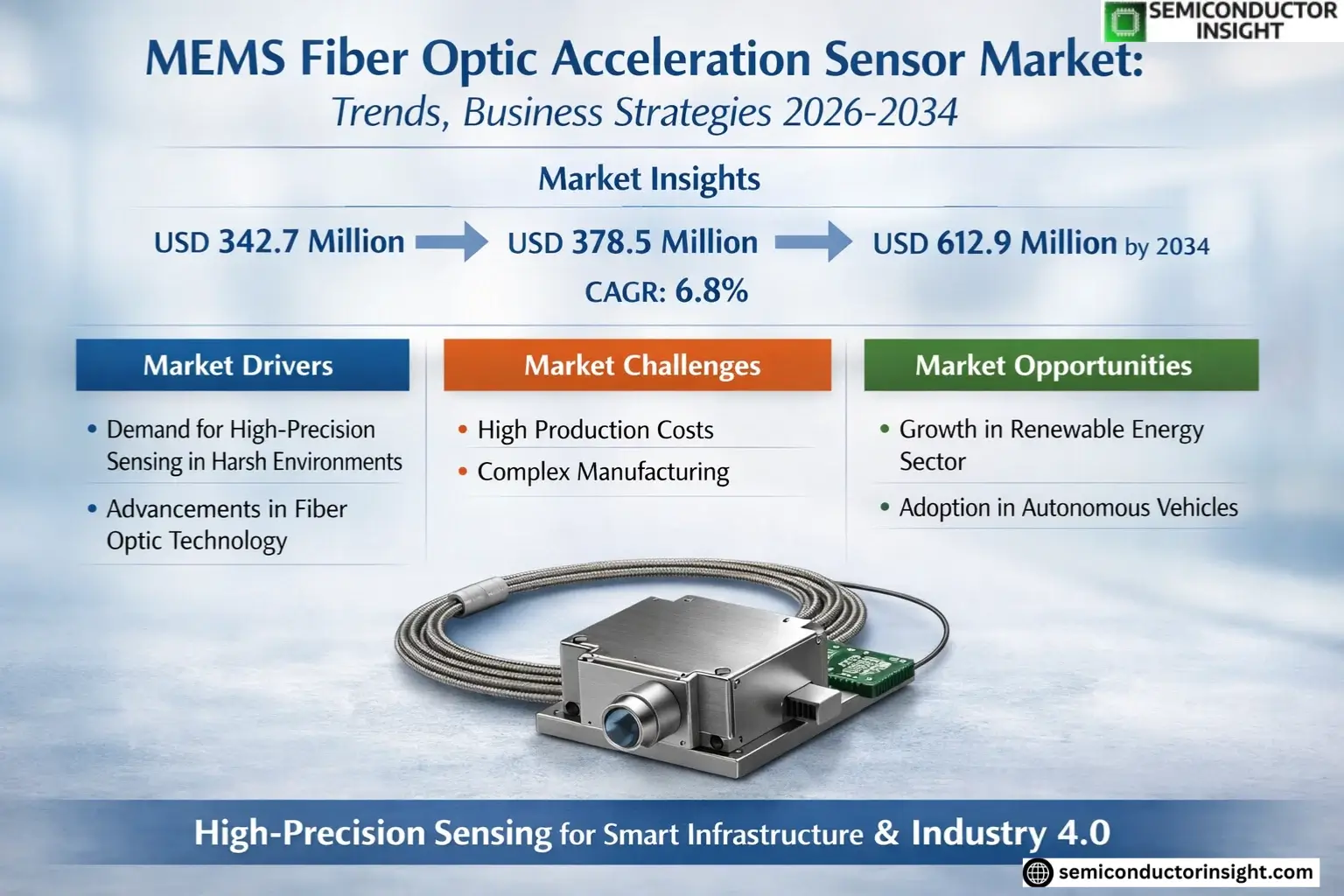
MARKET DRIVERS
Growing Demand for High-Precision Sensing in Harsh Environments
MEMS Fiber Optic Acceleration Sensor Market is witnessing strong growth due to increasing demand for reliable, high-precision sensing solutions in extreme conditions. These sensors excel in environments with electromagnetic interference, high temperatures, and corrosive atmospheres where traditional MEMS sensors fail.
Advancements in Fiber Optic Technology
Recent technological improvements in fiber optic components and miniaturization techniques have enhanced the performance and reduced the cost of MEMS fiber optic acceleration sensors. This has expanded their adoption across industrial, aerospace, and defense applications.
Increased government investments in smart infrastructure projects and the expansion of Industry 4.0 initiatives are creating additional demand for these specialized sensors in structural health monitoring systems.
MARKET CHALLENGES
High Production Costs and Complex Manufacturing
The precision required in manufacturing MEMS fiber optic acceleration sensors results in higher production costs compared to conventional accelerometers. The alignment of micro-optical components requires specialized equipment and skilled labor.
Other Challenges
Limited Awareness in Emerging Markets
Many potential end-users in developing regions remain unaware of the advantages of MEMS fiber optic acceleration sensors, preferring traditional solutions despite their limitations.
Integration Difficulties
Incorporating these sensors into existing measurement systems often requires additional interface components, increasing total system cost and complexity.
MARKET RESTRAINTS
Competition from Emerging Sensor Technologies
MEMS Fiber Optic Acceleration Sensor Market faces competition from alternative technologies such as piezoelectric and capacitive MEMS sensors, which continue to improve their performance in harsh environments.
MARKET OPPORTUNITIES
Expansion in Renewable Energy Sector
The growing wind energy market presents significant opportunities for MEMS fiber optic acceleration sensors in condition monitoring of turbine blades and gearboxes, where their immunity to lightning strikes and EMI is particularly valuable.
Adoption in Autonomous Vehicles
As autonomous vehicle testing expands, the need for highly reliable inertial measurement units incorporating MEMS fiber optic acceleration sensors is expected to rise, particularly for high-precision navigation systems.
MEMS Fiber Optic Acceleration Sensor Market Trends
Growing Demand for High-Precision Sensing Solutions
MEMS Fiber Optic Acceleration Sensor Market is witnessing increased adoption due to its superior performance in high-precision applications. These sensors offer advantages like immunity to electromagnetic interference and long-distance signal transmission, making them ideal for structural health monitoring in construction and aerospace industries. The integration with IoT platforms is further driving deployment in smart infrastructure projects.
Other Trends
Expansion in Industrial Automation
Manufacturing facilities are increasingly implementing MEMS fiber optic acceleration sensors for equipment condition monitoring. Their ability to detect subtle vibrations helps prevent machinery failures, reducing downtime. This trend is particularly strong in energy and heavy industries where predictive maintenance is critical.
Technological Advancements in Sensor Design
Recent developments in MEMS fabrication techniques have enabled production of more compact and energy-efficient fiber optic acceleration sensors. Leading manufacturers are focusing on multi-axis configurations to cater to complex measurement requirements in automotive testing and aerospace applications. Integration with wireless communication protocols is another emerging trend enhancing market growth.
Regional Market Developments
Asia-Pacific shows significant growth potential for MEMS fiber optic acceleration sensors, particularly in China’s expanding industrial and transportation sectors. North America continues to lead in technological innovation, with major players developing advanced solutions for defense and aerospace applications.
Increasing Competition Among Key Players
The market sees intensifying competition as established sensor manufacturers and new entrants develop specialized MEMS fiber optic acceleration solutions. Companies are focusing on product differentiation through improved sensitivity ranges and environmental durability to gain competitive advantage in various application segments.
COMPETITIVE LANDSCAPE
Key Industry Players
Global MEMS Fiber Optic Acceleration Sensor Market Dominated by Technology Innovators
MEMS Fiber Optic Acceleration Sensor Market is characterized by the presence of specialized manufacturers focusing on high-precision measurement solutions. Luna Innovations and Opsens Solutions lead the market with their advanced fiber optic sensing technologies, collectively holding a significant revenue share. These industry pioneers have strengthened their positions through continuous R&D investments and strategic partnerships with aerospace and industrial clients.
Niche players like Somni Solutions and MC-monitoring are gaining traction through customized solutions for structural health monitoring applications. Regional manufacturers, particularly in China, such as Shanghai Baiantek Sensing Technology and Wuxi BEWIS Sensing Technology, are expanding their global footprint with cost-competitive offerings. The competitive landscape remains dynamic with increasing collaboration between sensor manufacturers and IoT platform providers.
List of Key MEMS Fiber Optic Acceleration Sensor Companies Profiled
- Luna Innovations
- Opsens Solutions
- Somni Solutions
- MC-monitoring
- AtGrating
- TE Connectivity
- Althen
- Shanghai Baiantek Sensing Technology
- Jiaxing Synargy Micro-Electronics Technology
- Wuxi BEWIS Sensing Technology
- Guilin Guangyi Intelligent Technology
- HBM Test and Measurement
- Micron Optics
- Omnisens
- FISO Technologies
Segment Analysis:
| Segment Category | Sub-Segments | Key Insights |
| By Type |
|
Triple Axis dominates due to comprehensive motion tracking capabilities across all three dimensions.
|
| By Application |
|
Industrial leads the market with critical vibration monitoring requirements.
|
| By End User |
|
Aerospace & Defense shows strongest demand for high-performance sensing solutions.
|
| By Sensing Range |
|
Medium Range sensors show balanced adoption across multiple industries.
|
| By Connectivity |
|
Wired dominates due superior signal integrity demands.
|
Regional Analysis: MEMS Fiber Optic Acceleration Sensor Market
North America
U.S. defense contractors are pioneering MEMS fiber optic acceleration sensor integration in next-generation aircraft health monitoring systems, driving technological advancements in harsh environment operation.
Canada’s energy sector is adopting MEMS fiber optic acceleration sensors for pipeline integrity monitoring, valuing their immunity to electromagnetic interference in explosive environments.
Strategic university-corporate partnerships in Massachusetts and California are developing novel fabrication techniques for MEMS fiber optic acceleration sensors with sub-micron precision.
Smart city initiatives across major metro areas are deploying MEMS fiber optic acceleration sensors for real-time structural health monitoring of bridges and tunnels.
Europe
Europe’s MEMS Fiber Optic Acceleration Sensor Market is propelled by strict industrial safety mandates and growing renewable energy investments. Germany leads in automotive test applications, while the UK focuses on marine structure monitoring solutions. The region’s emphasis on distributed sensing networks for critical infrastructure creates substantial demand for ruggedized MEMS fiber optic acceleration sensors. Collaborative R&D programs funded by the European Union are advancing multi-parameter sensing capabilities.
Asia-Pacific
The Asia-Pacific region shows the fastest growth in MEMS fiber optic acceleration sensor adoption, driven by expanding industrial automation and infrastructure development. Japan leads in precision manufacturing applications, while China dominates production capabilities. Emerging applications in earthquake early warning systems are creating new demand across Southeast Asian markets. Regional players are investing heavily in cost-optimized designs for high-volume applications.
South America
South America’s MEMS Fiber Optic Acceleration Sensor Market is growing steadily, primarily serving the mining and energy sectors. Brazil leads in offshore oil platform monitoring solutions, while Chile focuses on seismic monitoring applications. Infrastructure modernization programs are driving adoption in urban construction projects, though technology adoption lags other regions due to limited local manufacturing capabilities.
Middle East & Africa
The Middle East demonstrates growing interest in MEMS fiber optic acceleration sensors for oilfield applications, with increasing focus on harsh environment durability. Africa’s market remains nascent but shows potential in mining safety applications. Regional aerospace projects in the Gulf states are creating specialized demand for high-temperature capable MEMS fiber optic acceleration sensors.
Report Scope
This market research report provides a comprehensive analysis of the MEMS Fiber Optic Acceleration Sensor Market , covering the forecast period 2025–2034. It offers detailed insights into market dynamics, technological advancements, competitive landscape, and key trends shaping the industry.
Key focus areas of the report include:
- Market Overview: The report begins with an overview outlining its current market scenario, key growth indicators, and industry transformation drivers. It discusses macroeconomic factors, demand–supply balance, regulatory landscape, and the strategic role of MEMS fiber optic acceleration sensors in powering advancements across industries such as building structure monitoring, industrial equipment, aerospace, intelligent transportation, Internet of Things, and smart wearable devices.
- Market Size & Forecast: Historical data and future projections for revenue, unit shipments, and market value across major regions and segments.
- Segmentation Analysis: Detailed breakdown by product type (Single Axis, Dual Axis, Triple Axis), application (Industrial, Architecture, Energy, Transportation, Others), and end-user industry to identify high-growth segments.
- Regional Insights: Insights into market performance across North America (U.S., Canada, Mexico), Europe (Germany, France, U.K.), Asia (China, Japan, South Korea), and other global regions.
- Competitive Landscape: Profiles of leading market participants, including their product offerings, market share, pricing strategies, and recent developments.
- Technology Trends: Assessment of emerging MEMS and fiber optic sensing technologies, integration with IoT, and evolving industry standards.
- Market Drivers & Restraints: Evaluation of factors driving market growth along with challenges, supply chain constraints, and regulatory issues.
- Stakeholder Insights: Strategic insights for component suppliers, OEMs, system integrators, and investors.
Primary and secondary research methods are employed to ensure the accuracy and reliability of the insights presented.
FREQUENTLY ASKED QUESTIONS:
What is the current market size of MEMS Fiber Optic Acceleration Sensor Market?
-> MEMS Fiber Optic Acceleration Sensor Market size was valued at USD 342.7 million in 2025. The market is projected to grow from USD 378.5 million in 2026 to USD 612.9 million by 2034, exhibiting a CAGR of 6.8% during the forecast period.
Which key companies operate in MEMS Fiber Optic Acceleration Sensor Market?
-> Key players include Luna Innovations, Opsens Solutions, Somni Solutions, MC-monitoring, AtGrating, TE Connectivity, Althen, Shanghai Baiantek Sensing Technology, Jiaxing Synargy Micro-Electronics Technology, and Wuxi BEWIS Sensing Technology. Global top five players held approximately % market share in 2025.
What are the key growth drivers?
-> Key growth drivers include increasing demand for high-precision acceleration measurement in structural health monitoring, industrial automation, aerospace applications, and the expansion of IoT and smart wearable devices.
Which region dominates the market?
-> The U.S. market was estimated at USD million in 2025, while China is projected to reach USD million.
What are the key product segments?
-> The market is segmented by type into Single Axis (projected to reach USD million by 2034), Dual Axis, and Triple Axis MEMS fiber optic acceleration sensors.
Get Sample Report PDF for Exclusive Insights
Report Sample Includes
- Table of Contents
- List of Tables & Figures
- Charts, Research Methodology, and more...
 Download Sample Report PDF


