
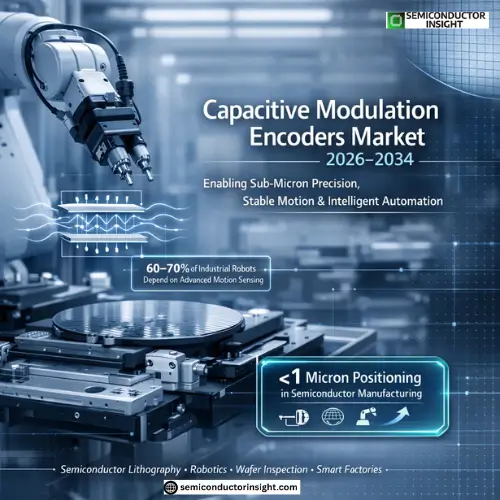
Capacitive Modulation Encoders Market Transformation Accelerates Industrial Positioning Technologies
Capacitive modulation encoders market represents a specialized segment within precision sensing and semiconductor instrumentation technologies, where motion, position, and displacement are measured through capacitance variation rather than optical or magnetic detection methods. These encoders operate by detecting minute changes in electric field interactions between conductive surfaces, enabling highly stable and noise-resistant measurement systems.
In semiconductor manufacturing and industrial automation environments, positioning precision often falls below 1 micron, making conventional sensing technologies vulnerable to vibration, contamination, and temperature drift. Capacitive modulation encoders address these limitations through non-contact sensing architectures, improved signal stability, and high repeatability.
The technology has gained strong relevance in wafer processing tools, robotics, lithography equipment, and high-speed motion platforms where measurement reliability directly influences production yield and equipment uptime.
Technology Architecture Driving Measurement Stability
Capacitive modulation encoders rely on patterned electrodes that create measurable capacitance changes when relative movement occurs between sensing components. The technology enables continuous position tracking without mechanical wear.
Key technological advantages include:
- Extremely high sensitivity enabling detection of nanometre-level displacement
- Reduced susceptibility to dust or oil contamination compared to optical systems
- Low power consumption architectures suited for embedded semiconductor tools
- Stable performance across temperature variations of 20-40% industrial environments
The most critical performance indicator remains signal resolution, with advanced systems achieving accuracy improvements of nearly 30-50% compared to conventional encoder structures used in legacy equipment.
Integration with Semiconductor Manufacturing Equipment
Semiconductor fabrication requires precise wafer positioning, alignment control, and stage movement synchronization. Capacitive modulation encoders play a central role in enabling these functions.
Modern fabrication equipment uses these encoders in:
- Wafer inspection platforms
- Lithography stage control
- Pick-and-place robotics
- Precision motion controllers
- Packaging and assembly systems
Manufacturing nodes below 10 nm require extremely precise alignment, and even minimal motion error can affect device yield. As a result, demand for highly accurate sensing technologies continues to expand within semiconductor equipment design.
The increasing adoption of advanced packaging technologies such as chiplets and heterogeneous integration further strengthens the need for improved motion control systems.
Industrial Automation Adoption and Motion Intelligence
The growth of smart factories and automated production lines has significantly influenced encoder demand. Industrial robots depend on high-precision feedback systems to ensure repeatable movement and safe operation.
Today, nearly 60-70% of industrial robots rely on advanced motion sensing technologies, including capacitive and magnetic encoder systems, to improve operational accuracy and reduce mechanical wear.
You can freely browse our most recent updated report to learn more about it before scrolling further:
https://semiconductorinsight.com/report/capacitive-modulation-encoders-market/
Capacitive modulation encoders offer advantages for automated environments because they provide:
- Smooth motion feedback
- Reduced calibration requirements
- Long operational lifespan
- Consistent performance in high-speed production lines
This transition reflects a broader industry shift toward intelligent motion control architectures.
Competitive Technology Landscape
The encoder ecosystem includes optical, magnetic, inductive, and capacitive technologies. While optical encoders remain widely used, capacitive modulation systems are gaining traction in high-precision applications.
Optical encoders dominate general industrial usage due to cost efficiency, yet they remain sensitive to contamination. Capacitive technologies, by contrast, are preferred in controlled environments requiring higher accuracy and stability.
The competitive shift is influenced by:
- Increasing semiconductor manufacturing complexity
- Demand for maintenance-free sensing solutions
- Equipment miniaturization requirements
- Reliability expectations in continuous production environments
Supply Chain and Material Engineering Considerations
The performance of capacitive modulation encoders depends heavily on material quality and micro fabrication processes. Semiconductor-grade conductive layers, dielectric materials, and precision patterning techniques are critical for achieving stable electrical response.
Manufacturers are investing in:
- Advanced dielectric materials with improved signal consistency
- Micro fabricated electrode structures
- High-purity conductive coatings
- Temperature-resistant substrates
Material innovation directly influences sensor durability and measurement reliability, particularly in environments involving heat fluctuations and electromagnetic interference.
Major Industry Participants and Strategic Positioning
The competitive environment includes sensor manufacturers, semiconductor equipment suppliers, and motion control technology providers.
Key industry participants include:
- Renishaw plc – Focuses on ultra-precision measurement technologies and high-resolution encoder systems
- Heidenhain Group – Develops advanced position feedback systems for semiconductor and industrial equipment
- TE Connectivity – Integrates sensor technologies into automation and motion control systems
- MicroE Systems – Specializes in miniature high-precision encoder technologies
- Broadcom Inc. – Provides semiconductor sensing components for industrial applications
Strategic approaches observed in the market include:
- Investment in miniaturized sensing modules
- Integration with smart control platforms
- Development of contamination-resistant encoder systems
- Expansion of semiconductor equipment partnerships
These strategies strengthen technology adoption in advanced manufacturing environments.
Recent Industry Developments and Market Signals
The semiconductor industry continues to push equipment precision requirements, driving encoder innovation. Recent developments indicate increasing investment in automation and sensing technologies.
Key industry signals include:
- Growing semiconductor equipment shipments across Asia-Pacific regions
- Expansion of robotics adoption in electronics manufacturing
- Rising demand for advanced packaging and wafer inspection tools
- Increased focus on equipment reliability and predictive maintenance
More than 75% of modern semiconductor facilities now prioritize precision feedback systems as part of process optimization initiatives.
Operational Advantages and Limitations
Capacitive modulation encoders provide several operational benefits but also face certain constraints.
Performance advantages include:
- High resolution measurement capability
- Minimal mechanical friction
- Long operational lifespan
- Stable performance in harsh environments
Technical limitations include:
- Higher initial system cost
- Requirement for precise electronic calibration
- Sensitivity to electromagnetic interference in poorly shielded environments
Despite these challenges, performance reliability continues to support adoption in high-precision industries.
Emerging Opportunities and Future Industry Direction
The future of the capacitive modulation encoders market is closely linked to semiconductor scaling, smart automation expansion, and robotics development.
Growth opportunities are expected from:
- AI-driven manufacturing systems
- Semiconductor equipment modernization
- Autonomous robotic platforms
- Advanced healthcare instrumentation
- Aerospace precision control systems
The ongoing transition toward intelligent motion control and autonomous production environments is expected to strengthen long-term demand.
Capacitive modulation encoders market is becoming an essential component of precision engineering infrastructure. As manufacturing processes demand higher accuracy and operational efficiency, advanced sensing technologies are moving from optional upgrades to critical system requirements.

Comments (0)